
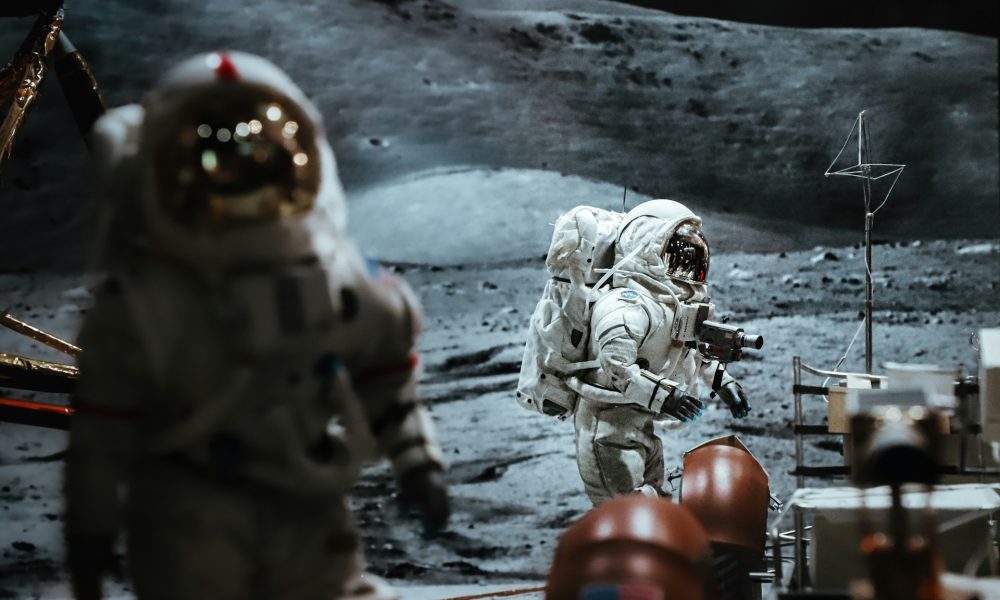
The night sky has long held humanity in awe as a canvas for countless myths and infinite dreams. But on July 20, 1969, the dream of touching the moon’s ethereal glow became a reality when Apollo 11 set foot on lunar soil. As Neil Armstrong took that iconic “giant leap for mankind,” a new chapter in human exploration began.
However, the illustrious Apollo 11 mission was just the opening act in a grand cosmic play that revealed the mysteries of Earth’s celestial neighbor. Beyond the initial triumphs, American space exploration journeyed further into the cosmos, unearthing extraordinary achievements that continue to inspire and captivate the world.
The Thrill of Discovery: Unveiling American Lunar History
American lunar history stands as a testament to humanity’s boundless curiosity and innovative spirit, astronauts wearing their spacesuits with the pride of soldiers wearing their thin ribbons. Since the Apollo 11 mission, the United States has embarked on a journey of discovery, uncovering the secrets of the Moon’s barren landscapes and ancient mysteries.
These missions expanded human understanding of Earth’s place in the universe and the untapped potential of human ingenuity. From Apollo 12 to future explorations, the legacy of American lunar landings is a testament to an insatiable thirst for knowledge and exploration.
1. Apollo 12
Following the groundbreaking success of Apollo 11, subsequent moon landings ventured further into uncharted lunar territory. These missions pushed the boundaries of scientific discovery and tested the limits of human endurance in the vastness of space.
Apollo 12, the second crewed mission to the Moon, demonstrated the precision and skill required to navigate the complexities of space travel. This mission confirmed the viability of lunar exploration and paved the way for further scientific endeavors.
2. Apollo 14
Apollo 14, the third mission to land on the Moon, showcased American determination and innovation in space exploration. Led by Commander Alan Shepard, this mission overcame early setbacks to successfully conduct scientific experiments and explore the lunar surface.
Despite encountering challenges, Apollo 14 reaffirmed the United States’ commitment to lunar exploration. The mission also underscored the enduring thirst for knowledge beyond Earth, inspiring future generations to reach for the stars.
3. Apollo 15
Apollo 15, the first of the “J” missions, introduced enhanced scientific capabilities to lunar exploration. Commanded by David R. Scott, this mission featured the Lunar Roving Vehicle, allowing astronauts to cover more ground and collect diverse geological samples.
With a strong focus on scientific research, Apollo 15 significantly expanded the understanding of the Moon’s geology. This mission was pivotal in laying the groundwork for more complex lunar explorations that would follow in its footsteps.
4. Apollo 16
Apollo 16 demonstrated the advancements in lunar exploration techniques. Under the command of John Young, this mission explored the highlands of the Moon, furthering collective knowledge of lunar geology and celestial evolution. With successful scientific experiments and meticulous sample collection, Apollo 16 solidified America’s position as a leader in space exploration.
5. The Apollo 17
The Apollo 17 mission marked the triumphant finale of America’s initial forays to the Moon, capping off a series of groundbreaking expeditions that expanded human understanding of lunar geology and history. Launched on December 7, 1972, Apollo 17 boasted a crew that included Eugene Cernan, Harrison Schmitt, and Ronald Evans.
As they touched down on the lunar surface, the astronauts embarked on a mission of unparalleled scientific discovery. Exploring the Taurus-Littrow Valley, the Apollo 17 crew collected invaluable samples that provided insights into the Moon’s ancient past.
Their discoveries enhanced understanding of lunar geology, revealing a tapestry of cosmic events that shaped the lunar landscape over billions of years. The mission’s success underscored the importance of continued lunar exploration and set the stage for future endeavors beyond Earth’s orbit.
The Never-Ending Quest for Celestial Exploration
The quest for celestial exploration is an unending journey fueled by human curiosity and the pursuit of knowledge. From the pioneering days of Apollo 11 to the final mission of Apollo 17, each moon landing has left an indelible mark on history, inspiring generations to reach for the stars.
The spirit of exploration lives on in the hearts of scientists, engineers, and dreamers worldwide. The next chapter of human space exploration beckons, with missions to the Moon, Mars, and beyond on the horizon. Advancements in technology, coupled with a renewed focus on international collaboration, promise to usher in a new era of cosmic discovery.
Embrace the spirit of discovery that has defined American space exploration and celebrate the remarkable achievements that have propelled explorers to the stars. The legacy of lunar landings serves as a reminder of what can be accomplished when people dare to dream, inspire, and reach for the heavens.




