
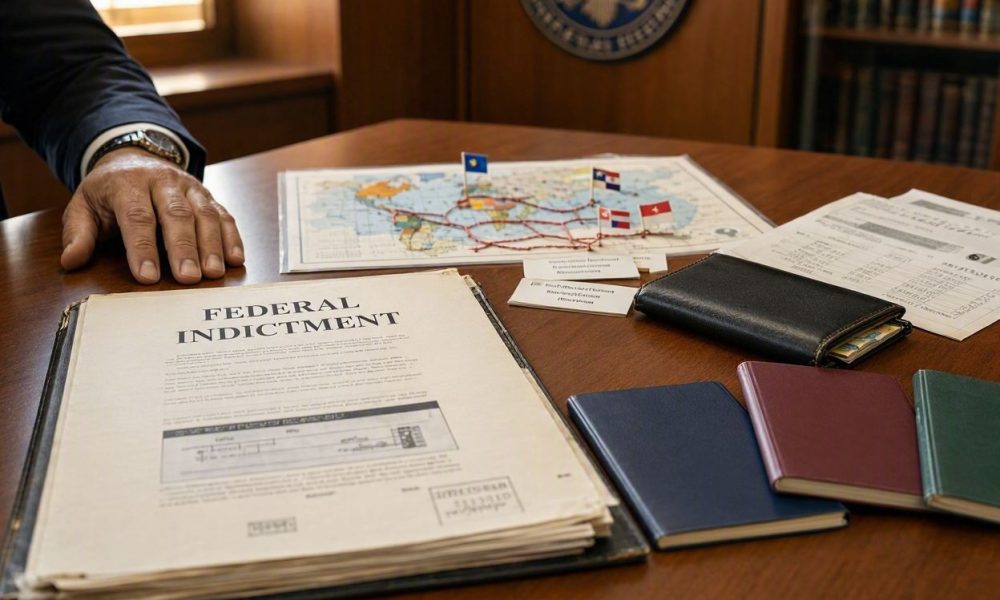
Prosecutors say the Panama cocoa business was part of a broader offshore concealment scheme.
WASHINGTON, D.C. — August 21, 2026 — Brian Nelson Booker’s years as a certified public accountant and international cocoa trader are now central to a federal tax prosecution alleging that a Panama-based business helped connect valuable foreign accounts, incomplete disclosures, and statements that authorities contend misrepresented why earlier reporting failures occurred.
The United States Department of Justice says Booker, formerly of Fort Lauderdale, owned a cocoa trading company organized under Panamanian law and operated that enterprise from Venezuela, Panama, and his Florida residence while maintaining financial interests across several international banking jurisdictions.
That company, identified in the indictment’s public accounts as Zaandam Trading Co., Inc., gives the prosecution a tangible commercial center for a case otherwise defined by bank records, tax forms, account ownership, disclosure duties, and the disputed meaning of one consequential certification submitted to the Internal Revenue Service.
The allegations do not establish that the cocoa company itself was unlawful, because Americans may legitimately own foreign corporations, trade internationally, and maintain overseas accounts, but prosecutors contend Booker failed to report particular financial interests and later falsely characterized those failures as non-willful conduct.
Booker has not been convicted of the charged offenses, and every factual assertion attributed to prosecutors remains an allegation the government must prove beyond a reasonable doubt, while the defendant retains the constitutional presumption of innocence throughout the federal proceedings.
A Panama Cocoa Company Becomes the Case’s Commercial Center
Zaandam Trading appears in the government’s narrative not merely as a corporate name on organizational papers, but as the operating business through which Booker allegedly conducted cross-border cocoa activity while managing financial relationships in countries historically associated with international commerce, private banking, and complex reporting obligations.
According to the government, Booker’s business specialized in international trade, a professional setting that naturally involved foreign currencies, overseas counterparties, banking intermediaries, and payments moving among jurisdictions, yet also created detailed responsibilities for accurately identifying beneficial interests and reporting worldwide income to American authorities.
The Panamanian incorporation of Zaandam did not automatically transform the enterprise into a concealment vehicle, since incorporating abroad can support legitimate supply chains, regional operations, and access to local banking, although prosecutors allege that accounts linked to the company were among interests Booker failed to disclose properly.
That distinction matters because the Booker prosecution is not a referendum on offshore commerce, Panama corporations, or cocoa trading generally, but a fact-specific dispute concerning what one American taxpayer allegedly knew, what accounts he controlled, what returns he filed, and what explanations he later provided under penalty of perjury.
Zaandam’s reported operations across Venezuela, Panama, and Florida also give investigators a geographic map linking commercial activity to Booker personally, allowing prosecutors to compare business records, account documentation, tax returns, and foreign reporting forms against the financial movements attributed to the company over multiple years.
The government’s theory consequently treats the corporation as evidentiary architecture, because ownership records can identify control, bank mandates can reveal signature authority, transaction histories can establish beneficial interests, and tax filings can show whether the disclosed financial picture matched the underlying cross-border reality.
Booker’s CPA Background Adds a Critical Knowledge Question
Booker’s former status as a certified public accountant is especially important because criminal tax cases often turn on willfulness, meaning prosecutors must prove more than a paperwork error by showing a voluntary, intentional violation of a known legal duty.
Public analyses of the indictment report that Booker was registered with the Texas State Board of Public Accountancy from 1976 to 1991, a professional history prosecutors may use to argue that he had greater familiarity with financial reporting principles than an inexperienced taxpayer.
Professional credentials do not establish criminal intent, and former accountants can misunderstand specialized international rules, rely on incomplete advice, or make negligent mistakes, yet the government may contend that Booker’s education and experience make his explanations less credible when evaluated alongside his prior filings.
The case therefore weighs technical knowledge against conduct, asking whether Booker’s background, earlier reporting choices, banking correspondence, account transfers, and eventual voluntary submission collectively show innocent misunderstanding or the deliberate concealment alleged by federal prosecutors.
Contemporary Bloomberg Tax reporting described the original case as involving a former accountant with international-trade ties whose Panamanian cocoa company operated from Venezuela, Panama, and Florida, reinforcing how Booker’s professional and commercial identities became intertwined in the charging narrative.
For accountants and cross-border advisers, that combination makes the case unusually instructive because technical credentials can become circumstantial evidence of knowledge, particularly when a defendant allegedly reported certain foreign accounts while omitting others that prosecutors consider financially significant.
Foreign Accounts Extend Beyond a Single Jurisdiction
The Justice Department alleges that Booker failed to disclose interests in financial accounts located in Switzerland, Singapore, and Panama on annual Reports of Foreign Bank and Financial Accounts for calendar years 2011 through 2013, despite federal rules requiring qualifying American account holders to file those reports.
Prosecutors also allege that his individual income tax returns for 2010 through 2012 did not identify all foreign accounts, creating parallel questions about the accuracy of annual tax returns and the separate informational forms used to disclose qualifying overseas financial relationships.
An FBAR is not an income tax return, because it is a distinct report identifying foreign financial accounts when their aggregate value crosses the applicable threshold, and a taxpayer can face scrutiny for nondisclosure even when the underlying funds came from lawful business activity.
That framework explains why the legality of Zaandam’s cocoa operations and the reportability of company-linked accounts remain separate issues, since prosecutors can acknowledge legitimate trade while alleging that Booker personally possessed a financial interest or signature authority requiring disclosure.
Public descriptions of the indictment say Booker filed FBARs for 2008, 2009, and 2010 that identified two Venezuelan accounts while allegedly omitting interests in Swiss and Panamanian accounts, a pattern the government may present as selective rather than wholly uninformed reporting.
Those descriptions further say the undisclosed accounts exceeded nine million dollars during some years, although the trial process must determine which balances, ownership arrangements, valuation dates, and reporting rules apply to each account and each charged filing period.
The multinational account structure gives prosecutors a documentary trail beyond a single secrecy jurisdiction, while giving the defense opportunities to contest beneficial ownership, reporting classifications, professional advice, control over company money, and the meaning of records obtained from foreign institutions.
Swiss Banking Records and an Insurance Wrapper Draw Attention
One strand of the allegations concerns an account at Schroder & Co. Bank AG in Switzerland, reportedly held in Zaandam’s name, which Booker allegedly controlled from about 2004 to 2009, before the assets were moved after a compliance request from the institution.
Public analyses state that the Swiss bank told Booker in 2009 to withdraw the funds or provide an Internal Revenue Service Form W-9, which would identify his taxpayer status and facilitate reporting of the financial relationship to American authorities.
The indictment reportedly alleges that Booker then directed the assets to another Swiss account held in the name of a Singaporean insurance company, an arrangement described as an insurance wrapper that placed investment assets behind the legal ownership of an insurance policy.
Insurance wrappers can serve lawful investment, succession, and risk-management purposes, but enforcement authorities scrutinize them when formal ownership obscures the person exercising control, receiving economic benefits, directing investments, or bearing the practical risks associated with the underlying assets.
Prosecutors may argue that the timing of a transfer following a bank’s reporting request reveals consciousness of disclosure obligations, while the defense may offer legitimate commercial, investment, insurance, or regulatory reasons for moving assets between financial institutions.
The government must prove its interpretation with admissible evidence rather than inference alone, because changing banks, using an insurance product, or maintaining a corporation-owned account does not, by itself, establish that a taxpayer intentionally violated American reporting laws.
Booker allegedly retained an interest in the insurance-linked arrangement for years after the transfer, and prosecutors also contend that he failed to file required excise-tax forms or pay tax connected with premiums involving the foreign insurance product.
That allegation broadens the case beyond a missed box or account number, presenting what authorities characterize as a sustained reporting problem involving account ownership, insurance-related payments, foreign income, and information returns across several connected financial structures.
Panamanian Accounts Tie Zaandam Directly to Booker
Public accounts of the indictment say Booker held financial interests from 1999 through 2013 in accounts at Banco General, S.A., headquartered in Panama City, with those accounts reportedly maintained in the name of Zaandam Trading rather than Booker individually.
Corporate account titles can create difficult reporting questions for owners who mistakenly treat business money as entirely separate from personal disclosure duties, although American rules may still require reporting when an individual has sufficient financial interest, ownership, or signature authority.
Prosecutors allege Booker understood those obligations yet failed to identify the company-linked Panamanian accounts properly, while the defense can examine whether professional advice, corporate governance, ownership percentages, account authority, and contemporary guidance support a different interpretation.
Zaandam therefore matters because the company name allegedly appeared between Booker and the accounts, giving prosecutors a potential explanation for how substantial assets remained outside the financial picture presented on his personal reporting forms.
For legitimate international entrepreneurs, the lesson is not that foreign corporations are inherently suspect, but that corporate separation does not erase beneficial-ownership reporting, worldwide-income taxation, or the need to reconcile company accounts with every applicable personal disclosure requirement.
Guidance concerning compliant offshore banking structures similarly emphasizes that tax identification, documented ownership, and alignment with local and international obligations are essential foundations for lawful privacy, because secrecy and legal confidentiality are not interchangeable concepts.
A Swiss Bank Program Reportedly Opens the Records
The case also illustrates how international bank secrecy changed after the Justice Department’s Swiss Bank Program encouraged participating institutions to reduce potential American criminal exposure by disclosing information about accounts linked to United States taxpayers.
Schroder reportedly entered that program and provided American authorities with information concerning Booker’s relationship with the bank, demonstrating how records thought to be sheltered within a private institution can later become evidence through negotiated disclosure, regulatory cooperation, or institutional remediation.
Once investigators obtained foreign banking records, they could compare account names, beneficial-interest documentation, transfer instructions, tax identification materials, and balances against Booker’s returns and FBARs, turning an abstract suspicion into a chronological evidentiary reconstruction.
That process shows why offshore concealment cases often mature slowly, because investigators must acquire records across borders, translate institutional structures, identify control behind corporate titles, trace transfers, and reconcile those findings with years of domestic tax filings.
It also underscores a recurring enforcement reality that a taxpayer cannot control whether a foreign bank changes policy, joins a government resolution program, responds to a treaty request, or decides that institutional survival requires cooperation with another country’s investigators.
The Streamlined Submission Becomes the Central Dispute
Booker allegedly tried to correct earlier reporting failures through the Internal Revenue Service’s Streamlined Domestic Offshore Procedures, a compliance pathway designed for eligible domestic taxpayers whose failures resulted from negligence, inadvertence, mistake, or a good-faith misunderstanding rather than intentional misconduct.
Public analyses say he filed delinquent FBARs in July 2015 for calendar years 2008 through 2014, identifying interests or signature authority involving fourteen foreign financial accounts that had not all appeared in his earlier submissions.
The volume and timing of those disclosures may support competing arguments, since the defense could portray them as an effort to become compliant, while prosecutors may contend they arrived only after circumstances made continued nondisclosure increasingly difficult.
In October 2015, Booker allegedly submitted Form 14654 and certified that he learned about FBAR requirements in 2008 but mistakenly believed only personal accounts, rather than relevant business-linked accounts, needed to be reported to federal authorities.
That certification reportedly asserted that the failures to report all income, pay all tax, and submit every required information return resulted from non-willful conduct, language that qualified applicants must sign under penalty of perjury to receive streamlined treatment.
Prosecutors contend the explanation was false, making the attempted compliance filing itself part of the alleged criminal conduct rather than a document that simply repaired earlier omissions and closed the matter with reduced civil consequences.
This feature distinguishes Booker’s prosecution from a conventional FBAR case because the government is challenging not only what was omitted years earlier, but also the truthfulness of the narrative later offered to explain why those omissions occurred.
The non-willfulness certification is therefore more than procedural language, since it asks the taxpayer to provide a complete account of relevant conduct, acknowledge unfavorable facts, and establish that the reporting failure did not arise from a conscious decision to disregard a known duty.
Tax Identity Must Match the Financial Record
The allegations demonstrate why a taxpayer’s identifying information, declared residence, entity ownership, and account documentation must form one coherent record across banks and tax authorities, especially when wealth and business operations span multiple countries.
A properly issued tax identification number can support lawful international banking only when the associated identity, residency position, beneficial ownership, and filings are accurate, because a legitimate identifier cannot cure false statements or undisclosed financial interests.
For globally mobile entrepreneurs, cross-border planning should begin before accounts open or entities receive funds, allowing qualified advisers in every affected jurisdiction to determine reporting duties, document ownership, and preserve evidence supporting the taxpayer’s good-faith compliance position.
When corrective disclosure becomes necessary, counsel must investigate the complete history before selecting a program, because a streamlined filing based on non-willfulness can create additional exposure if emails, prior forms, bank notices, or transfer records contradict the taxpayer’s certification.
Booker’s case consequently warns professionals that remediation cannot be treated as a marketing shortcut or standardized questionnaire, since the accuracy of every factual explanation may later be tested against records the taxpayer has never seen or believed authorities could obtain.
Years Abroad Delayed but Did Not End the Prosecution
The Justice Department alleges Booker left the United States in 2016 after learning about the criminal investigation, later lived in Russia, and remained abroad while the federal case advanced without an order compelling Russian authorities to extradite him.
His location transformed a technical tax prosecution into an international fugitive case, yet the unresolved indictment remained active while American authorities continued monitoring his movements and foreign governments retained independent power over his immigration status.
Booker was arrested in Belarus in May 2025, according to the Justice Department, and remained detained there until Belarusian authorities eventually ordered his expulsion, producing a return route that placed him within immediate reach of federal agents.
He arrived in the United States on July 24, 2026, and was arrested at a Miami airport before making his initial federal court appearance three days later on tax and false-statement charges that had remained pending during his years abroad.
The sequence illustrates how residence in a country without an effective extradition outcome does not erase an indictment, because expulsion, deportation, onward travel, document problems, political change, or transit through a cooperating jurisdiction can abruptly restore American custody.
It also highlights a basic distinction between extradition and expulsion: extradition transfers a wanted person through a formal legal process tied to criminal charges, while expulsion removes a foreign national under the host country’s immigration or sovereign authority.
Potential Penalties and the Presumption of Innocence
The Justice Department says Booker faces a statutory maximum of five years in prison for each charged failure to file an FBAR, and each charged false statement to the United States if convicted, although maximum penalties do not predict the sentence imposed in any individual case.
The government further says each count involving an allegedly false document filed with the Internal Revenue Service carries a maximum three-year prison term, with any eventual punishment depending upon convictions, judicial findings, sentencing guidelines, statutory factors, and arguments presented by both sides.
IRS Criminal Investigation is handling the investigation, and Senior Litigation Counsel Sean Beaty is prosecuting the case for the Justice Department, placing the matter within a broader federal enforcement effort focused on fraud, offshore reporting, and the integrity of voluntary compliance programs.
Booker may challenge the government’s evidence, intent theory, account classifications, document interpretations, foreign records, and alleged knowledge, while also presenting lawful explanations for corporate arrangements, banking decisions, and statements contained in his streamlined submission.
No reader should treat the indictment, arrest, or government press release as proof of guilt, because an indictment states accusations selected for prosecution and does not replace the adversarial testing of evidence through motions, trial, and any subsequent appellate review.
Why Zaandam Trading Remains the Defining Name
Zaandam Trading gives the case its clearest narrative thread because the Panama cocoa enterprise allegedly connects Booker’s professional sophistication, overseas operations, foreign accounts, corporate ownership, and personal reporting decisions across more than a decade of financial activity.
Without the company, the prosecution might resemble a collection of disconnected forms and accounts, but Zaandam allows authorities to argue that the same commercial structure repeatedly appeared in business operations, bank relationships, income reporting, and omitted disclosures.
For the defense, that same continuity could support a lawful-business explanation, since an operating cocoa company with genuine international activity may require foreign accounts and sophisticated financial products without those arrangements necessarily proving tax evasion or intentional concealment.
The decisive issue will not be whether Booker possessed offshore wealth, conducted business through Panama, or once practiced accounting, but whether prosecutors can prove that he knowingly violated reporting duties and intentionally made material false statements in documents submitted to American authorities.
As the case proceeds, Zaandam Trading will remain more than background color, because its ownership, accounts, transactions, revenues, and administrative records may determine whether the government’s concealment theory withstands scrutiny or whether reasonable doubt emerges from the complexity of cross-border commerce.
The broader message for international business owners is equally direct: lawful offshore planning depends upon transparent beneficial ownership, consistent tax identities, accurate worldwide-income reporting, and carefully documented professional advice long before a foreign institution or enforcement agency begins asking questions.
Booker’s return has finally given federal prosecutors the opportunity to test allegations first developed years earlier, but the courtroom process must now separate inference from proof while determining what Zaandam represented in practice, what Booker understood, and whether his filings crossed the line from mistake into crime.




