
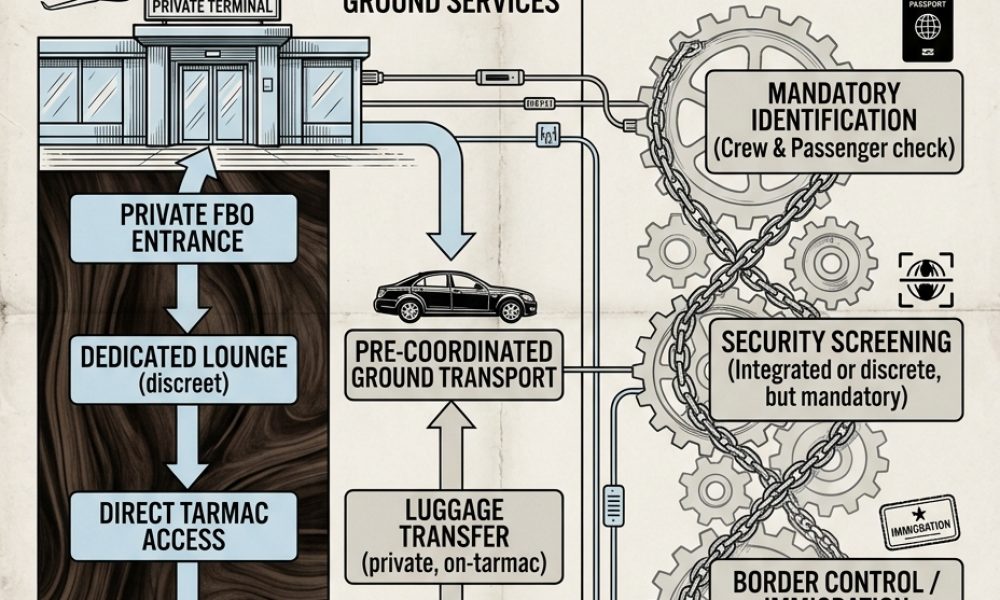
Separate facilities and coordinated ground services can reduce public visibility, while Identification, security, and border requirements remain separate considerations.
WASHINGTON, DC, October 19, 2026 — Private aviation can offer travelers a quieter airport experience through separate facilities and individually coordinated services. Still, travelers should assess the privacy benefits alongside the operational, Identification, and border requirements that apply to the specific journey.
For public figures, executives and families, the attraction may involve fewer encounters with unrelated passengers, greater control over accompanying guests or more predictable coordination between ground transportation and departure, depending on the facilities and arrangements available.
Those benefits concern the travel environment, so it’s important to distinguish reduced public visibility from the Information that operators, handling providers, and government authorities may require before allowing an international flight to proceed.
A realistic assessment therefore begins with the traveler’s specific needs, then examines the actual departure and arrival arrangements rather than assuming that the words private aviation describe an identical experience at every airport or on every route.
Separate Facilities Change the Passenger Experience
Private aviation facilities can offer an alternative to the main passenger terminal, letting travelers coordinate their airport visit in a different service environment. However, the layout, amenities, and level of separation vary by location.
Signature Aviation, for example, describes a network of private aviation terminals serving business and private aviation customers, illustrating the established role of dedicated facilities without establishing that every location offers exclusive use or the same passenger arrangements.
For someone seeking discretion, the key questions are who shares the space, how the terminal manages passenger arrivals, and whether a separate room or other agreed arrangement is available before departure.
A private aviation terminal should therefore be evaluated as a specific facility with confirmed service details, rather than treated as a blanket assurance that the traveler will encounter no other customers, visitors, or personnel during the journey.
Discretion Depends on the Entire Ground Arrangement
The airport experience begins before a passenger enters a terminal, so coordinating vehicles, collection instructions, and arrival times matters when assessing how the proposed service will reduce unnecessary exposure or waiting in public areas.
Travelers should ask where their vehicle will stop, who will meet them, and how changes will be communicated, especially when the driver, aircraft operator, and ground handler belong to different organizations with separate booking responsibilities.
Do not assume direct vehicle access near an aircraft from promotional photographs, and confirm any proposed arrangement with the responsible operator or handler in accordance with the permissions and procedures applicable at that airport.
A clear description of the ground process gives the traveler a practical basis for judging the service, including whether it addresses the original concern or replaces one waiting area with another that offers different amenities.
Private Flights Still Generate Identifying Information
International private aviation should not be described as travel without passenger records, because official reporting requirements can apply even when passengers use separate facilities and never enter the airport’s main commercial departure hall.
United States Customs and Border Protection’s general aviation processing guidance states that advance passenger manifest Information is required for general aviation arrivals and departures and covers the relevant passengers and crew through the agency’s reporting framework.
The same guidance explains that pilots arriving from abroad must secure permission to land by contacting the intended CBP arrival port directly after transmitting the manifest and before departing the foreign location for the United States.
These requirements show why a more discreet airport experience should be understood separately from official Identification, with the operator explaining the relevant process rather than letting the customer infer that reduced public contact means reduced accountability.
Different Countries Apply Their Own Procedures
An international itinerary requires attention to the rules at each relevant point, because arrangements accepted for one journey should not be assumed sufficient for another destination, a different departure country or a flight involving additional stops.
The United Kingdom’s official general aviation guidance, updated on October 12, 2026, addresses advance reporting, permitted arrival and departure locations, and immigration documentation, demonstrating that private flight planning involves more than selecting an aircraft and a preferred timetable.
For travelers, the practical task is to establish who checks these requirements and who confirms that the proposed arrangements remain suitable when passenger details, timing or the route change before the aircraft is ready to depart.
The planning discussion should also distinguish an operator’s responsibility for flight reporting from the passenger’s need to provide accurate Information and obtain any required travel authorization, avoiding assumptions that one completed administrative step resolves every other issue.
Identity Documents Remain Part of the Journey
Travelers should identify which original documents they must carry and when they need to provide supporting Information, treating document review as part of the travel plan rather than assuming private transportation changes the underlying purpose of Identification.
The Amicus International Consulting guide to modern passport security explains distinctions between physical document features, electronic Information, and verification, providing context for why a passport remains an identity credential regardless of the passenger facility used.
A provider should explain why it is requesting passport details, identify the intended recipients,s and offer an appropriate transfer process, allowing the customer to assess Information handling without confusing necessary documentation with unrestricted permission to circulate personal records.
Address any uncertainty about a document before departure with an appropriate Authority or qualified adviser, since a comfortable aircraft and carefully arranged ground services cannot resolve questions about the document itself or the holder’s eligibility.
Security Arrangements Require Specific Explanations
Passengers should ask what checks and access procedures apply to their particular flight, recognizing that the absence of a familiar commercial-terminal queue does not provide enough Information to describe the security arrangements governing the aircraft or airport.
The operator should explain the instructions relevant to passengers, baggage and accompanying visitors, while avoiding broad assurances that imply the customer may disregard requirements simply because the journey uses a privately arranged aircraft or a separate facility.
This discussion is particularly useful when travelers have experience with only one kind of aviation service, because expectations formed during a previous journey may not match the arrangements confirmed for another operator, airport or international destination.
The goal is a clear understanding of the process, so passengers arrive prepared and follow instructions without mistaking differences in presentation or location for an exemption from the procedures applicable to the planned flight.
Confidentiality Extends Beyond the Aircraft Cabin
A traveler may prefer a private cabin for personal conversations or time with family. Still, planning should also consider how the organizations coordinating the flight, ground transportation, and services at either end handle Information.
The customer should identify which business operates the aircraft, which organization manages the booking, and which providers receive passenger details, particularly when an adviser or broker coordinates arrangements through several separate companies involved in delivering the journey.
Written confidentiality expectations can address promotional use, unnecessary disclosure and staff access. However, the terms should recognize legitimate operational sharing and applicable reporting requirements rather than suggesting that no Information will leave the original adviser’s possession.
The most useful commitments describe actual practices, such as limiting access to those arranging the service and seeking permission before publishing client photographs, making it possible to assess whether the provider’s behavior matches the discretion promised during booking.
Public Figures and Executives May Have Different Priorities
For a recognizable traveler, a separate facility may be attractive because it can reduce encounters in heavily used public spaces. At the same time, the key planning questions concern the layout, shared areas, and handling arrangements available on the chosen travel dates.
An executive may place greater importance on limiting the circulation of meeting details, with the flight itself as only one part of a broader confidentiality plan involving assistants, counterparties, drivers, and the people coordinating accommodation or onward transportation.
Communicate these priorities accurately, since a request to protect a confidential business purpose differs from a request for a quiet family departure, even when both customers ultimately select similar aircraft and airport services.
A useful proposal should explain how each requested measure addresses the stated concern, helping the traveler evaluate whether additional arrangements provide meaningful value instead of assuming that a more expensive package necessarily delivers better confidentiality in practice.
Families Need Practical Details Alongside Privacy
Families considering private aviation should discuss each traveler’s needs, including assistance, seating arrangements, and baggage handling, so an emphasis on discretion doesn’t obscure questions that determine whether the journey will be comfortable.
The departure briefing should explain who will meet the group, where companions will wait, and how changes will be communicated, especially when children or older relatives may need extra time or assistance during the transition from ground transportation to the aircraft.
Family members should also agree on photographs and public posts, because even carefully coordinated facilities cannot prevent companions from voluntarily sharing details another traveler expected to remain private during the trip or after returning home.
The planning objective should be a manageable experience supported by clear instructions, with privacy preferences considered alongside practical needs rather than imposed through arrangements that create confusion for the people they are intended to benefit during travel.
Arrival Services Need Their Own Confirmation
Don’t treat a departure experience as a promise about arrival; confirm the destination facility, expected processing arrangements, and onward transport separately instead of assuming the service will operate symmetrically at both ends.
Travelers should know which organization will meet them, how the driver receives accurate updates, and where to wait if the vehicle is delayed, especially when arrival procedures must be completed before the onward transfer can begin.
Translate descriptions such as seamless or direct into concrete arrangements, identifying the responsible provider and any conditions affecting delivery, so the customer understands what has actually been confirmed before relying on the proposed schedule.
This level of detail is especially useful when discretion is the principal reason for choosing the service, because an unresolved handover between suppliers can undermine the experience even when the aircraft portion of the journey proceeds as expected.
Disruptions Can Change the Privacy Experience
A contingency discussion should consider how the arrangements will be reviewed if the flight changes, including whether an alternative airport or replacement provider can offer the same facilities and whether the customer will receive clear notice of material differences.
The traveler should identify who can approve changes and which privacy preferences remain priorities, so the coordinator can make practical decisions without assuming every substitute arrangement automatically meets the conditions agreed for the original itinerary before departure.
If a disruption introduces additional organizations, the provider should explain what Information must be shared and update relevant contacts, while avoiding unnecessary distribution of the entire customer file to arrange a revised transfer or booking.
A workable plan accepts that circumstances may change while keeping responsibilities clear, giving the traveler a reliable point of contact and an honest explanation of which parts of the original service remain available under the revised arrangements.
The Value Lies in Defined Benefits
Before confirming a private aviation booking, customers should review the specific facilities, passenger procedures, information-sharing arrangements, and ground services offered, ensuring the proposal describes the complete journey rather than relying mainly on cabin photographs.
The assessment should also distinguish confirmed services from requests that remain subject to approval, since this difference helps travelers understand whether an important privacy preference has been secured or merely communicated to another organization for possible accommodation.
Operators and advisers can support informed decisions by explaining the limits of their control, particularly where airport procedures, official requirements or independent suppliers affect the experience, while keeping their promises focused on arrangements they can realistically deliver.
Private aviation can provide meaningful discretion when the facilities and coordination match the traveler’s needs, with its value best understood through reduced public exposure and carefully managed service rather than expectations of anonymity or exemption from official requirements.




