
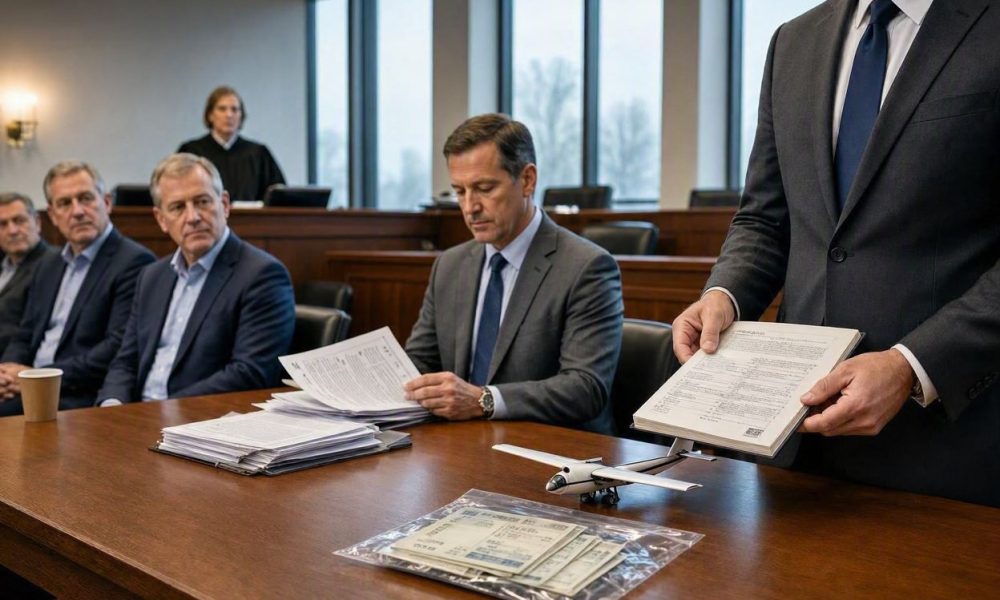
Members reportedly paid upfront fees to help buy aircraft, but prosecutors said the money went elsewhere.
WASHINGTON, DC — AeroVanti’s “Top Gun” members believed their $150,000 advance payments would help place specific airplanes into a growing private aviation fleet, but federal prosecutors showed a Maryland jury records indicating that substantial amounts instead financed Patrick Britton-Harr’s personal spending and unrelated obligations.
The resulting six-count wire fraud conviction turned what had once appeared to be an exclusive flight-access opportunity into a cautionary account of restricted-purpose payments, unverified aircraft ownership, missing escrow protections, and the danger of relying upon founder assurances instead of completed financial safeguards.
Jurors concluded that Britton-Harr, the Annapolis businessman who owned and controlled AeroVanti and affiliated entities, deliberately misled customers about how their money would be used and protected, rejecting the idea that the disputed transfers reflected only an ambitious company struggling with ordinary operating pressure.
The case matters beyond one failed aviation club because Top Gun members occupied an unusual position between customers and financiers, advancing acquisition capital while expecting discounted flight hours and security tied to airplanes that prosecutors said were never purchased with their money as promised.
Their experience shows how a luxury service can shift significant business risk to consumers without always making that transfer obvious, especially when persuasive branding, limited-time availability, and promises of collateral make a speculative expansion plan seem protected and nearly complete.
A private flying club sold a capital proposition
AeroVanti marketed an alternative to aircraft ownership for members seeking private travel without managing crews, maintenance, insurance, hangars, regulatory compliance, or the large fixed costs associated with buying and operating a business airplane independently.
The company promoted access to a fleet built around distinctive Piaggio Avanti aircraft, combining sleek presentation, concierge service, sports partnerships, and claims of favorable hourly pricing to suggest that luxury flying could become more efficient without sacrificing exclusivity.
That proposition helped Britton-Harr build attention around an enterprise tied to both Annapolis and Sarasota, positioning him as a disruptive founder who could translate customer demand into a rapidly expanding fleet and a nationally recognizable private aviation brand.
The Top Gun offer went far beyond an ordinary monthly membership because participants were asked to contribute $150,000 in advance toward aircraft acquisitions, effectively providing AeroVanti with immediate growth capital before the promised airplanes became available for their travel.
In exchange, members expected blocks of future flight time at discounted rates, while Britton-Harr represented that their payments would acquire particular aircraft and that titles would enter escrow, creating an apparent layer of protection if the company encountered trouble.
The limited-time presentation added urgency, encouraging prospective members to act before the opportunity disappeared while relying on AeroVanti’s descriptions of purchase plans, asset protection, and future availability rather than waiting to inspect completed acquisitions.
Approximately one hundred members ultimately supplied nearly $15 million toward five aircraft, giving the company a substantial pool of customer-funded capital while concentrating enormous importance on the accuracy of Britton-Harr’s statements about designated uses and promised security.
Escrow language made the offer appear protected
Escrow is a powerful term in any capital transaction because it ordinarily indicates that money, titles, or other property will be held by an independent party under documented conditions rather than remaining under the unrestricted control of a promoter.
For Top Gun members, the promise that aircraft titles would be delivered into escrow could reasonably suggest their advance payments were tied to identifiable assets, reducing the perceived risk that AeroVanti might spend the money elsewhere before completing each purchase.
According to the Justice Department’s summary of the trial evidence, Britton-Harr promised to buy specific aircraft with member payments and protect those contributions through escrowed titles, representations that became central to the government’s wire fraud case.
Those assurances were not peripheral marketing language because they addressed the questions a careful customer would ask before advancing six figures: what asset will be purchased, who will own it, where will the title remain, and what protects the payment.
When a company invokes escrow without completing the corresponding legal structure, customers may believe an independent safeguard already exists even though their money can remain exposed to operating expenses, affiliated-company transfers, creditor claims, or personal withdrawals.
True protection generally requires an executed escrow agreement, identification of the independent holder, delivery of authentic title documents, clearly stated release conditions, and confirmation that no superior lender or competing claimant holds an earlier interest.
Aircraft transactions add further complexity because ownership, operational control, financing, maintenance responsibility, and regulatory authority may rest with different entities, making it difficult for a club member to determine whether a promoted airplane is actually owned, merely leased, or temporarily available.
That complexity increased the members’ dependence upon Britton-Harr’s representations, while also giving investigators objective records against which they could compare the promises, including titles, loan documents, closing dates, account statements, and communications with sellers or lenders.
Prosecutors followed the payments
The government’s case focused not simply upon AeroVanti’s eventual inability to deliver flights, but upon the path member money followed after Britton-Harr obtained it through communications prosecutors characterized as materially false and intentionally deceptive.
Trial evidence showed that the five promised airplanes were not bought using Top Gun payments as represented, while portions of the money instead supported purchases and expenses having no apparent connection to placing those aircraft into charter operations for members.
Prosecutors identified yachts, jewelry, personal living costs, and a Tampa-area home renting for approximately $10,000 each month among the uses financed with member money, presenting those expenditures as evidence that Britton-Harr personally benefited from the diversion.
Luxury expenditures can become especially persuasive evidence in a fraud trial because they allow jurors to compare an explicit capital promise with purchases that are readily understandable, visually memorable, and difficult to characterize as necessary aircraft-acquisition costs.
The government also presented evidence that Britton-Harr later secured a one-point-five-million-dollar loan to purchase an aircraft he had already claimed was acquired with Top Gun money, while withholding material information from the lender used to complete that financing.
That later loan mattered because prosecutors treated it as an effort to conceal the earlier misrepresentation rather than an ordinary refinancing decision, arguing that the transaction showed Britton-Harr knew the aircraft had not been bought as members were told.
Financial records gave the jury a chronology connecting solicitation statements, incoming electronic payments, outgoing transfers, delayed aircraft financing, and personal expenditures, enabling prosecutors to construct the alleged scheme through documents rather than relying exclusively on disappointed customers’ recollections.
Wire fraud law made those electronic transfers central because the government needed to establish a knowing scheme to obtain money through materially false representations and show that interstate wire communications advanced that scheme.
Failure alone would not have proved fraud
Private aviation companies can fail for legitimate reasons, including fuel volatility, maintenance delays, insurance costs, limited aircraft availability, crew shortages, financing pressure, scheduling inefficiency, and demand that does not produce sufficient margins to sustain dependable operations.
Founders can also make optimistic forecasts that later prove unrealistic without committing a federal crime, provided their statements reflected honest expectations rather than knowing misrepresentations about existing assets, completed transactions, protected money, or facts material to a customer’s decision.
The distinction between commercial failure and criminal fraud therefore turned upon Britton-Harr’s intent when soliciting and controlling Top Gun payments, not merely upon whether AeroVanti eventually grounded flights or disappointed members who expected greater access.
Prosecutors had to persuade jurors beyond a reasonable doubt that the promises were knowingly false or misleading when used to obtain money, while the defense could challenge the interpretation of transactions, business discretion, timing, intent, and corporate circumstances.
By returning guilty verdicts on all six counts, the jury accepted the government’s explanation of the payment trail and concluded that Britton-Harr’s conduct crossed the legal boundary separating unsuccessful entrepreneurship from a deliberate scheme to defraud.
An Aviation International News report on the conviction emphasized that AeroVanti never purchased the airplanes promised to members, underscoring why verified aircraft ownership became the central factual test of the Top Gun representations.
The verdict does not mean every failed membership program is fraudulent, but it demonstrates that founders cannot invoke business risk as a universal explanation when contemporaneous records contradict specific statements used to secure restricted-purpose customer payments.
Members carried more risk than ordinary customers
Top Gun participants were described as members, customers, and sometimes investors because the program combined elements of each relationship, offering consumption benefits through flight hours while using their advance payments as capital for fleet expansion.
That hybrid arrangement can obscure participants’ protections because ordinary customers may expect consumer-style remedies, while investors generally understand that their capital is exposed and should receive extensive disclosures, governance rights, or formal security documentation.
The members were not merely prepaying for a defined flight scheduled on an aircraft already under AeroVanti’s control, since their money was supposed to create the additional capacity required for the company to honor future discounted-hour commitments.
Their promised benefits therefore depended upon several linked events: AeroVanti had to acquire the identified airplanes, complete any necessary refurbishment, satisfy regulatory requirements, secure crews and maintenance support, and operate the equipment economically enough to deliver discounted flying.
Failure at any stage could reduce availability, delay service, or create additional capital needs, so the promised title protections were particularly significant because they appeared to address risk in a transaction with many uncertain operational steps.
Members seeking verification could have requested purchase agreements, closing statements, title searches, escrow confirmations, aircraft registration information, lien records, and evidence showing that their particular payment reached an account restricted to the specified acquisition.
Yet even sophisticated customers may hesitate to demand such materials when a business presents the opportunity as exclusive, associates itself with prominent organizations, projects rapid growth, and implies that extended diligence could cause an applicant to lose a desirable position.
That psychological pressure is common in high-value membership sales because scarcity encourages people to interpret urgency as evidence of demand, although the same urgency may reduce the time available to test financial claims before sending irrevocable funds.
The company’s public momentum concealed private weakness
AeroVanti’s outward image featured branded aircraft, expansion announcements, recognizable partnerships, and a confident founder, creating social proof that could reassure prospective members even though public visibility offered no independent confirmation that Top Gun funds remained protected.
Marketing success can obscure financial weakness because customers naturally assume that prominent sponsorships, media attention, and luxury presentation require institutional resources, even when those activities may depend on ongoing advances from new members or outside financing.
As service problems intensified, members encountered canceled trips, reduced availability, and uncertainty about the fleet, while disputes involving aircraft owners, vendors, employees, and creditors produced a widening documentary record of AeroVanti’s deteriorating position.
Those operational failures did not independently establish Britton-Harr’s criminal intent, but they prompted customers to compare earlier representations against observable conditions and helped bring contracts, messages, bank records, and ownership questions into lawsuits and investigative review.
The Federal Bureau of Investigation and the Transportation Department’s inspector general examined the conduct, combining traditional financial-investigation methods with transportation expertise on aircraft ownership, charter operations, financing arrangements, and claims about regulated aviation services.
When a federal grand jury indicted Britton-Harr in 2025, the case consolidated scattered disputes into six wire fraud allegations centered upon the Top Gun program, replacing generalized accusations of mismanagement with a defined theory involving particular promises and payments.
The later trial gave Britton-Harr the opportunity to contest those allegations under criminal procedures, while requiring prosecutors to prove every charged offense beyond a reasonable doubt before jurors could return the convictions that now define the AeroVanti case.
The verdict created additional financial questions
Britton-Harr faces a statutory maximum of twenty years’ imprisonment for each wire fraud count, although the maximum is not a forecast of his eventual sentence and federal judges must consider guidelines, offense characteristics, history, victim losses, and statutory sentencing factors.
The court must also address restitution and any forfeiture sought by prosecutors, processes that require careful accounting because the amount attributed to a fraud scheme does not necessarily equal the cash or property still available for recovery.
Former members may compete with lenders, vendors, aircraft owners, judgment creditors, and other claimants across multiple affiliated entities, making repayment considerably more complicated than identifying the amount originally transferred into an AeroVanti-controlled account.
Money spent on rent, living expenses, consumed services, or depreciating purchases may be difficult to recover, while yachts, jewelry, accounts, and other traceable property can generate disputes about ownership, liens, valuation, and whether particular assets represent proceeds.
The financial aftermath illustrates why preventive controls matter more than later litigation, since even a criminal conviction and restitution order cannot guarantee that victims will receive full repayment after money has moved through businesses, affiliates, creditors, and personal expenditures.
Britton-Harr has also requested a new trial based upon alleged improper interactions between a former courtroom deputy clerk and jurors, leaving sentencing postponed while the court considers a procedural challenge separate from the evidence concerning Top Gun funds.
His convictions remain operative unless the trial judge grants relief or a later appellate decision overturns them, and reporting must distinguish the pending motion from an actual judicial finding that juror impartiality was compromised.
Separate proceedings demand careful distinctions
Britton-Harr also faces an unrelated federal indictment alleging health care fraud and money laundering connected to Medicare claims for respiratory pathogen testing, a separate matter involving different transactions, witnesses, records, statutes, and asserted victims.
Prosecutors allege that laboratory-related businesses associated with Britton-Harr submitted more than $15 million in claims for tests that were unnecessary, improperly ordered, or sometimes not performed, and that Medicare paid more than $5 million.
Those health care allegations have not been resolved at trial, and the aviation conviction cannot substitute for proof in that prosecution, where Britton-Harr retains the presumption of innocence, and the government must independently prove every charged element.
The cases nevertheless intensify public scrutiny because both involve representations used to obtain money in industries where outsiders depend heavily on specialized providers, whether customers are trusting statements about aircraft or Medicare is relying on claims about medical testing.
A related civil health care proceeding resulted in a substantial default judgment, but civil defaults, criminal indictments, jury convictions, sentencing decisions, and post-trial motions carry different legal meanings that should never be merged into a single undifferentiated accusation.
Precision protects both the public and the accused because it identifies what a jury has established, what prosecutors continue to allege, what remedies a civil court has imposed, and which questions remain open for future judicial determination.
Corporate controls could have reduced the exposure
A business accepting advance payments for designated aircraft should maintain segregated accounts, transaction-specific ledgers, dual-approval requirements, independent reconciliation, and board-level reporting to prevent one executive from redirecting funds without immediate detection and documented authorization.
Create escrow protection before or at the same time as payment, and provide customers with the escrow agent’s identity, signed instructions, proof of title delivery, release conditions, and procedures for refunds if an acquisition does not close.
Aircraft ownership should be verified through independent title searches and registration records, with separate confirmation of liens, leases, operating control, maintenance status, insurance, and authority to conduct the charter services described in membership materials.
Boards and investors should require founders to disclose related-party transactions and personal expenses, while external accountants should test whether transfers among affiliated entities match written agreements and whether restricted customer money remains traceable to its authorized purpose.
When warning signs emerge, organizations need accurate, legally reviewed crisis communications management that separates established facts from disputed assertions, addresses affected stakeholders consistently, and avoids promotional claims unsupported by underlying documents.
Individuals and companies rebuilding credibility may also need structured social and reputational rebranding, but durable recovery depends on verifiable accountability, transparent records, corrected controls, and lawful outcomes rather than search-engine presentation alone.
No communications campaign could have resolved the central AeroVanti problem identified by prosecutors because the decisive questions concerned where member payments went, whether airplanes were acquired, and whether promised title protections actually existed when customers relied upon them.
Top Gun became a lesson in transactional diligence
Prospective private aviation members should identify the exact legal entity receiving funds, determine whether their money purchases services or finances assets, and obtain professional review whenever a program combines prepaid travel with investment-like promises of collateral or future fleet growth.
They should confirm that every advertised airplane is owned, leased, or contractually available under terms sufficient to support promised access, because photographs, tail numbers, partnership announcements, and occasional flights do not prove durable operational control.
Customers should also resist artificial urgency when the payment is large and difficult to reverse, since a legitimate operator should be able to provide ownership records, financial safeguards, cancellation terms, and clear explanations without treating reasonable diligence as disloyalty.
Lenders and counterparties can reduce exposure by checking whether an aircraft offered as collateral or described as previously acquired has competing claims, while independently verifying the representations made to customers whose payments may have financed the broader enterprise.
For aviation entrepreneurs, the prosecution supplies a direct warning that designated-use promises create measurable obligations, and any departure from those promises must be transparently authorized rather than concealed through affiliated transfers, delayed purchases, or incomplete disclosures to later lenders.
For members, the verdict confirms that their losses were not treated merely as the unfortunate result of a risky startup, because jurors found that Britton-Harr intentionally obtained their money through materially false representations transmitted by wire.
The Top Gun name once suggested priority, exclusivity, and privileged access to an expanding fleet, but the federal case has given it a different meaning as shorthand for a payment structure whose promised aircraft and protections did not match the financial record.
What began as an invitation to participate in AeroVanti’s growth ultimately exposed the Annapolis founder to criminal liability, demonstrating that luxury branding can attract capital quickly while documents, titles, and bank statements determine whether the underlying promises survive federal scrutiny.




