
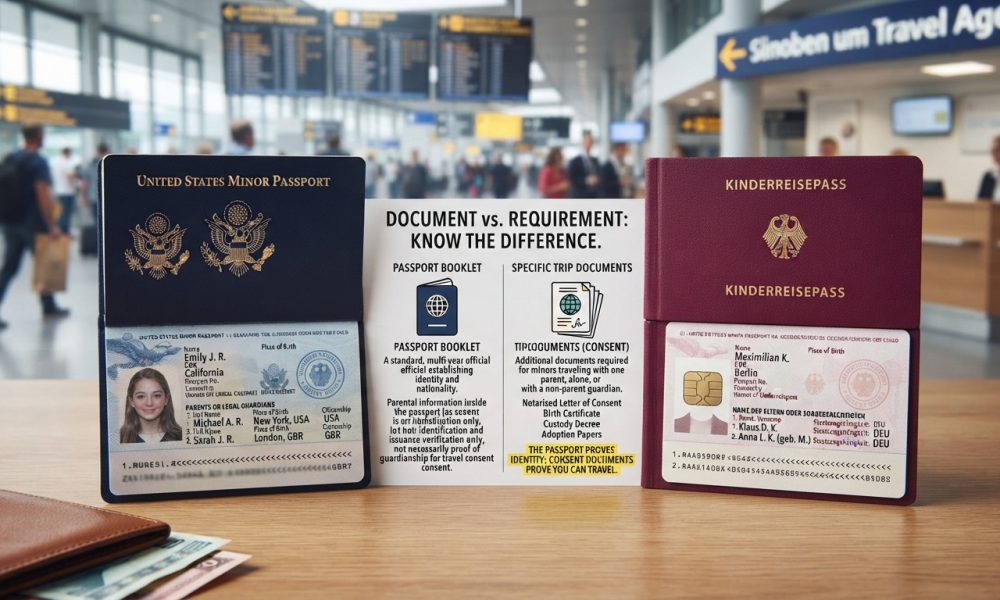
Comparing parental Information fields shows why families should distinguish a passport booklet’s contents from the documents required for a specific trip, especially when identity records, parental consent, and departure permissions serve different purposes across national systems.
WASHINGTON, DC, October 18, 2026: Children’s passports can include different combinations of family Information and travel endorsements, so not all passport booklets record what supporting documents an international journey will require.
Mexico’s electronic passport design includes Information and photographs identifying people exercising parental authority or guardianship. At the same time, Brazil allows specific travel authorizations to be printed in children’s passports, reflecting different needs within national document systems.
For families, the key focus is the legal significance: the booklet separately reviews the child’s nationality, accompanying arrangements, and itinerary, ensuring that visible passport Information is interpreted in context.
Start With What the Booklet Actually Contains
Parents should carefully examine the child’s current passport, identify the personal data page, any family Information page, and any observations or travel authorizations, rather than assuming every booklet issued to a minor follows the same format.
A useful review distinguishes Information identifying the child from Information identifying other people, then considers whether any additional wording expressly grants a particular permission or records details relevant to the passport’s issuance and the family relationship.
The family should use the issuing authority’s explanation when interpreting an unfamiliar field, especially where translated labels or legal terminology make it unclear whether the page identifies a parent, a guardian or another person with recognized authority.
This approach avoids relying on appearance alone, allowing parents to ask focused questions about the actual document instead of treating a photograph, signature, or printed name as evidence of every permission needed for travel.
Mexico Includes a Dedicated Page for Relevant Adults
Mexico’s official specification for electronic passport contents describes a first interior page used for minors that records the full name, nationality, photograph and signature of the person or people exercising parental authority or guardianship, with CURP Information where applicable.
The specification provides a concrete example of family Information appearing inside the booklet itself, placing identifying details about the relevant adults alongside the child’s travel document rather than leaving all such Information exclusively in separate Application records.
A practical implication is that an officer can inspect those printed details when examining the booklet. However, families should confirm what the receiving authority accepts as evidence before deciding another supporting record is unnecessary.
Parents comparing documents should describe this feature precisely, avoiding the assumption that the page must show two biological parents or that every family will have the same combination of names, photographs, and legal relationships recorded.
Printed Family Details and Travel Permission Serve Different Purposes
Information identifying a parent or guardian can help explain a relationship. However, the family still needs to establish whether the proposed journey is authorized under the applicable arrangements, particularly when the child travels without one or more relevant adults.
For example, a child might hold a passport displaying parental Information while traveling with a grandparent, so you may need to review how to document the grandparent’s role and the parents’ permission for that party.
The visible family page should therefore be considered alongside the travel plan, with parents asking what evidence is needed for departure, entry, and any return journey involving a different companion or a different country’s requirements.
A useful preparation note can identify what the passport already demonstrates and what remains to be established separately, helping the accompanying adult understand why the travel file may contain additional permissions despite detailed family Information in the booklet.
Brazil Allows Specific Travel Authorizations in the Passport
Brazil’s Federal Police explains that international travel authorization can be printed in a child’s passport when properly authorized, including one option permitting travel with either parent and another allowing unaccompanied travel.
The agency also distinguishes consent to issue the passport from permission for international travel, making the endorsement important in determining whether the document covers the planned departure or whether separate authorization is needed for the journey.
This feature illustrates a different function from a page that identifies family members, because the wording of a travel authorization concerns permission and scope rather than merely recording who was identified during the passport Application process.
Families should read the particular endorsement and confirm its Application to the intended arrangements, especially where a child will travel with another adult, use a different passport, or encounter a situation requiring additional assessment under Brazilian rules.
Application Records Are Another Part of the Picture
The Australian Passport Office provides detailed procedures on parental consent for child passport applications, showing why families should review the issuance process separately from any conclusion about what Information or permissions appear in the resulting booklet.
A passport Application may request family details or supporting records for official assessment. Still, parents should avoid assuming that every item submitted will subsequently appear in print or be available to another country’s officer during travel.
When reviewing a national system, the family can ask three distinct questions: what Information the Application requires, what Information the issued document displays, and what additional records the intended journey requires at each relevant stage.
Keeping those questions separate makes comparisons more useful, allowing parents to understand a document’s function without drawing unsupported conclusions about a country’s safeguards from the presence or absence of a particular visible field in one booklet.
Some Authorities Recognize Parent Details as Alternative Evidence
South Africa’s Department of Home Affairs advisory states that a child presenting a passport containing parental details need not produce a birth certificate or equivalent document under that provision, demonstrating a specific recognition of Information recorded within the booklet.
That example should be read within the advisory’s applicable categories and conditions, not expanded into a universal claim that parental Information in any passport replaces every birth certificate, consent letter, or supporting legal record during international travel.
Parents should identify exactly which document a provision allows them to replace, then check whether other requirements remain because of the child’s nationality, accompanying arrangements, or the separate purpose of another requested record.
A useful inquiry would describe the passport page and the proposed journey, and ask whether the authority accepts that Information for the specified purpose instead of broadly asking whether the child’s passport contains everything needed for travel.
Canada Recommends Supporting Records According to Circumstances
Canada’s guidance on travel documents for children identifies passports alongside potentially relevant records such as consent letters, birth certificates and documents concerning family circumstances, including custody arrangements or the death of a parent where those records are applicable.
The practical lesson is to build a document checklist around the individual journey, considering what each record explains rather than assuming a passport’s design determines the full set of papers the child should carry.
A family traveling together may have different supporting-document questions than a child traveling with a school group, so the review should reflect the actual companion and purpose rather than rely on a generic collection of family records.
Where the relevant authority accepts alternative evidence, parents can record that conclusion in their planning notes, helping avoid unnecessary duplication while ensuring that any decision to omit a document rests on guidance applicable to their circumstances.
Check the Actual Edition and Issue Date
Mexico’s 2021 electronic passport specification called for a phased introduction and stated that existing non-electronic machine-readable passports would remain valid until expiry, illustrating why different document generations can coexist after a new design is announced.
Families should therefore compare their booklet with guidance for its edition, rather than assume a photograph of the latest design describes every valid passport held by children of the same nationality.
If a newly introduced page or feature is absent, parents should verify with the issuing authority when necessary, rather than immediately concluding that an older document is defective or that its holder must obtain a replacement.
Likewise, a redesign announcement should include instructions for existing documents, allowing parents to distinguish a future issuance change from a requirement that affects the passport already available for the child’s planned journey.
Family Changes May Require a Document Review
Adoption, legal name changes, or revised guardianship arrangements can raise questions about consistency between a passport and supporting records, so families should review documents before relying on Information recorded during an earlier Application.
Parents should ask the issuing authority whether the change requires correction or replacement, describing the legal event and the current booklet accurately rather than assuming every family change automatically invalidates the passport or leaves it unaffected.
The review should also consider how the relevant relationships will be explained during travel, especially where an accompanying adult’s current name differs from the name appearing in an older document or another record within the travel file.
Complete any necessary updates through the proper issuing process, keep the supporting evidence required for the journey, and avoid informal alterations to printed passport Information that could complicate the document’s use.
Dual-National Children Need a Complete Assessment
Brazil’s Federal Police state that a Brazilian child using another nationality’s passport does not remove applicable travel authorization requirements, clearly showing why the booklet presented cannot be treated as the sole determinant of departure rules.
For a child holding more than one nationality, parents should determine how each relevant country treats the traveler and which documents it expects, and disclose the actual circumstances when asking authorities about permission, Identification, and passport use.
The family should avoid choosing a document solely because its layout appears simpler; instead, confirm the appropriate presentation and ensure that any family Information or authorization relied upon can be inspected in the required form.
A practical travel note can explain which documents address each stage of the journey, giving the accompanying adult a consistent account without expecting them to infer legal effects from differences between two countries’ passport designs.
Printed Information and Electronic Information Need Separate Interpretation
Amicus International Consulting’s guide to scanning a passport’s NFC chip and understanding the results explains the differences between reading electronic Information, assessing digital security features, and establishing current travel validity, giving context for families interested in examining the passport’s electronic component.
Families should avoid assuming that every item printed elsewhere in the booklet is necessarily displayed by a smartphone reader, or that an Application’s results provide a complete account of the document’s legal significance for a particular journey.
Interpret a technical reading based on what the Application actually retrieves and checks, while questions about parental authority, consent, and departure permission remain matters for the relevant records and official procedures governing the proposed trip.
For practical preparation, parents can compare identifying details across the booklet, reservation, and supporting papers, raise discrepancies with the appropriate authority, and keep electronic verification within its stated purpose rather than treating it as comprehensive travel clearance.
Protect Family Information While Preparing the Travel File
A passport containing Information about both the child and relevant adults deserves careful handling, so families should consider what a requested copy reveals and, when a legitimate procedure requires it, provide only the needed pages through an appropriate channel.
When a school, organizer, or service provider requests a complete scan, parents can ask which pages are necessary and how the records will be handled, so they understand the request before sharing more family Information than needed.
The accompanying adult should still have access to documents required for inspection, with protected backups arranged separately so that privacy precautions support the journey without leaving essential records unavailable at check-in or during a border examination.
Before departure, the family should compare the current passport, confirmed itinerary,,and relevant permissions one final time, ensuring the travel file explains tthe child’sidentity, accompanying arrangements, and authorization through documents appropriate to the actual journey.




