
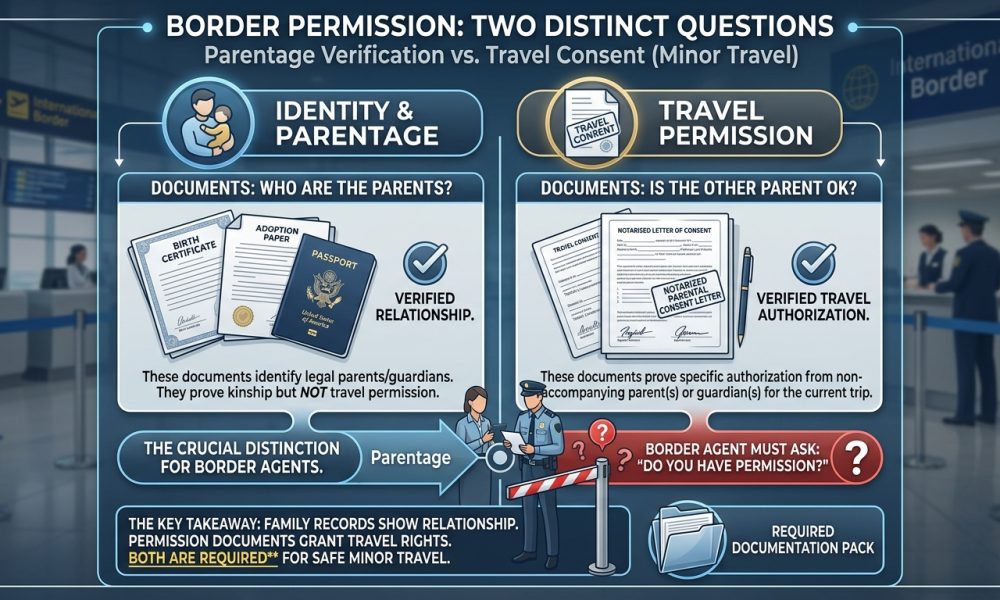
Documents showing who a child’s parents are do not necessarily grant permission for a specific international trip, so families should review relationship records, decision-making authority, and travel arrangements together before departure.
WASHINGTON, DC, October 18, 2026: Families preparing for international travel should distinguish evidence of a child’s parentage from evidence that the proposed journey is authorized, because a document establishing a family relationship may leave important questions about travel permission unanswered.
A birth certificate, passport, and consent letter can each provide useful Information, but understanding each record’s purpose helps parents spot gaps before departure instead of assuming one familiar document answers every question.
Different Documents Answer Different Questions
A practical document review starts with four questions about the child’s identity, the accompanying adult’s relationship to the child, who can make relevant decisions, and the permission covering the journey being undertaken.
A passport generally establishes the holder’s identity and nationality for international travel. At the same time, a birth or adoption record can help establish a family relationship without necessarily explaining every subsequent development affecting parental responsibility or travel authority.
A consent document addresses another issue by recording agreement to travel. However, its usefulness depends on the circumstances, the Authority of the people signing it, and the requirements applicable to the countries involved in the journey.
Keeping these purposes separate provides a useful way to organize documents for families, especially when several records repeat names and dates but support different parts of the explanation an accompanying adult may need to provide.
Official Guidance Separates Relationship Evidence From Permission
The United States Department of State recommends carrying a child’s birth certificate or other evidence of the legal relationship, while also noting that some countries require formal permission from a parent who is not traveling.
Its guidance also states that the United States does not require evidence of both parents’ permission for a minor’s international travel, illustrating why families should avoid treating another country’s documentation practices as a universal border rule.
For parents organizing a trip, this distinction means collecting relationship evidence and investigating travel authorization should remain separate preparation tasks, even when both concern the same child, the same adults, and the same itinerary.
A useful working folder can therefore identify what each document demonstrates, allowing the person reviewing the records to notice when several identity documents have been collected but the question of permission remains unresolved for the proposed journey.
A Birth Certificate Does Not Describe Every Later Development
A birth certificate can provide an important starting point for establishing parentage. Still, families should not expect it to explain later court orders, guardianship changes, or restrictions that may affect decisions about a particular international trip.
For example, a hypothetical parent could have a birth certificate naming both parents while also holding a later order addressing travel, so the documents should be considered together rather than treating the earlier record as complete.
The practical question is whether the collection of records accurately explains the family’s current circumstances, including any relevant decision-making arrangements, instead of merely showing that an adult’s name appeared in a registration made years before departure.
When a family knows an order or agreement affects international travel, identifying the relevant provisions early can help them get appropriate advice on the proposed itinerary before they commit to bookings that may be difficult to change.
Parental Responsibility Requires Its Own Review
The British government’s guidance on taking a child abroad addresses permission from people with parental responsibility or a court, while separately recommending relationship evidence such as a birth or adoption certificate when preparing for travel.
That guidance also describes an exception involving certain child arrangements orders, reinforcing the need to examine the applicable legal circumstances rather than assuming that every parent traveling alone faces precisely the same permission requirements for every trip.
Families should therefore be careful with everyday descriptions such as primary parent, sole caregiver, or weekend parent, because those expressions may describe household routines without accurately identifying who has the relevant legal Authority to make international travel decisions.s When an order’s meaning is uncertain, a focused question about the proposed destination, departure date, return arrangements, and accompanying adult is more useful than a general request to confirm whether someone qualifies as a parent.
Consent Letters Must Be Understood in Their Proper Context
The Government of Canada’s consent-letter guidance recommends a signed letter when children travel abroad without one or both parents or legal guardians, while expressly stating that such a letter is not legally required in Canada.
Canadian guidance explains that airline staff or border authorities may still request the document, and it cautions that another country may have its own requirements or may not accept the letter as sufficient evidence.
For families, the useful distinction is between an official recommendation, a legal requirement and a practical supporting document, since describing all three as mandatory can create confusion just as readily as dismissing a recommendation as unnecessary paperwork.
A sensible preparation process records which Authority supplied each instruction and which part of the journey it concerns, helping the accompanying adult understand why a document was prepared and when it may become relevant during travel.
Different Surnames Call for Clear Connections Between Records
A parent and child may use different surnames for many ordinary reasons, so families should focus on whether their records clearly connect the people involved rather than expecting matching names to explain their relationship.
British guidance specifically identifies marriage or divorce certificates as potentially helpful where a single parent’s family name differs from the child’s, alongside the separate relationship and permission documents discussed elsewhere in its advice for overseas travel.
During preparation, an adult can compare the names on the passport, relationship record, and relevant supporting documents, noting whether a name change or spelling difference needs clarification before presenting the documents together during the journey.
Families should investigate any discrepancy through the appropriate issuing Authority or adviser, and avoid informal alterations that could make the records harder to assess or leave uncertainty about which version accurately reflects the person’s official particulars.
Familiar Adults Still Need Clearly Defined Roles
When a child travels with a grandparent, stepparent, coach or family friend, preparation should identify the adult’s actual role in the journey rather than assuming that a close personal relationship explains every aspect of Authority and permission.
A hypothetical grandparent accompanying a child on holiday may be well known to the entire family. Yet the travel folder should still make clear who arranged the journey and which documents support the permission relied on.
Similarly, a stepparent’s involvement in daily care should prompt a careful review of the relevant arrangements, particularly where the family is uncertain whether that adult holds legal responsibility or is traveling with permission granted by someone else.
Describing the role accurately also helps with practical planning, because the adult accompanying the child may differ from the person receiving the child abroad, the person providing accommodation or the person responsible for arranging the return journey.
Permission Should Correspond to the Actual Itinerary
A useful review compares the proposed permission with the actual travel plan, checking whether the destination, dates, and accompanying adult remain accurate after booking changes, rather than relying on a document prepared for an earlier version of the trip.
Canadian guidance identifies the child, relevant parents or decision-makers, accompanying adult, and trip details as standard consent-letter contents, while recommending that signing arrangements reflect the decision-makers who will not accompany the child.
As a practical organizational step, families can place the itinerary beside the permission documents and mark any unresolved differences, particularly where one adult accompanies the outward journey and another adult is expected to bring the child home.
Repeat this comparison after a significant change, allowing the family to determine whether the existing documents remain suitable and whether an authority, airline, or legal adviser needs to clarify the revised arrangements.
Departure From the Destination Deserves Separate Attention
The State Department advises families to review both entry and exit requirements, noting that some countries impose specific conditions when a minor leaves and may require formal consent or documentation about the accompanying adult’s legal relationship.
Parents should therefore give the return journey its own place in the preparation process, recording which adult will accompany the child and which documents will still be available when the family reaches the departure airport abroad.
For example, if the adult who organized the outward journey returns home early, the remaining companion should have access to the appropriate records instead of discovering that essential paperwork left the destination inside another traveler’s hand luggage.
The same planning exercise can cover intermediate stops, particularly when the family has not yet confirmed whether a connection involves entering another country or whether a change of route introduces an additional documentation question requiring official clarification.
Passport Checks Cannot establish every form of Authority.
A passport review helps identify errors or questions about the travel document itself. Still, families should not treat a successful inspection of a booklet or electronic chip as confirmation that the accompanying adult has travel permission.
Amicus International Consulting’s guide to scanning a passport’s NFC chip and understanding the results discusses electronic passport Information, providing technical context that families should keep distinct from their separate review of parentage, decision-making arrangements, and permission for the journey.
A useful way to organize these tasks is to complete the passport review alongside the family-document review, ensuring that confidence in one part of the travel folder does not cause another unresolved question to be overlooked.
Parents can also record which checks remain outstanding, distinguish confirmed passport details from assumptions about legal Authority, and direct each remaining question to the appropriate official source or qualified adviser.
Document Format and Availability Need Practical Planning
Once families have identified the relevant documents, they should ask the relevant Authority whether it needs originals, certified copies, translations, or other formalities, rather than assuming every destination will assess the same collection the same way.
Keeping a clear record of the answer can make preparation more manageable, particularly when several adults are sharing responsibility for obtaining documents, and each person needs to know exactly which version should accompany the child during travel.
Digital backups can support organization, but families should confirm that the documents they intend to present meet the applicable instructions, including any requirements that cannot be satisfied by displaying a photograph on a mobile phone.
The accompanying adult should know where the records are stored and how they relate to one another, reducing the need to search through unrelated messages or contact several relatives merely to explain the basic arrangements for the trip.
Resolve Uncertainty Before It Becomes an Airport Problem
When the difficulty concerns who may authorize travel, address that legal question directly rather than producing additional relationship documents that repeat Information already established without resolving the uncertainty affecting the proposed journey itself.
Likewise, if the issue concerns a missing certificate, an inconsistent name, or an unclear itinerary, the preparation process should focus on correcting that gap instead of assuming a more elaborate consent letter will resolve everything.
A final review can bring the separate questions together by checking the child’s identity, the adult’s relationship, the relevant decision-making arrangements, and the permission supporting each stage of the journey against the actual travel plans and applicable guidance.
Answering each question separately helps families assemble a coherent travel folder with documents that explain who the child’s parents are and why the accompanying adult is entitled to undertake the planned journey.




