
Summary: Global yogurt coatings market is set to reach USD 1.25 billion by 2036, driven by demand for cultured-dairy flavors in industrial bakery products, convenient coating formats, and specialty formulations.
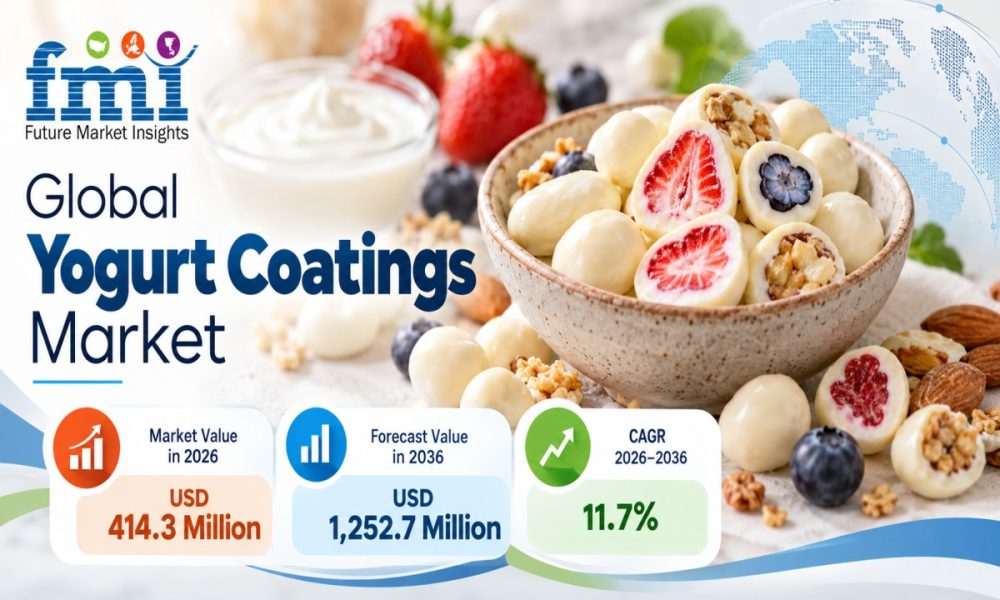
The global yogurt coatings market is expanding as industrial bakeries seek to introduce distinctive cultured-dairy flavors without disrupting established production processes. The market is projected to grow from USD 414.3 million in 2026 to USD 1,252.7 million by 2036, registering an 11.7% CAGR during the forecast period, according to the latest insights by Future Market Insights (FMI).
Global Yogurt Coatings Market Snapshot
· 2026 market value: USD 414.3 million
· 2036 forecast: USD 1,252.7 million
· CAGR, 2026–2036: 11.7%
· Leading product type: Standard grade
· Standard grade share, 2026: 44.0%
· Leading form: Powder / dry
· Powder / dry share, 2026: 38.0%
Get detailed market forecasts, competitive benchmarking, and pricing trends:
https://www.futuremarketinsights.com/reports/sample/rep-gb-34762
Why Is the Yogurt Coatings Market Growing?
Industrial bakeries are adopting yogurt coatings to introduce cultured-dairy flavors across established bakery products without making major changes to existing coating and decorating lines. Application support and reliable coating performance are important as manufacturers seek consistent results across production runs.
Cargill reopened its Singapore Innovation Center in April 2025, with laboratories covering dairy, bakery, and confectionery development. Such facilities help manufacturers evaluate formulations before moving to full-scale production trials.
Standard Grade Leads the Product Type Category
Standard grade is estimated to account for 44.0% of product type demand in 2026, making it the leading category.
Its position reflects broad ingredient flexibility, predictable processing behavior, and comparatively straightforward qualification on established coating lines. Manufacturers can adjust dairy solids and other ingredients to manage flavor, viscosity, and setting without rebuilding an entire coating specification.
In March 2026, Cargill expanded its Port Klang specialty-fats facility with a new line serving bakery and fillings applications. Such investments strengthen ingredient availability for compound-style coatings used in industrial bakery production.
Why Does Powder / Dry Lead the Form Category?
Powder / dry formats are projected to represent 38.0% of form demand in 2026.
These formats support controlled dosing, efficient storage, and standardized preparation across centralized premix operations. They can also simplify ingredient handling for manufacturers supplying multiple production facilities.
However, dispersion quality remains important. Poor wet-out can produce uneven acidity and viscosity, affecting coating consistency. Manufacturers therefore evaluate powder performance during local batch preparation to maintain repeatable results across different production sites.
Bread & Rolls Lead Application Demand
Bread and rolls are anticipated to account for 31.0% of application demand in 2026.
High-volume bakery lines require predictable coating weight, adhesion, and cooling behavior. Small changes in viscosity can affect deposition, finished appearance, and packaging performance during extended production runs.
Corbion addressed clean-label reformulation and consistency requirements for commercial bakers at IBIE in September 2025. These considerations demonstrate why coating approval depends on finished-product performance rather than visual appearance alone.
Direct Industrial Supply Strengthens Commercial Adoption
Direct supply to industrial bakeries is projected to represent 53.0% of sales channel demand in 2026.
Direct technical relationships allow coating suppliers to coordinate plant-specific trials, evaluate application problems, and adjust specifications without unnecessary communication delays.
Puratos announced innovation centers in Montreal and Costa Rica in August 2025 to support industrial bakery mixes and related application development. Such technical infrastructure can help manufacturers address adhesion, setting, and processing challenges during commercialization.
Nutrition Reformulation Creates Opportunities and Challenges
Sugar and fat reduction can change coating viscosity, crystallization, and setting behavior, extending approval cycles when revised formulas fail to match established production conditions.
The U.S. FDA proposed a front-of-package Nutrition Info box in January 2025 covering saturated fat and added sugars. These developments increase the importance of nutrition calculations and plant-level testing when manufacturers reformulate specialty coatings.
United Arab Emirates Leads the Profiled Country Growth
The United Arab Emirates is projected to register a 13.1% CAGR through 2036, supported by food imports, distributor networks, and demand from industrial bakery accounts. Dubai Municipality reported inspecting 579,913 food consignments containing approximately 1,947,200 products during 2025. Documentation quality, temperature-managed samples, and local warehousing remain important for market entry.
Saudi Arabia follows with a 12.8% CAGR, supported by bakery demand and established distribution networks. Hot logistics conditions and nutrition scrutiny increase the importance of stable fats, reliable product specifications, and documented reformulation support.
South Korea is projected to grow at 12.4% CAGR, supported by bakery innovation and product development across different bread substrates. MAFRA reported in April 2025 that 30 bakeries participated in a floury-rice recipe program that developed 120 new varieties of floury-rice breads and confections.
The United States is forecast to register a 12.1% CAGR, driven by industrial bakery scale and recurring product development. Nutrition reformulation and viscosity requirements make plant trials and documented formulation performance important.
Competitive Landscape: Cargill, AAK and Barry Callebaut Strengthen Coating Capabilities
The competitive environment includes specialty-fat suppliers, compound-coating manufacturers, dairy ingredient providers, and bakery application specialists.
Cargill, AAK and Barry Callebaut offer coating and specialty-fat capabilities relevant to melting behavior and processing performance. Puratos and Corbion support bakery formulation and application development, while Arla Foods Ingredients and FrieslandCampina Ingredients provide dairy functionality. IFF contributes flavor and formulation expertise.
Competition increasingly depends on consistent coating behavior, cultured-dairy flavor delivery, application support, and reliable ingredient supply. Suppliers that help manufacturers reduce scrap and shorten qualification cycles can strengthen their position in recurring industrial bakery programs.
What Does the Market Mean for Industry Decision-Makers?
The 11.7% CAGR indicates growing opportunities for yogurt coatings across industrial bakery and snack applications.
For manufacturers, the priority is selecting coatings that deliver consistent flavor, viscosity, adhesion, and cooling performance while meeting nutrition targets. For suppliers, technical support, reliable specialty-fat and dairy ingredient access, and plant-level validation are important for securing repeat orders.
The strongest opportunities are likely to emerge where cultured-dairy differentiation, efficient processing, and application-specific formulation expertise come together.
Get the Complete Story—Read More About Our Latest Report:
https://www.futuremarketinsights.com/reports/yogurt-coatings-market
Related Food & Beverages Industry Reports
For companies tracking specialty coatings and bakery ingredient technologies, relevant FMI research areas include:
· Bakery Ingredients Market
· Compound Chocolate Market
· Specialty Fats Market
· Dairy Ingredients Market
· Food Coating Ingredients Market
About Future Market Insights (FMI)
Future Market Insights, Inc. is an ESOMAR-certified, ISO 9001:2015 market research and consulting organization trusted by Fortune 500 companies. With a global presence across the U.S., UK, India and Dubai, FMI delivers data-driven insights across 30+ industries and 1,200 markets worldwide.



