
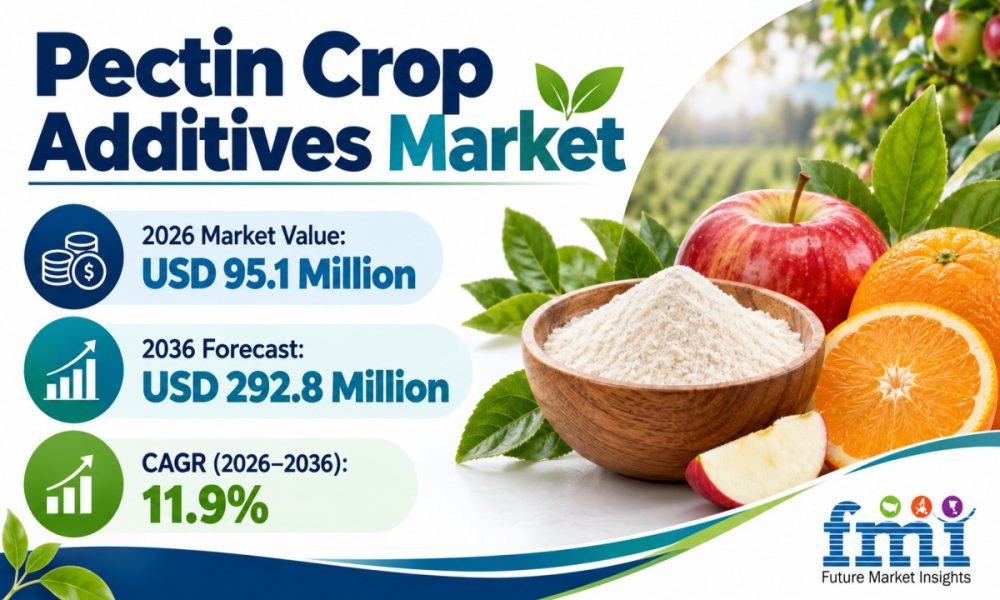
Summary: Global pectin crop additives market is set to reach USD 292.8 million by 2036, driven by demand for pectin-derived crop inputs, plant-defense applications, and standardized biological formulations that deliver repeatable agricultural results.
The global pectin crop additives market is expanding as agricultural input manufacturers explore pectin-derived ingredients for crop protection, plant biostimulation, and soil applications. The market is projected to grow from USD 95.1 million in 2026 to USD 292.8 million by 2036, registering an 11.9% CAGR during the forecast period, according to the latest insights by Future Market Insights (FMI).
Global Pectin Crop Additives Market Snapshot
- 2026 market value: USD 95.1 million
· 2036 forecast: USD 292.8 million
· CAGR, 2026–2036: 11.9%
· Leading product type: Raw / Crude Extract Grades
· Raw / Crude Extract Grades share, 2026: 52.2%
· Leading crop type: Cereals & Grains
· Cereals & Grains share, 2026: 40.9%
· Leading application method: Soil Application
· Soil Application share, 2026: 46.1%
Get detailed market forecasts, competitive benchmarking, and pricing trends:
https://www.futuremarketinsights.com/reports/sample/rep-gb-34748
Why Is the Pectin Crop Additives Market Growing?
Pectin-derived oligogalacturonides are gaining attention as agricultural ingredients because they can activate plant-defense responses. These compounds provide a defined biological mechanism for developing crop-protection and biostimulant formulations.
Research published in Frontiers in Plant Science in 2025 examined the role of oligogalacturonides in plant immunity while noting that excessive signaling can interfere with plant growth. Consequently, commercial adoption depends on controlled ingredient chemistry, appropriate application rates, and consistent crop responses under different field conditions.
Why Do Cereals & Grains Lead Crop Type Demand?
Cereals & Grains are expected to represent 40.9% of crop type demand in 2026.
Their position reflects extensive cultivated acreage and established soil-treatment and crop-management routines. These conditions provide opportunities for suppliers to evaluate whether pectin-derived products can deliver measurable benefits alongside existing nutrition and plant-protection programs.
However, wider adoption requires crop-specific validation. Results must remain consistent across variations in soil, weather, disease pressure, and application timing before products can secure regular purchasing from commercial growers.
Soil Application Leads the Application Method Category
Soil Application is forecast to account for 46.1% of application method demand in 2026.
The method provides a direct route for pectin-rich materials to reach the root zone and can complement biological inputs used around plant roots. Research published in Plants found that a pectin-rich amendment enhanced Bacillus velezensis-mediated soybean growth promotion and nodulation, providing a scientific basis for soil-oriented product development.
Large Commercial Farms and Agri-Input Distributors Strengthen Adoption
Large Commercial Farms are projected to represent 41.0% of farm type demand in 2026. Their ability to conduct structured field trials, compare treated and untreated plots, and standardize application procedures supports the evaluation of emerging crop inputs.
Agri-Input Distributors are expected to account for 40.5% of sales channel demand in 2026. Distributors provide growers with product recommendations, application guidance, label information, and technical support.
Regulatory Standardization Creates Opportunities and Challenges
Commercial adoption depends on standardized active fractions and clear product-use requirements. Variations in oligomer structure, concentration, and application timing can affect plant responses, making formulation quality and field validation important.
FytoFend markets FytoSave, which uses the pectin-derived COS-OGA complex, while INTERMAG offers PLANTICINE, an oligogalacturonide-based biostimulant identified by the company as registered under Regulation (EU) 2019/1009.
South Korea Leads the Profiled Country Growth
South Korea is projected to register an 11.5% CAGR through 2036, supported by smart-farming initiatives and controlled production systems that can improve application monitoring and measurement of crop responses. The country’s agricultural modernization programs create opportunities for biological inputs, although local validation and registration remain important.
Germany follows with an 11.2% CAGR, supported by an established regulatory route for pectin-derived crop-protection products. FytoSave’s authorization provides a commercial reference for COS-OGA applications under specified conditions.
The USA is projected to grow at 10.9% CAGR, supported by agricultural research into pectin-rich soil amendments and opportunities for field-crop applications. Commercial expansion will depend on compatibility with existing crop inputs and consistent field performance.
The UK is forecast to register a 10.3% CAGR, with authorized COS-OGA products providing a defined route into protected-crop disease-management programs. Label-specific application requirements and distributor support remain important.
Japan is projected to record a 9.9% CAGR through 2036. Biostimulant labeling guidance issued by the Ministry of Agriculture, Forestry and Fisheries in May 2025 provides a framework for communicating product claims, supporting evidence, and safety information.
Competitive Landscape: FytoFend and INTERMAG Strengthen Pectin-Derived Crop Applications
The competitive environment spans direct agricultural formulation companies, biological crop-protection distributors, and upstream pectin suppliers.
FytoFend S.A. and INTERMAG sp. z o.o. offer direct agricultural products based on pectin-derived oligogalacturonides. Biobest Group NV provides a distribution route for biological crop-protection solutions.
Tate & Lyle, Cargill, International Flavors & Fragrances (IFF), Herbstreith & Fox, and JRS Silvateam Ingredients bring pectin production, ingredient standardization, or formulation capabilities relevant to upstream material supply.
Competition increasingly depends on consistent ingredient specifications, validated crop responses, regulatory compliance, and technical support. Suppliers that connect reliable pectin chemistry with practical agricultural application requirements are better positioned to encourage repeat use.
What Does the Market Mean for Industry Decision-Makers?
The 11.9% CAGR indicates growing opportunities for pectin-derived agricultural inputs and standardized biological formulations.
For agricultural manufacturers, the priority is demonstrating consistent crop responses through controlled chemistry, suitable application rates, and field validation. For ingredient suppliers, standardized fractions and application-specific technical support can help translate pectin chemistry into commercially useful products.
Get the Complete Story—Read More About Our Latest Report:
https://www.futuremarketinsights.com/reports/pectin-crop-additives-market
Related Agriculture Industry Reports
For companies tracking biological crop inputs and pectin-related technologies, relevant FMI research areas include:
- Biostimulants Market
· Biopesticides Market
· Pectin Market
· Biofertilizers Market
· Agricultural Biologicals Market
About Future Market Insights (FMI)
Future Market Insights, Inc. is an ESOMAR-certified, ISO 9001:2015 market research and consulting organization trusted by Fortune 500 companies. With a global presence across the U.S., UK, India and Dubai, FMI delivers data-driven insights across 30+ industries and 1,200 markets worldwide.



