
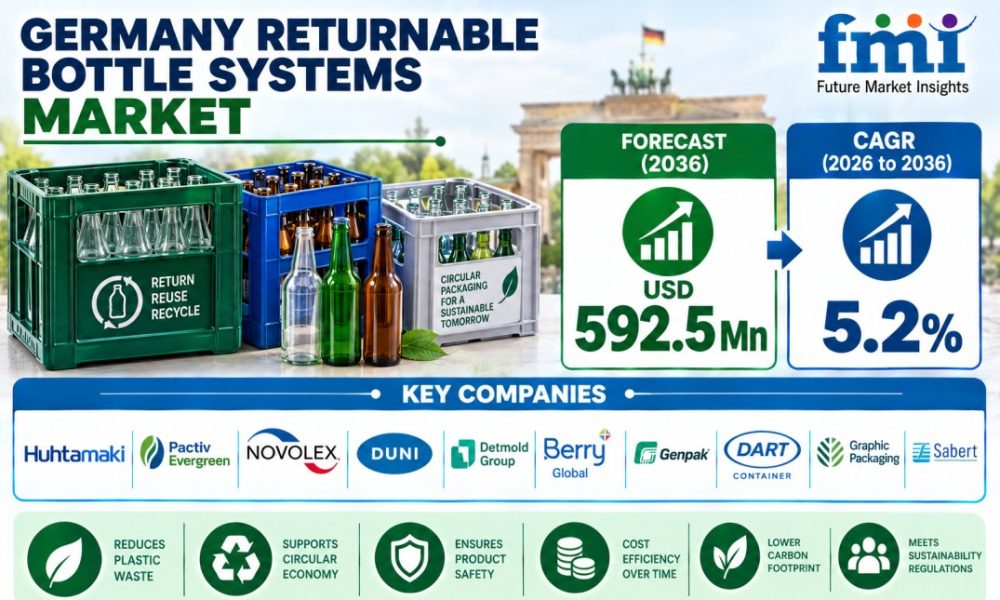
The Germany Returnable Bottle Systems Market is projected to increase from USD 356.9 million in 2026 to USD 592.5 million by 2036, expanding at a compound annual growth rate (CAGR) of 5.2%, according to Future Market Insights (FMI). The forecast represents an increase of USD 235.6 million over the ten-year period.
The commercial case for returnable packaging depends on how efficiently containers move through collection, reconditioning and reuse. Operators must generate enough completed cycles to offset collection, washing, replacement and handling expenses. Collection density and return frequency are therefore important factors in determining the viability of reuse systems.
Germany has an established base of reusable beverage packaging. The report page cites Umweltbundesamt data indicating that 34.5% of beverages sold in Germany during 2024 were filled in reusable packaging. This existing return habit provides a foundation for further development, although extending reuse systems still requires effective collection arrangements and reliable operating procedures.
👉 Get Detailed Market Forecasts, Competitive Benchmarking, and Pricing Trends: https://www.futuremarketinsights.com/reports/sample/rep-gb-35224
Return Frequency Shapes Commercial Viability
Returnable systems require more than durable containers. Businesses must establish practical processes for collecting used packaging, transporting it for cleaning and returning it to circulation. When containers travel long distances or customers fail to return them, the number of completed cycles may fall short of the level needed to recover operating costs.
These considerations influence where reuse programs are deployed. Concentrated collection points, predictable return routes and coordinated washing capacity can help reduce the cost of handling individual units. Businesses evaluating new systems need to measure return rates, losses and reconditioning costs under actual operating conditions rather than relying solely on the purchase price of a container.
Regulatory requirements are also increasing the importance of reuse planning. Regulation (EU) 2025/40 establishes requirements for reusable packaging in specified foodservice settings, including an obligation for relevant hospitality, restaurant and catering operators to offer reusable packaging by 12 February 2028, subject to the regulation’s provisions. Businesses need to assess which requirements apply to their operations and plan suitable packaging and return processes accordingly.
Operational Design Will Influence Adoption
The market’s development will depend on whether return systems can fit existing logistics and service routines. Dense collection networks may make it easier to consolidate used packaging and share return infrastructure. Institutional catering, events and other settings with concentrated consumption can provide opportunities to test return processes across predictable volumes.
However, performance must be assessed at the level of the complete system. Return rates, cleaning capacity, transport distance, container loss and replacement requirements all affect the economics of repeated use. Businesses should establish measurable pilot targets before expanding programs across multiple locations.
Nandini Roy Choudhury, Principal Consultant at Future Market Insights, observes: “Returnable systems should be judged on completed cycles rather than unit price alone. Commercial value depends on return frequency because collection and washing cost must stay below the avoided single-use spend.”
Access detailed market insights: https://www.futuremarketinsights.com/reports/brochure/rep-gb-35224
Competitive Landscape
The companies profiled on FMI’s market page include Huhtamaki, Pactiv Evergreen, Novolex, Duni, Detmold Group, Berry Global, Genpak, Dart Container, Graphic Packaging International and Sabert. The page describes a competitive landscape spanning foodservice packaging, paperboard conversion and broader packaging platforms.
For buyers, supplier evaluation should focus on the requirements of the intended return system, including format compatibility, durability, cleaning procedures, distribution support and the availability of suitable collection infrastructure. Company capabilities should be verified against the specific bottle or container application under consideration.
Outlook Through 2036
FMI forecasts the Germany Returnable Bottle Systems Market to reach USD 592.5 million by 2036, with growth at a 5.2% CAGR from 2026. Converting this projected demand into commercially sustainable programs will depend on repeat circulation, collection efficiency and cost control.
Businesses assessing opportunities should validate return rates and operating costs through pilots, confirm regulatory obligations and evaluate whether local logistics can support repeated use at scale.
To explore how FMI Custom Research can support your strategic priorities, connect with our team at – [email protected]
About Future Market Insights (FMI)
Future Market Insights, Inc. is an ESOMAR-certified, ISO 9001:2015 market research and consulting organization trusted by Fortune 500 companies. With a global presence across the U.S., UK, India, and Dubai, FMI delivers data-driven insights across 30+ industries and 1200 markets worldwide.



