
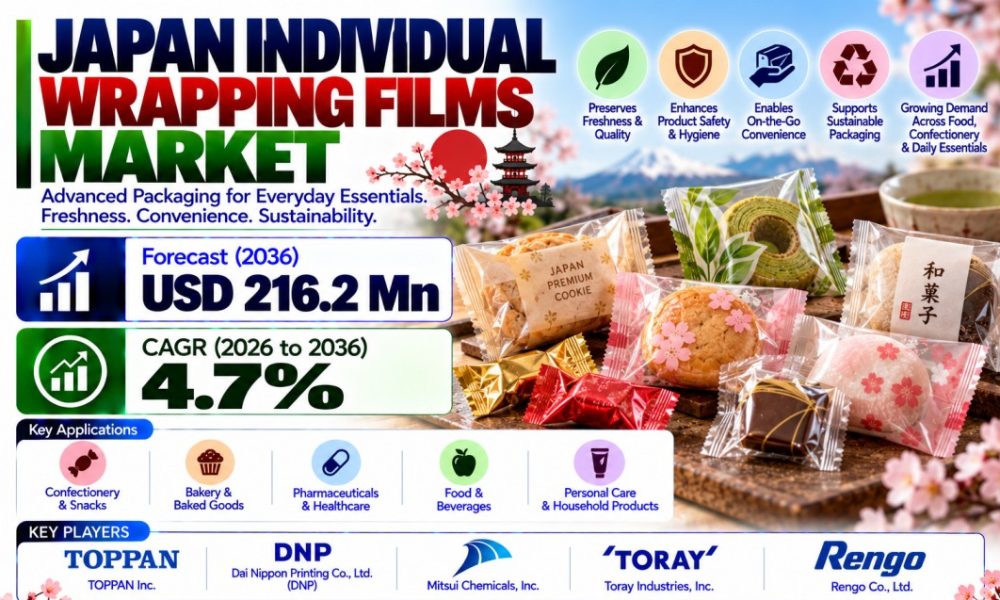
The Japan Individual Wrapping Films Market is projected to grow from USD 136.6 million in 2026 to USD 216.2 million by 2036, registering a compound annual growth rate (CAGR) of 4.7%, according to Future Market Insights (FMI). The forecast reflects recurring demand for packaging used in prepared-food and foodservice operations, where individual items require wrapping or containment during preparation and distribution.
For film suppliers and foodservice buyers, packaging performance depends on more than material cost. Films must provide the required barrier properties, form consistent seals and withstand handling between packing and consumption. These requirements are particularly relevant for takeaway and delivery applications, where packages may be stacked or moved before reaching the customer.
Material changes also require careful qualification. Food-contact documentation, sealing behavior and compatibility with existing equipment can determine whether a new film structure progresses from testing to routine commercial use.
👉 Get Detailed Market Forecasts, Competitive Benchmarking, and Pricing Trends: https://www.futuremarketinsights.com/reports/sample/rep-gb-35290
Standard Formats Support Replenishment
FMI estimates that standard formats will account for 39.0% of format-type demand in 2026. Stocked dimensions and familiar specifications can help foodservice operators and distributors manage inventory while reducing the need to qualify new formats for routine menu changes.
Standard meal formats are projected to represent 43.0% of format-size demand. Delivery platforms are expected to account for 28.0% of end-use demand, reflecting the need for containment and presentation during transport. Broadline foodservice distributors are forecast to hold 39.0% of sales-channel demand in 2026, supported by consolidated ordering and the availability of commonly stocked packaging specifications.
For flexible-film applications, these operating requirements translate into practical purchasing criteria. Buyers need to assess web dimensions, puncture resistance, seal consistency and the ability to maintain product protection under expected storage and transport conditions.
Food-Contact Compliance Influences Material Changes
Japan’s food-contact requirements are an important consideration when changing film composition. In June 2025, the Consumer Affairs Agency issued updated questions and answers on its Positive List System for synthetic resins used in food apparatus, containers and packaging. Suppliers and buyers need to maintain documentation that matches the final material structure and its intended food-contact use.
A material may perform well in initial trials but still require further review before routine use. Resin and additive records, coating composition and the suitability of the final packaging construction should be considered early in the approval process.
Mono-material structures offer another development route. They can reduce material complexity when barrier performance and reliable sealing can be maintained. However, the suitability of any redesign depends on the food product, packaging process and recovery system for which it is intended.
Developments in Barrier Films and Mono-Material Packaging
Recent developments cited by FMI illustrate continued work on flexible-packaging performance. In July 2025, TOPPAN reported the first domestic adoption of an all-polypropylene (PP) mono-material retort pouch for a Japanese food product following package-suitability and filling tests. That month, Dai Nippon Printing (DNP) announced an aluminum-deposited film designed to double barrier performance for mono-material packaging.
In May 2026, Mitsui Chemicals reported a flexible-packaging process and adhesive development aimed at lowering manufacturing emissions. These developments highlight the need to balance barrier properties and process performance as converters evaluate alternative film structures.
They do not establish that a particular material is suitable for every individual wrapping application. Buyers should verify the performance of each proposed construction on the intended packaging line and under the required food-storage conditions.
Nandini Roy Choudhury, Principal Consultant at Future Market Insights, said: “Japanese foodservice companies should compare line handling and food-contact records before unit price becomes the deciding variable. Formats earn repeat orders when they protect prepared meals without forcing kitchens or distributors to reopen routine material qualification.”
Competitive Landscape
Companies profiled by FMI include TOPPAN Inc., Dai Nippon Printing Co., Ltd. (DNP), Mitsui Chemicals, Toray Industries, Rengo, The Pack Corporation, Shimojima, Kureha, FP Corporation and RISUPACK.
Their capabilities span flexible films, barrier materials, packaging conversion, food wraps and broader foodservice packaging. Buyers should distinguish between suppliers of flexible-film structures and companies whose principal relevance lies in trays, rigid containers or distribution. Product-level validation remains necessary when evaluating suppliers for an individual wrapping-film application.
>> Access detailed market insights:https://www.futuremarketinsights.com/reports/brochure/rep-gb-35290
Outlook Through 2036
FMI forecasts the Japan Individual Wrapping Films Market to reach USD 216.2 million by 2036, expanding at a 4.7% CAGR from 2026. Growth will depend on packaging structures that meet food-protection and production requirements while complying with applicable food-contact rules.
For foodservice operators and converters, the next step is to evaluate sealing performance, barrier requirements, material documentation and recovery considerations together. This approach can help reduce qualification delays and ensure that packaging changes work under actual commercial conditions.
To explore how FMI Custom Research can support your strategic priorities, connect with our team at – [email protected]
About Future Market Insights (FMI)
Future Market Insights, Inc. is an ESOMAR-certified, ISO 9001:2015 market research and consulting organization trusted by Fortune 500 companies. With a global presence across the U.S., UK, India, and Dubai, FMI delivers data-driven insights across 30+ industries and 1200 markets worldwide.



