
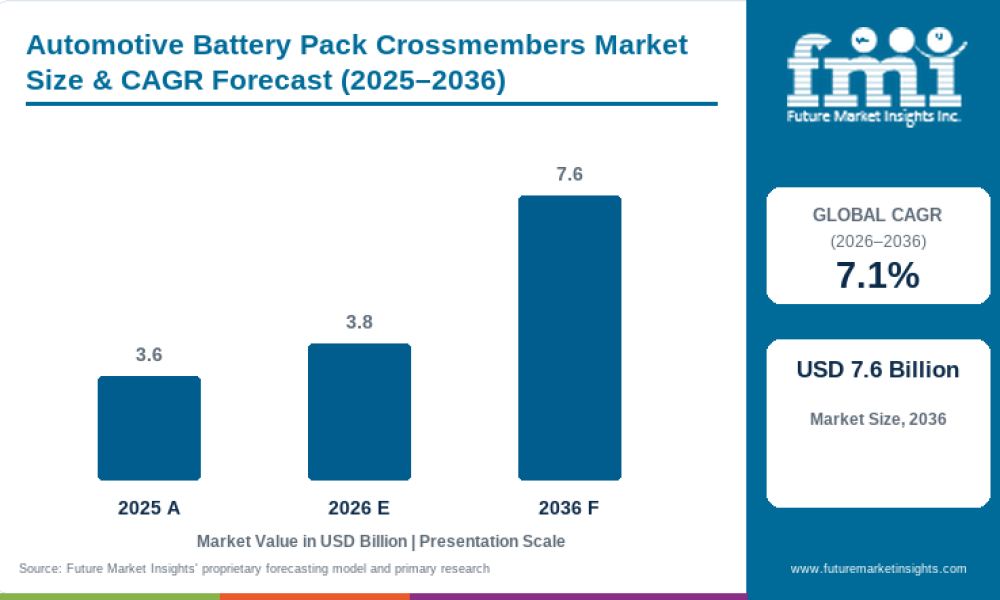
The global automotive battery pack crossmembers market is projected to grow from USD 3.8 billion in 2026 to USD 7.6 billion by 2036, registering a 7.1% CAGR over the forecast period. The market was valued at USD 3.6 billion in 2025. Demand is increasing as electric vehicle battery packs become larger and occupy more of the vehicle floor, raising the need for transverse structural members that support the pack, reduce unsupported spans, and help protect battery cells during a crash.
Crossmembers are becoming more closely integrated with battery enclosures and vehicle floor structures. This links demand with the wider Electric Vehicle Battery Housing Market and the Vehicle Crossmember Assemblies Market. Suppliers that combine section design, forming, joining, and dimensional control can support vehicle programs from early engineering through production. Early involvement is particularly important because changes to crossmember geometry or joining methods after battery packaging and crash targets are finalized can increase redesign costs and complicate qualification.
What Are the Key Segments in the Automotive Battery Pack Crossmembers Market?
The automotive battery pack crossmembers market is segmented by material, pack type, vehicle type, function, sales channel, and region. Demand varies according to battery architecture, vehicle packaging, structural performance requirements, and supplier integration capabilities.
- Aluminum Extrusions – 38.0% of material demand: Aluminum extrusions are projected to lead the material segment in 2026. Closed profiles can provide a balance of low weight and adjustable stiffness, supporting vehicle mass targets while maintaining structural performance.
- Skateboard EV Packs – 36.0% of pack-type demand: Skateboard battery packs represent the leading pack-type segment in 2026. Their integration into the vehicle floor increases the importance of crossmembers that support the enclosure and contribute to the overall structural layout.
- Battery Electric Cars – 33.0% of vehicle-type demand: Battery electric cars account for the leading vehicle-type share in 2026, reflecting the need to balance battery packaging, vehicle weight, passenger space, and crash protection.
Get detailed market forecasts, competitive benchmarking, and pricing trends:
https://www.futuremarketinsights.com/reports/sample/rep-gb-35468
Other material categories include stamped steel, high-strength steel, composite crossmembers, and hybrid metal-composite structures. Pack configurations also include module-based packs, structural battery packs, and commercial EV packs. Crossmember functions range from crash load-path management and battery tray reinforcement to mounting support and torsional stiffness.
Sales channels include automaker captive supply, body structure Tier-1 suppliers, battery enclosure suppliers, and aluminum extrusion suppliers. These channels connect component manufacturers with the engineering and production teams responsible for vehicle body structures and battery systems.
Which Countries Are Growing Fastest in the Automotive Battery Pack Crossmembers Market?
Canada is projected to record the fastest growth among the profiled countries, with an 8.0% CAGR from 2026 to 2036. The market outlook reflects opportunities associated with electric vehicle manufacturing, battery-related industrial investment, and the need for locally supported structural component production. Suppliers that can meet vehicle program requirements for dimensional consistency, joining quality, and structural performance may be well positioned to support new and expanding production programs.
Mexico is expected to grow at a 7.5% CAGR. Its established automotive manufacturing base and role in North American vehicle supply chains create opportunities for crossmember suppliers serving automakers and Tier-1 structural component manufacturers.
South Korea is projected to expand at a 7.2% CAGR, supported by its automotive and battery technology ecosystem. Crossmember demand is linked to the integration of battery enclosures with vehicle structures and the need for components that satisfy packaging, weight, and crash-performance requirements.
The United States is forecast to grow at a 6.8% CAGR. Vehicle platform development and battery enclosure integration are expected to influence sourcing decisions, particularly where suppliers can demonstrate manufacturing consistency and support early-stage engineering requirements.
Germany is projected to record a 6.4% CAGR, while France is expected to grow at 6.1%. Both markets are influenced by automotive engineering capabilities and the need to integrate battery structures into electric vehicle platforms without compromising safety, stiffness, or packaging requirements.
Japan is expected to grow at a 5.7% CAGR through 2036. Demand will depend on electric vehicle platform development and suppliers’ ability to deliver structurally reliable components that meet automaker requirements for manufacturing quality and vehicle integration.
What Is Driving Demand for Automotive Battery Pack Crossmembers?
Larger Battery Packs Increase Structural Support Requirements
As battery packs expand across the vehicle floor, crossmembers help manage structural loads and reduce unsupported spans within the battery enclosure. Their placement and geometry influence how loads are transferred through the floor structure and around the pack.
Crossmembers must therefore satisfy several requirements simultaneously: supporting the enclosure, maintaining dimensional stability, contributing to crash load paths, and fitting within limited packaging space. These competing demands increase the importance of coordinated design between automakers, battery enclosure suppliers, and structural component manufacturers.
Lightweight Materials Support Vehicle Efficiency
Aluminum extrusions are projected to account for 38.0% of material demand in 2026. Their combination of low mass and adaptable profile geometry can help engineers address weight constraints while maintaining the stiffness required by a particular vehicle architecture.
Material selection remains application-specific. Stamped steel and high-strength steel can offer structural and manufacturing advantages, while composite and hybrid structures may serve programs with specialized performance requirements. Suppliers must balance material properties with forming, joining, cost, and production-volume considerations.
Battery Enclosure Integration Increases the Value of Early Engineering
Crossmembers increasingly function as part of an integrated battery and body structure rather than as isolated metal components. Their design can affect enclosure mounting, sealing interfaces, dimensional tolerances, and the way structural loads move through the vehicle.
When suppliers participate early in vehicle development, they can help align section geometry, joining processes, and manufacturing tolerances with program requirements. This can reduce the risk of expensive engineering changes after tooling and qualification work have begun.
Electric Vehicle Platform Diversity Creates New Requirements
Skateboard EV packs are projected to represent 36.0% of pack-type demand in 2026, while battery electric cars account for 33.0% of vehicle-type demand. Differences among passenger cars, SUVs, pickup trucks, vans, and electric buses or trucks create varied requirements for crossmember dimensions, load capacity, mounting locations, and manufacturing processes.
Suppliers that can adapt designs to different battery layouts while maintaining repeatable production quality can support a broader range of vehicle programs.
Drive Your Business Growth Strategy: Checkout the Report for Key Insights!
https://www.futuremarketinsights.com/checkout/35468
What Are the Key Challenges in the Automotive Battery Pack Crossmembers Market?
Qualification is a central challenge because changes to crossmember geometry, material properties, or joining methods can alter crash response, sealing performance, and dimensional stability. A design that meets one structural target may require additional validation when incorporated into a different battery enclosure or vehicle platform.
Manufacturers must also manage the relationship between lightweight construction and structural performance. Material selection, profile design, joining quality, and production tolerances all influence whether a component can meet program specifications consistently.
Another challenge is the timing of supplier involvement. Late changes to the battery layout or vehicle floor structure can require design revisions, new tooling, and further validation. Suppliers that lack early engineering access may have fewer opportunities to influence the final design or secure a long-term position in a vehicle program.
What Opportunities Exist for Automotive Battery Pack Crossmember Manufacturers?
Opportunities are emerging for suppliers that combine structural engineering with production capabilities. Integrating section design, forming, joining, and dimensional inspection can help automakers reduce supplier coordination requirements and improve manufacturing consistency.
Material and design optimization is another opportunity. Suppliers can work with vehicle manufacturers to assess how aluminum extrusions, stamped steel, high-strength steel, and hybrid structures meet specific weight, stiffness, crash, and cost targets.
Local manufacturing and technical support can also strengthen supplier positioning. Automotive programs require components to meet defined production schedules and quality standards, making reliable delivery, engineering collaboration, and consistent dimensional control important considerations during supplier selection.
What Is the Outlook for the Automotive Battery Pack Crossmembers Market?
The automotive battery pack crossmembers market is projected to increase from USD 3.8 billion in 2026 to USD 7.6 billion by 2036, at a 7.1% CAGR. Demand is expected to remain connected to electric vehicle platform expansion, battery enclosure integration, lightweight structural design, and the need for reliable crash load management.
As battery packs become more integrated with vehicle floor structures, crossmember suppliers will be evaluated on more than metal conversion capacity. Design collaboration, material selection, joining consistency, dimensional control, and production support will remain important factors in securing and retaining vehicle programs.
According to Nikhil Kaitwade, Principal Consultant at Future Market Insights, “Battery pack crossmembers are moving closer to the center of vehicle architecture because the component now has to satisfy pack support, crash protection and floor-structure requirements at the same time. The strongest supplier position is created before tooling is committed. Companies that can translate a crash target into a manufacturable section, stable joining process and locally supported production program will capture more value than suppliers competing only on metal conversion.”
About Future Market Insights
Future Market Insights (FMI) provides market research, consulting, and industry analysis across automotive, manufacturing, energy, and other sectors. Its research combines market data, industry analysis, and forecasting to help businesses assess market developments, competitive positioning, and investment opportunities.



