
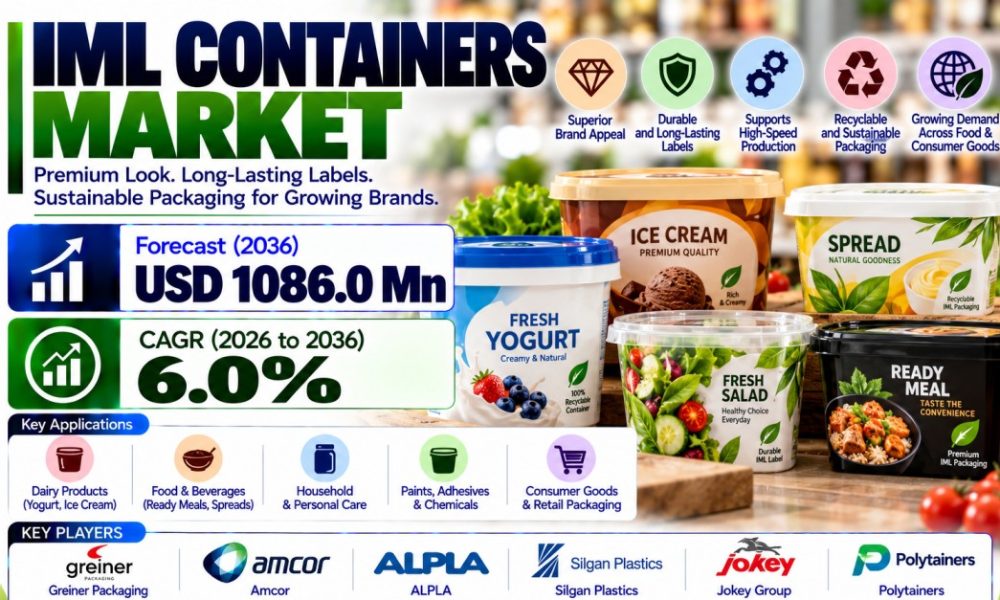
The global IML Containers Market is projected to grow from USD 606.4 million in 2026 to USD 1.086 billion by 2036, registering a compound annual growth rate (CAGR) of 6.0%, according to Future Market Insights (FMI). The market was valued at USD 572.1 million in 2025, reflecting continued demand for rigid containers that combine product packaging and decoration in a single manufacturing process.
In-mold labeling (IML) integrates a printed label into a container during molding. This approach can eliminate a separate labeling step for suitable applications and provide durable, high-quality graphics. Food brands and other consumer-product manufacturers use decorated containers to support product identification, shelf presentation and brand differentiation.
However, the commercial decision extends beyond appearance. Buyers must evaluate resin selection, label construction, ink behavior, filling-line compatibility and the recyclability of the complete decorated package before committing to tooling and production volumes.
👉 Get Detailed Market Forecasts, Competitive Benchmarking, and Pricing Trends: https://www.futuremarketinsights.com/reports/sample/rep-gb-35275
Standard Formats Lead Product Demand
Standard formats are projected to account for 42.0% of the format-type segment in 2026, according to FMI. Familiar container geometries can simplify tooling decisions and filling-line qualification while allowing brands to differentiate products through artwork.
Custom-engineered and premium formats remain relevant when a product requires a distinctive shape or specific functional characteristics. Recyclable-optimized formats also provide an option for brands seeking to align packaging design with end-of-life requirements.
The 250–750 ml capacity category is expected to hold 35.0% of demand in 2026. These containers can accommodate common retail portions while providing sufficient surface area for graphics and product information. PET and recycled PET (rPET) are projected to account for 31.0% of material demand, supported by transparency, stiffness and the availability of recycled grades for selected applications.
Food is forecast to represent 31.0% of end-use demand in 2026. Cups and tubs require decoration that remains legible through filling, storage, handling and retail display. Direct brand contracts are expected to account for 51.0% of sales, reflecting the coordination required among brand owners, converters and filling partners.
Recyclability Requires Whole-Pack Assessment
The recyclability of an IML container cannot be determined by resin type alone. Label stock, ink coverage and the container material must be assessed together because decoration can affect the appearance and quality of recovered material.
RecyClass reported in April 2022 that polypropylene-based IML samples generally processed through its test protocol, although inks could color recycled pellets because the decoration was not separated. The findings illustrate why recyclability claims require technical evidence for the complete construction.
Packaging Regulation (EU) 2025/40 also increases the importance of evaluating packaging design against applicable recyclability requirements. In Germany, the Zentrale Stelle Verpackungsregister’s minimum standard provides a framework for assessing the recyclability of packaging constructions.
For brand owners, the practical response is to qualify the resin, label and artwork together. That process should include testing for molding performance, filling-line compatibility and the behavior of the decorated container in the intended recycling system.
Country Growth Varies Across Markets
FMI projects the United Arab Emirates to record the fastest growth among the profiled markets, with a CAGR of 7.4% between 2026 and 2036. Saudi Arabia follows at 7.1%, while South Korea is forecast to grow at 6.8%. The United States is projected to expand at 6.5%, Germany at 6.2%, the United Kingdom at 5.9%, France at 5.6% and Japan at 5.3%.
These forecasts reflect differing market conditions, including packaging regulations, recycled-material availability and the maturity of local collection and recycling infrastructure. Suppliers must account for these differences when developing container specifications and supporting customer qualification.
Competitive Landscape
Companies profiled in the IML Containers Market include Greiner Packaging, Amcor, ALPLA, Silgan Plastics, Jokey Group and Polytainers. Their capabilities vary by molding process, container format, geographic reach and customer design support.
Recent developments cited by FMI include Greiner Packaging’s February 2025 introduction of spice-portion packaging concepts that support IML among several decoration options. In April 2025, Amcor completed its combination with Berry Global, bringing the companies’ packaging capabilities together. ALPLA also opened a second plant in Thailand in February 2025, with injection molding capabilities and a customer design center.
These developments illustrate investment in packaging production and design capabilities. For buyers, supplier selection should consider technical support, repeatable decoration, material documentation and the ability to validate a container on the intended filling line.
Nandini Roy Choudhury, Principal Consultant at Future Market Insights, said: “A resin name alone does not establish recyclability. The label, inks and container need to be assessed as one package before the brand commits to production tooling.”
Access detailed market insights: https://www.futuremarketinsights.com/reports/brochure/rep-gb-35275
Outlook to 2036
FMI forecasts the IML Containers Market to reach USD 1.086 billion by 2036, with growth at a 6.0% CAGR from 2026. As brands pursue integrated decoration and improved packaging designs, commercial success will depend on more than graphic quality or material choice alone.
Converters and brand owners will need to balance production efficiency, container performance and documented recyclability. Joint qualification of the resin, label and ink system can help reduce the risk of costly redesigns after tooling investment.
To explore how FMI Custom Research can support your strategic priorities, connect with our team at – [email protected]
About Future Market Insights (FMI)
Future Market Insights, Inc. is an ESOMAR-certified, ISO 9001:2015 market research and consulting organization trusted by Fortune 500 companies. With a global presence across the U.S., UK, India, and Dubai, FMI delivers data-driven insights across 30+ industries and 1200 markets worldwide.



