
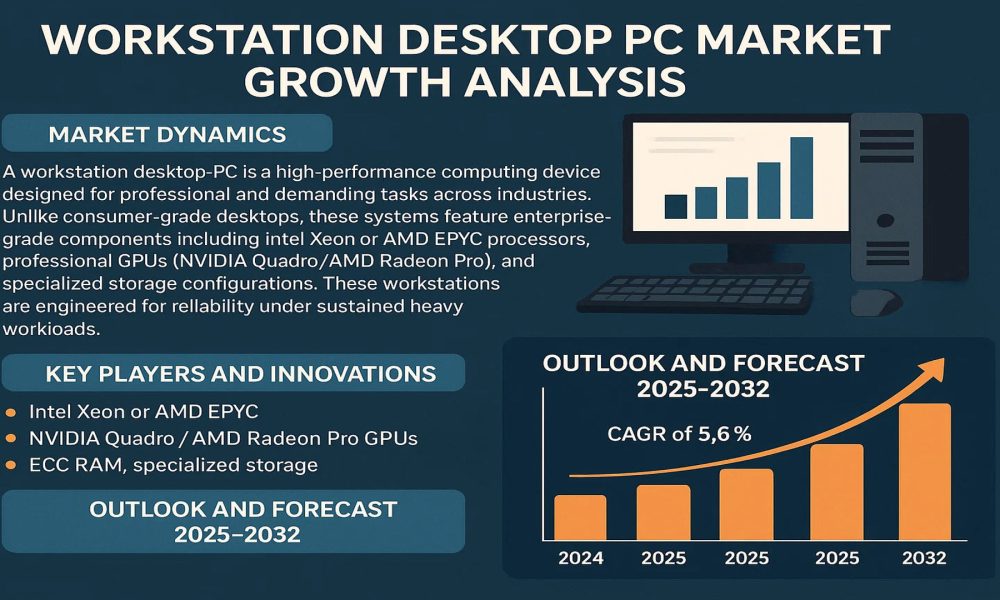
Workstation Desktop PC Market size was valued at USD 1,922 million in 2024. The market is projected to grow from USD 2,016 million in 2025 to USD 2,809 million by 2032, exhibiting a CAGR of 5.6% during the forecast period.
A workstation desktop PC is a high-performance computing device designed for professional and demanding tasks across industries. Unlike consumer-grade desktops, these systems feature enterprise-grade components including Intel Xeon or AMD EPYC processors, professional-grade GPUs (NVIDIA Quadro/AMD Radeon Pro), error-correcting memory (ECC RAM), and specialized storage configurations. These workstations are engineered for reliability under sustained heavy workloads in sectors such as engineering, architecture, media production, and scientific research.
Market growth is driven by increasing demand for compute-intensive applications like 3D rendering, AI development, and CAD/CAM workflows. The U.S. accounts for approximately 35% of global market revenue (2024), while Asia-Pacific shows the fastest growth potential. Key segments include tower workstations (holding 42% market share) and all-in-one configurations gaining traction in design studios. Major manufacturers like Dell (Precision series), HP (Z series), and Lenovo (ThinkStation) continue to dominate, collectively controlling over 60% of the professional workstation market.
Claim Your Free Sample Report- https://www.intelmarketresearch.com/download-free-sample/3845/workstation-desktop-pc-market
WORKSTATION DESKTOP PC MARKET DYNAMICS
MARKET DRIVERS
Increasing Demand for High-Performance Computing Across Industries Accelerates Market Growth
The workstation desktop PC market is experiencing robust growth due to surging demand across key industries requiring intensive computing power. With global digital transformation spending projected to exceed $3.4 trillion by 2026, organizations are prioritizing workstation-class hardware capable of handling complex simulations, 3D rendering, and AI workloads. Engineering sectors currently account for 32% of workstation deployments, while media/entertainment contributes another 25% market share. The adoption of resource-intensive applications like AutoCAD, MATLAB, and Adobe Creative Suite continues to push hardware requirements beyond standard PC capabilities. Furthermore, as computational fluid dynamics and finite element analysis become mainstream in product development cycles, engineering firms are increasingly investing in workstation infrastructure to maintain competitive advantage.
Advancements in GPU Technology Fuel Professional Workstation Adoption
GPU manufacturers have significantly enhanced workstation capabilities through architectural improvements. The latest professional GPUs deliver up to 2.5 times better performance in ray tracing and AI-accelerated workloads compared to previous generations. This technological leap enables media professionals to render high-resolution content 40% faster while allowing engineers to visualize complex assemblies in real-time. Major GPU vendors have also improved driver stability and certified hundreds of professional applications, ensuring optimized performance for mission-critical workflows. These advancements have expanded workstation utilization beyond traditional strongholds into emerging sectors like medical imaging and scientific research, where compute-intensive visualization drives decision-making.
Hybrid Work Environments Create New Demand for Desktop Workstations
The shift toward hybrid work models has unexpectedly boosted workstation desktop sales as organizations seek to equip both office and home workspaces with professional-grade hardware. While mobile workstations remain popular for field work, many knowledge workers require stationary high-performance systems at multiple locations. IT departments report configuring up to 35% of their workforce with duplicate workstation setups to maintain productivity across locations. This trend complements the growing preference for dedicated hardware over virtualization in creative fields where latency and real-time performance are critical. Additionally, enterprise workstation purchases have increased as companies standardize hardware to streamline support and security management across distributed teams.
MARKET OPPORTUNITIES
Emerging Markets Present Untapped Growth Potential
Developing economies represent the most significant expansion opportunity as digital transformation accelerates across Asia, Latin America, and Africa. Governments in these regions are actively promoting local technology ecosystems through tax incentives and infrastructure investments. The engineering services market in Southeast Asia alone is projected to grow at 8.3% CAGR through 2030, creating substantial demand for professional computing hardware. Local workstation manufacturers are gaining traction by offering price-optimized configurations tailored to regional software ecosystems and power environments. Furthermore, educational institutions are establishing dedicated workstation labs to equip students with industry-relevant skills, building future demand pipelines.
Edge Computing Integration Opens New Application Areas
Workstation capabilities are expanding beyond traditional office environments through edge computing implementations. Industrial facilities are deploying ruggedized workstations directly on factory floors for real-time quality control and machine vision applications. These systems combine traditional workstation processing power with industrial I/O capabilities and specialized cooling solutions. The manufacturing sector’s edge computing investments are forecast to grow at 22% annually, creating fresh demand for purpose-built workstation solutions. Similarly, scientific field research increasingly utilizes portable workstation configurations capable of processing complex datasets without cloud connectivity, opening new vertical market opportunities.
Segment Analysis:
By Type
Tower Workstations Lead the Market with Superior Performance for Demanding Professional Applications
The global workstation desktop PC market is segmented based on type into:
- Micro/Mini Workstations
- All-in-One (AIO) Workstations
- Small Form Factor (SFF) Workstations
- Tower Workstations
By Application
Commercial Use Dominates Market Share with Increasing Adoption Across Enterprise Workflows
The market is segmented based on application into:
- Commercial Use
- Gaming Use
- Others
By Processor
Intel Xeon Processors Maintain Market Leadership in Professional Workstation Segment
Key processor segments include:
- Intel Xeon
- AMD EPYC/Ryzen Threadripper
- Others
By End User
Engineering & Architecture Sector Represents Largest Adoption Base for High-End Workstations
Primary end user segments are:
- Engineering & Architecture
- Media & Entertainment
- Scientific Research
- Financial Services
- Education
List of Key Workstation Desktop PC Manufacturers
- Dell Technologies (U.S.)
- HP Inc. (U.S.)
- Lenovo (China)
- Intel Corporation (U.S.)
- Gigabyte Technology (Taiwan)
- Acer Inc. (Taiwan)
- Corsair (U.S.)
- Puget Systems (U.S.)
- Velocity Micro (U.S.)
- Supermicro (U.S.)
- AMD (U.S.)
- NVIDIA (U.S.)
Demand for High-Performance Computing Drives Growth in the Workstation Desktop PC Market
The global workstation desktop PC market continues to expand as professionals across industries require powerful computing solutions to handle increasingly complex workloads. With the market projected to grow from $1922 million in 2024 to $2809 million by 2032, representing a 5.6% CAGR, manufacturers are racing to meet demand for systems capable of handling data-intensive applications. Unlike consumer-grade computers, workstation desktops feature enterprise-class components like Intel Xeon and AMD EPYC processors, professional-grade GPUs, and ECC memory that deliver the stability and performance required for CAD, 3D rendering, AI development, and scientific simulations. The rise of 4K/8K content creation and real-time ray tracing has particularly fueled demand for workstations with high-end NVIDIA RTX or AMD Radeon Pro graphics.
Emerging Trends in Workstation Design
Compact Form Factors Gain Popularity
While tower workstations still dominate market share, the Micro/Mini workstation segment is showing the fastest growth as professionals seek powerful yet space-efficient solutions. Advances in thermal design and component miniaturization now allow workstation-level performance in smaller footprints, with manufacturers introducing innovative cooling solutions to maintain stability under load. The demand for Small Form Factor (SFF) workstations has increased by approximately 18% year-over-year as architectural firms, engineering consultancies, and media production houses opt for more flexible workspace arrangements without compromising computing power.
Claim Your Free Sample Report- https://www.intelmarketresearch.com/download-free-sample/3845/workstation-desktop-pc-market
Recent Developments in the Workstation Desktop PC Market
- AI and Machine Learning Integration
- Major players are launching workstation desktops optimized for AI workloads, deep learning, and data science applications.
- Companies like Dell, HP, and Lenovo are integrating NVIDIA RTX GPUs, Intel Xeon processors, and AMD Threadripper Pro CPUs to support high-performance AI model training and inference.
- Next-Gen Processors & GPUs Adoption
- The market is witnessing strong adoption of Intel Xeon W-3400/W-2400 Series, AMD Ryzen Threadripper PRO 7000 WX-Series, and NVIDIA RTX 6000 Ada Generation GPUs.
- These new components are designed for 3D rendering, simulation, CAD, VR/AR, and engineering workloads.
- Hybrid & Remote Work-Oriented Workstations
- With the rise of remote and hybrid work, vendors are introducing compact and energy-efficient desktop workstations with cloud-based collaboration tools.
- Dell and Lenovo have been focusing on ISV-certified small form-factor workstations to fit modern workspace needs.
- Sustainability and Energy Efficiency
- Workstation manufacturers are increasingly adopting eco-friendly designs with recyclable materials, lower power consumption, and improved cooling efficiency.
- HP introduced sustainable workstation lines with ocean-bound plastics and reduced carbon footprint certifications.
- Workstation Virtualization & Cloud Workstations
- Cloud-based workstation solutions are gaining traction, allowing engineers and designers to access high-performance desktops virtually.
- Partnerships between NVIDIA (Omniverse, RTX Virtual Workstations) and OEMs are shaping the hybrid workstation ecosystem.
- Security-Focused Workstations
- With cybersecurity concerns rising, workstation desktops now come with hardware-level security features like Trusted Platform Module (TPM) 2.0, Intel vPro, AMD PRO security, and BIOS protection.
- Industry-Specific Customization
- Vendors are tailoring workstation solutions for industries like media & entertainment, architecture, healthcare imaging, and financial modeling.
- For example, Dell and HP launched VR-ready and AR-ready workstations for immersive design and training applications.
About Intel Market Research
Intel Market Research delivers actionable insights in technology and infrastructure markets. Our data-driven analysis leverages:
- Real-time infrastructure monitoring
- Techno-economic feasibility studies
Competitive intelligence across 100+ countries
Trusted by Fortune 500 firms, we empower strategic decisions with precision.
International: +1(332) 2424 294 | Asia: +91 9169164321
Website: https://www.intelmarketresearch.com
Follow us on LinkedIn: https://www.linkedin.com/company/intel-market-research




