
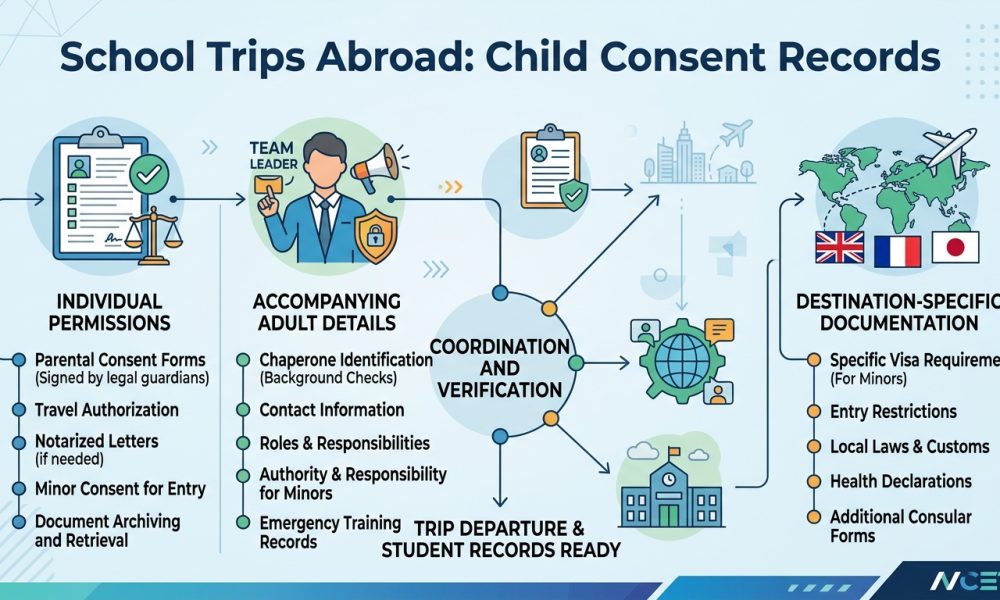
Organizers planning international school trips must coordinate each student’s travel permission, accompanying adult details, and destination requirements, while recognizing that a school participation form may serve a different purpose than documents requested by airlines or border authorities.
WASHINGTON, DC, October 17, 2026: International school trips require organizers to reconcile group arrangements with individual circumstances, because students sharing a classroom, itinerary and supervising teacher may have different nationalities, parenting arrangements and documentation requirements affecting their ability to travel.
A completed school permission form can record a family’s agreement to participate. Still, organizers should confirm whether it also provides the Information and formalities needed to demonstrate permission for the child’s specific international journey and accompanying adults.
The practical challenge is to assemble accurate records early enough to resolve missing signatures, inconsistent details or destination requirements, while protecting sensitive family Information and ensuring that responsible staff can access essential documents throughout the outward and return journeys.
Group Travel Still Requires Individual Preparation
Canada’s guidance on consent letters for children traveling abroad specifically includes school groups and recommends written permission when children travel without their parents or legal guardians. However, Canadian law does not require the letter itself.
For organizers, the important operational distinction is that a group booking describes the traveling party. At the same time, each student’s records must support that individual’s identity, permission, and eligibility under the rules relevant to the journey.
A practical preparation system should therefore track each student separately, identifying which documents have been reviewed, which questions remain unresolved and who is responsible for obtaining the missing Information before the school confirms readiness for departure.
That approach also helps families receive specific requests rather than repeated general reminders, so a parent can understand whether the outstanding issue concerns a signature, passport detail, legal arrangement, or destination requirement affecting their child’s participation.
School Approval and Border Documentation Serve Different Purposes
The Department for Education’s guidance for England distinguishes routine visits from trips that require additional planning and identifies overseas visits as involving extra risks, showing why an international journey deserves assessment beyond the arrangements used for ordinary classroom outings.
A school’s internal approval process may address educational objectives, activities, and supervision. In contrast, travel documentation addresses separate questions about identity, permission, and entry or exit conditions that the school’s authorization alone cannot safely be assumed to resolve.
Organizers should compare their participation form’s contents with the requirements for the journey, determining whether one document can adequately serve several purposes or whether additional records are needed for particular students and destinations.
A signature should also be understood in context, because agreement to an activity, acknowledgment of a school policy, and permission for international travel are different matters that should be explained clearly to the person completing the paperwork.
Establish Who Can Authorize Each Student’s Travel
The school should identify who has the relevant authority to consent, considering the student’s current family arrangements rather than assuming that the first adult listed as an emergency contact can make every decision about an international journey.
Government guidance on taking children abroad in England and Wales explains that, subject to specified exceptions, permission from those with parental responsibility or a court may be necessary, showing why legal arrangements must be examined rather than inferred from school records.
When a family reports an order or restriction affecting travel, designated staff should seek guidance through the school’s established process and avoid informal interpretations by a teacher who may lack the relevant expertise or complete documentation.
Handle sensitive circumstances privately and early, giving families time to clarify authority or obtain necessary decisions without requiring the student to explain personal legal matters in front of classmates during final preparations or airport check-in.
Describe the Actual Journey Clearly
A useful consent record should identify the student, the responsible accompanying adult, and the intended journey, with clear dates and destinations, so the arrangement can be explained without relying on an unrelated email or verbal understanding.
Organizers should maintain one authoritative itinerary for preparation, check that the Information supplied to families matches the bookings, and identify material changes that require another review of permissions, supporting records, or the school’s own approval arrangements.
For example, a hypothetical change from a direct flight to an overnight connection in another country could raise questions not addressed in the original Information package, making the updated route relevant to documentation as well as logistics.
Families should know how changes will be communicated and who can answer questions, so the consent process reflects an informed understanding of the trip rather than a signature obtained before essential arrangements are in place.
Identify Accompanying Adults and Their Responsibilities
The records should let you link each student to the adults responsible for the journey, especially when teachers, parent volunteers, or staff from an outside organization share supervision at different stages of the itinerary.
A recommended group document would identify the school, trip leader, and contact arrangement. In contrast,e individual permission records and any required supporting documents explain the student’s participation without relying entirely on a general statement that everyone belongs to the same class.
If the lead teacher changes before departure, organizers should review affected records instead of assuming every authorization automatically covers an unnamed replacement, check the applicable requirements, and obtain updated documentation when the change makes that necessary.
Apply the same attention when students travel in separate groups, because the adult named in one set of papers may not be present with a particular child during a connecting journey, early return, or separately arranged departure.
Check Destination and Transit Rules for Each Traveler
The State Department’s guidance on travel with minors explains that countries can impose different requirements for children traveling without a parent, including formal consent or evidence of custody, making destination research an essential part of planning an international school visit.
Organizers should assess requirements based on each student’s nationality and travel documents, rather than assuming that enrollment at a local school means every participant has the same citizenship or qualifies for the same entry arrangements as the majority.
The review should cover transit and the return journey, as well as arrival, with questions directed to the relevant authorities when an itinerary, nationality, or residence situation makes the applicable rules unclear for a particular student.
A useful planning record would identify the official source checked and the review date, helping staff revisit an answer if circumstances change rather than relying on an undocumented assurance carried forward from a previous school trip.
Age and Citizenship Can Change the Documentation Picture
Canada’s guidance on children’s travel documents notes that the definition of a minor differs between jurisdictions, so assess a student’s age against the relevant rules rather than only the school’s grade classification or local expectations.
An older student should not automatically be treated as exempt from child travel requirements simply because they manage their own bookings or hold a passport issued under an adult Application process, since those circumstances answer different administrative questions.
Dual nationality can also affect how another country treats the student, so families should disclose relevant travel-document circumstances through an appropriate confidential process and seek official clarification where the destination may apply rules associated with its own citizens.
As a planning measure, the school should explain that collecting this Information supports accurate preparation, limit access to those who need it, and avoid unnecessary circulation of students’ nationality or immigration details within the wider group.
Review Signatures, Originals and Required Formalities
Canada recommends original signed consent letters and strongly recommends having a notary witness the signature, while acknowledging that other countries may impose their own requirements and may not regard a general consent letter as sufficient for their purposes.
Organizers should distinguish a recommendation from a legal requirement and establish which formalities apply to the actual itinerary, avoiding a blanket instruction that every school trip worldwide requires the same notarization, translation, or document Authentication process.
A document review should confirm the requested signatures are present and that any required witnessing or certification is complete, giving families time to correct issues before the records are packed for departure.
Digital copies can support administrative preparation, but staff should verify whether originals or other specified formats must accompany the group, rather than assuming a scanned signature or photo on a phone will be accepted wherever the students travel.
Keep Passport Checks Separate From Permission Checks
Passport preparation should review each student’s required documents and suitability for the intended journey. In contrast, consent preparation should establish permission and supporting arrangements, ensuring that completing one review does not hide an unresolved issue in the other.
Canadian guidance identifies passports and possible supporting records such as birth certificates and relevant family documents, reinforcing that a child’s travel file may contain several kinds of evidence serving distinct purposes during an international journey.
For families interested in electronic document checks, Amicus International Consulting’s guide to scanning a passport’s NFC chip and understanding the results explains technical questions that remain separate from whether a student has the necessary permission to travel with the school.
An electronic reading should therefore never be recorded as confirmation that the consent file is complete, and organizers should avoid collecting additional biometric or chip Information merely because a consumer Application makes that Information available to a device user.
Separate Travel Consent From Health and Activity Arrangements
A school should review medical Information, emergency contacts, and activity permissions through its established procedures, checking what the destination and planned activities require rather than assuming a general travel letter resolves every care-related question.
England’s guidance on health and safety during educational visits calls for emergency and communication plans and clear responsibilities when outside organizations are involved, providing a useful example of operational planning that extends beyond collecting parental signatures.
As a practical measure, the trip leader should know how to obtain necessary Information if a student needs assistance, while the school should establish who can contact the family and coordinate decisions if an unexpected situation interrupts the itinerary.
Any proposed change involving a substantially different activity should receive the appropriate assessment and authorization, rather than being treated as covered simply because families originally agreed to an overseas visit with the school and its accompanying staff.
Protect Sensitive Records While Keeping Them Accessible
Consent files can contain names, signatures, contact Information, and details about family arrangements, so organizers should use theschool’ss approved handling procedures and collect Information for defined purposes instead of placing complete records in broadly shared group folders.
A practical access plan should identify which staff need which documents, how essential records will remain available during travel, and how to reach a backup if the principal folder or device becomes unavailable at a critical moment.
For example, if the trip leader accompanies a student to a hospital, the remaining staff should be able to locate the records needed for their group, making continuity of access an important organizational consideration.
After the trip, staff should handle records according to the school’s applicable retention and privacy obligations, following established instructions rather than keeping copies indefinitely or deleting documents the institution must retain.
Plan for Withdrawals, Substitutions and Separate Returns
A student withdrawing, an adult being replaced, or a family arranging a different return journey can change the assumptions reflected in the consent records, so organizers should establish a clear process to review these changes before implementing them.
For a hypothetical early collection by a relative overseas, the school should confirm the applicable authority, identity, and agreed handover arrangements through its procedures, rather than releasing the student solely because the adult describes a family connection.
If permission is disputed or a relevant restriction becomes known, staff should promptly escalate the issue to the responsible school officials and appropriate advisers, ensuring departure decisions reflect the actual legal position rather than pressure to preserve the group schedule.
Families should also understand the practical deadline for resolving outstanding matters so they can respond. At the same time, there is still time to clarify and avoid assuming that payment for the trip guarantees participation regardless of unresolved documentation.
Use the Final Review to Confirm Readiness
Before departure, organizers should reconcile the final participant list, accompanying adults, itinerary, and individual records, ensuring changes made during planning reach the people responsible for carrying documents and supervising students at each stage.
A briefing should cover where forms are held, who keeps and handles them, and when families receive an age-appropriate explanation of the journey and instructions for staying with their assigned group.
The final review should also confirm that the appropriate person has resolved unresolved issues, rather than merely marking them as paperwork pending in a spreadsheet that no one has checked against the actual departure arrangements.
For international school trips, reliable preparation means coordinating individual permissions with the actual journey, giving families clear Information, and ensuring staff have the records and procedures needed to support each student throughout the visit and return home.




