
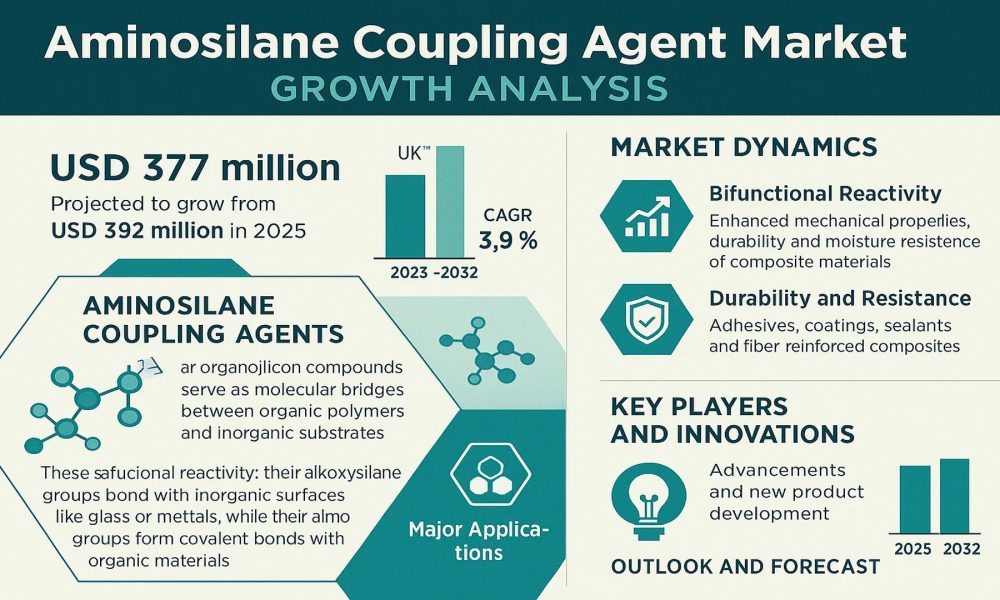
Aminosilane Coupling Agent Market size was valued at USD 377 million in 2024. The market is projected to grow from USD 392 million in 2025 to USD 492 million by 2032, exhibiting a CAGR of 3.9% during the forecast period.
Aminosilane coupling agents are organosilicon compounds that serve as molecular bridges between organic polymers and inorganic substrates. These specialty chemicals feature bifunctional reactivity: their alkoxysilane groups bond with inorganic surfaces like glass or metals, while their amino groups form covalent bonds with organic materials. This dual functionality significantly enhances the mechanical properties, durability, and moisture resistance of composite materials. Major applications span across adhesives, coatings, sealants, and fiber-reinforced composites where interfacial bonding is critical.
The market growth is driven by increasing demand from end-use industries, particularly in the Asia-Pacific region where construction and automotive sectors are expanding rapidly. While China’s market size is projected to reach significant valuation by 2032, North America maintains strong demand due to advanced manufacturing sectors. Key players like Shin-Etsu and Evonik dominate the market, collectively holding substantial revenue share through innovative product development and strategic collaborations.
Claim Your Free Sample Report- https://www.intelmarketresearch.com/download-free-sample/3846/aminosilane-coupling-agent-market
MARKET DYNAMICS
MARKET DRIVERS
Expanding Composite Materials Industry to Fuel Aminosilane Coupling Agent Demand
The global composites market, valued at over $100 billion in 2023, is creating significant demand for aminosilane coupling agents. These specialty chemicals play a crucial role in improving the interfacial adhesion between organic polymers and inorganic reinforcements like glass fibers. The lightweight and high-strength properties of composites make them indispensable in aerospace and automotive applications, where manufacturers increasingly adopt these materials to meet stringent emission regulations. For instance, the aerospace composites sector alone is projected to grow at a CAGR of 7.5% through 2030, directly correlating with increased aminosilane coupling agent consumption.
Growth in Construction Chemicals Sector to Boost Market Expansion
The construction industry’s rapid development, particularly in emerging economies, is driving substantial demand for high-performance adhesives and sealants that incorporate aminosilane coupling agents. These additives significantly improve product performance in challenging environmental conditions, with the global construction chemicals market expected to reach $70 billion by 2028. Major infrastructure projects across Asia-Pacific nations, where construction spending exceeds $1 trillion annually, particularly benefit from the moisture resistance and enhanced durability provided by silane coupling agents in concrete admixtures and protective coatings.
Furthermore, the push for sustainable construction materials aligns perfectly with the functional benefits of aminosilane coupling agents. Their ability to reduce material consumption while improving performance makes them increasingly valuable in green building applications.
MARKET OPPORTUNITIES
Emerging Electric Vehicle Battery Applications to Create New Growth Avenues
The rapid growth of the electric vehicle sector, projected to reach 45 million units annually by 2030, presents exciting opportunities for aminosilane coupling agent applications. These chemicals play a crucial role in battery component manufacturing, particularly in improving the adhesion and thermal stability of electrodes and separators. Recent developments in solid-state batteries, where global R&D investments exceeded $2 billion in 2023, specifically utilize modified silanes to enhance interfacial properties between different battery components.
Advancements in Nanotechnology to Drive Product Innovation
The nanotechnology sector offers significant potential for aminosilane coupling agent applications, particularly in surface modification of nanoparticles. The global nanomaterials market, growing at over 15% CAGR, increasingly utilizes these coupling agents to functionalize nanoparticles for various advanced applications. Recent breakthroughs in quantum dot displays and targeted drug delivery systems demonstrate how modified silanes can enable precise control over surface interactions at the nanoscale, opening new possibilities in electronics and biomedical applications.
Segment Analysis:
By Type
Monoamino Type Leads Market Share Due to Versatile Applications in Adhesives & Sealants
The market is segmented based on type into:
- Monoamino Type
- Diamino Type
- Others
By Application
Adhesives and Sealants Segment Dominates Owing to Strong Bonding Requirements Across Industries
The market is segmented based on application into:
- Adhesives and Sealants
- Composite Material
- Rubber Products
- Others
By End User Industry
Automotive Sector Accounts for Major Consumption Driven by Lightweight Material Trends
The market is segmented by end user industry into:
- Automotive
- Construction
- Electronics
- Aerospace
- Others
List of Key Aminosilane Coupling Agent Companies Profiled
- Shin-Etsu Chemical Co., Ltd. (Japan)
- Evonik Industries AG (Germany)
- Dow Chemical Company (U.S.)
- Momentive Performance Materials (U.S.)
- Wacker Chemie AG (Germany)
- HENGDA Chemical (China)
- SiSiB SILICONES (China)
- Gelest Inc. (U.S.)
- Nitrochemie GmbH (Germany)
- Sinograce Chemical Co., Ltd. (China)
AMINOSILANE COUPLING AGENT MARKET TRENDS
Growing Demand in Composite Materials to Drive Market Expansion
The global aminosilane coupling agent market is witnessing significant growth, primarily driven by the increasing demand for high-performance composite materials in industries such as automotive, aerospace, and construction. These agents play a crucial role in enhancing the bonding between organic polymers and inorganic fillers, improving mechanical strength, thermal stability, and chemical resistance. The market is projected to grow from $377 million in 2024 to $492 million by 2032, growing at a CAGR of 3.9% during the forecast period. The U.S. and China remain dominant markets, with China showing robust growth due to rapid industrialization and infrastructure development. Innovations in silane chemistry, such as the development of eco-friendly and water-based formulations, are further catalyzing market expansion, addressing stringent environmental regulations and sustainability goals.
Other Trends
Rising Adoption in Adhesives and Sealants
Aminosilane coupling agents are increasingly being utilized in adhesives and sealants to improve durability and moisture resistance. With the construction sector expanding globally, especially in emerging economies, demand for high-performance adhesives has surged. These agents enhance adhesion to substrates like glass, metals, and ceramics, making them indispensable in manufacturing processes. The monoamino type segment, in particular, is expected to witness strong growth due to its versatility in formulations, while the diamino type finds increased use in highly demanding industrial applications.
Claim Your Free Sample Report- https://www.intelmarketresearch.com/download-free-sample/3846/aminosilane-coupling-agent-market
Recent Developments in the Aminosilane Coupling Agent Market
1. Rising Demand in Adhesives & Sealants
- Major adhesive manufacturers have increased the adoption of aminosilane coupling agents due to their excellent bonding properties with inorganic substrates like glass, metals, and ceramics.
- In 2024–2025, new formulations of silane-based adhesives with improved thermal stability and water resistance were introduced, targeting automotive and construction industries.
2. Expansion in Composite Materials
- The growing use of glass fiber-reinforced plastics (GFRP) in wind turbines, aerospace, and automotive has fueled the demand for aminosilanes as surface treatment agents.
- Companies are investing in research to develop low-VOC, eco-friendly coupling agents that comply with environmental regulations such as REACH and EPA standards.
3. Innovations in Paints & Coatings
- In mid-2025, leading coating producers integrated aminosilane-modified resins to enhance corrosion resistance and adhesion on metal surfaces.
- Recent R&D is focused on developing multifunctional silanes that provide anti-scratch, anti-corrosion, and hydrophobic properties in coatings.
4. Strategic Collaborations & Capacity Expansion
- Global chemical giants like Evonik, Shin-Etsu Chemical, and Momentive have expanded production capacities to meet rising demand in Asia-Pacific.
- Several mergers and collaborations were reported in 2024–2025, aiming at strengthening regional supply chains and reducing dependency on imports.
5. Focus on Green & Sustainable Chemistry
- A key trend in 2025 is the shift toward bio-based and solvent-free aminosilane coupling agents.
- Manufacturers are investing in sustainable silane synthesis methods to reduce carbon footprint and comply with stringent environmental policies.
6. Increasing Role in Electronics & Semiconductors
- With rapid semiconductor advancements, aminosilane coupling agents are being used for surface modification and dielectric layer enhancement.
- Companies are developing ultra-pure aminosilane grades tailored for microelectronics, especially for chip packaging and advanced circuit boards.
About Intel Market Research
Intel Market Research delivers actionable insights in technology and infrastructure markets. Our data-driven analysis leverages:
- Real-time infrastructure monitoring
- Techno-economic feasibility studies
Competitive intelligence across 100+ countries
Trusted by Fortune 500 firms, we empower strategic decisions with precision.
International: +1(332) 2424 294 | Asia: +91 9169164321
Website: https://www.intelmarketresearch.com
Follow us on LinkedIn: https://www.linkedin.com/company/intel-market-research




