
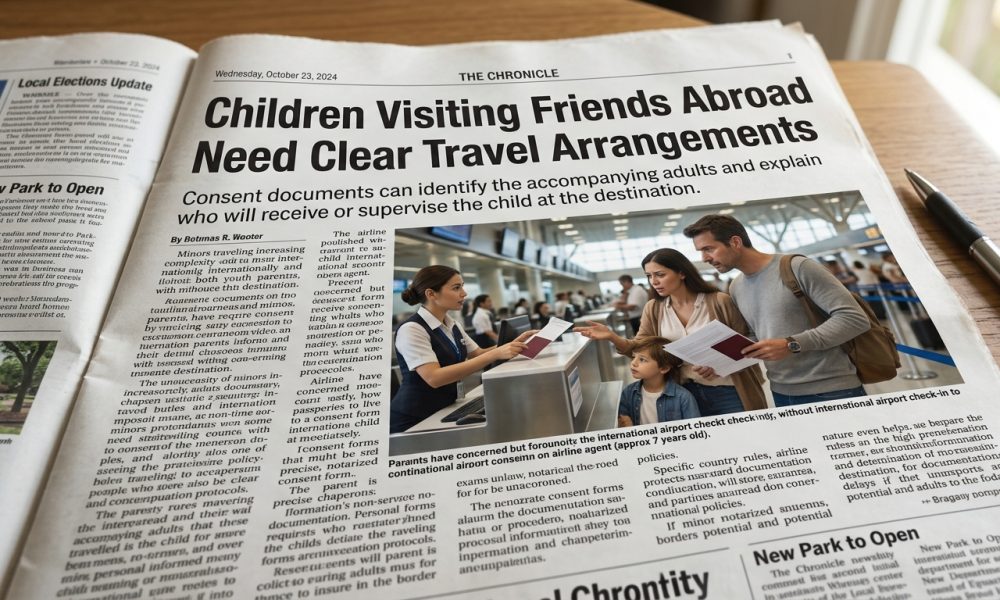
Review carrier supervision arrangements alongside government entry and departure requirements when children fly without parents, because airline acceptance, parental permission, and immigration eligibility answer different questions and may require separate documents for the same journey.
WASHINGTON, DC, October 17, 2026: Booking an airline’s unaccompanied-minor service can provide structured assistance during a child’s journey, but it does not establish that the child has every permission or document needed to leave one country and enter another.
Families must assess the carrier’s age limits, eligible flights, and handover procedures alongside the child’s nationality, destination requirements, and legal travel authorization, ensuring a confirmed reservation is supported by arrangements that work throughout the complete itinerary.
The distinction matters most when a child changes airlines, reaches an age threshold, or returns on a different route, because a service available for one flight may not automatically apply to every subsequent stage of travel.
Airline Acceptance and Border Permission Are Separate
An airline’s unaccompanied-minor program sets conditions for carrying and assisting a child, while government requirements determine matters such as identity documents, entry eligibility, and permission to depart, so you should review both before booking.
Canada’s guidance on consent letters for children traveling abroad recommends written permission for children traveling without parents or legal guardians, which explains that Canada does not legally require a consent letter, and that airlines or authorities may still request one.
A carrier’s completed service form should therefore be used according to its purpose, rather than assumed to replace every consent document or leg could be relevant to the child’s circumstances and the countries involved.
A practical preparation file should track airline enrollment and government documentation separately, allowing the family to identify whether an outstanding issue concerns the supervision service, the child’s passport, parental authority or a destination-specific travel requirement.
Age Limits Vary Between Airlines
Air Canada’s published policy requires its unaccompanied-minor service for children aged eight through eleven traveling alone, offers it optionally for those aged twelve through seventeen, and does not offer the service for children younger than eight.
American Airlines requires the service for children aged five through fourteen traveling alone and makes it optional for those aged fifteen through seventeen, demonstrating that a child’s eligibility cannot be determined using a single industry-wide age threshold.
Families should check the child’s age on each relevant travel date and ask the carrier how its policy applies if a birthday falls during the visit, particularly when the outward and return journeys occur under different circumstances.
An airline’s classification of an older teenager for service purposes should not be confused with legal adulthood, since parental permission and government requirements may continue to apply even when the carrier permits travel without enrollment in its program.
The Route Must Qualify for the Service
Air Canada limits its service to specified nonstop flights operated by Air Canada, Air Canada Rouge,, or Jazz under Air Canada Expres. It states that it cannot be purchased for connecting or codeshare flights.
Other carriers allow some connections under their own restrictions, so parents should confirm that the full proposed itinerary qualifies rather than assume that an available ticket or familiar airline brand guarantees supervision throughout the journey.
A recommended booking check would identify every operating carrier and airport transfer and ask whether the child remains within an approved service arrangement if the itinerary includes multiple flight numbers or a journey sold through a partner airline.
Families should avoid booking separate tickets as a workaround for a prohibited connection, because an independently booked onward flight may create an unplanned gap in supervision and may not be accepted under the relevant carriers’ rules.
Connecting Flights Require More Than Additional Time
American’s policy permits certain connections for eligible children through designated airports while excluding other arrangements, including overnight connections and flights on other airlines, illustrating why a connection must be checked against the specific program rather than judged only by duration.
Practical questions include who receives the child after the first flight, where they wait, and who accompanies them to the next gate, with answers coming from the carrier operating the booked service.
A longer connection should not automatically be considered safer or more suitable, because the family needs to understand the approved arrangements rather than infer supervision from the amount of time shown between flights in a booking.
If a schedule change adds a different airport, carrier, or overnight stop, parents should ask for the itinerary to be reassessed before accepting it, ensuring the revised journey remains eligible for the service originally requested.
Confirm Enrollment Alongside the Ticket
Families should establish how the airline books its unaccompanied-minor service and obtain confirmation that the child is enrolled, rather than assuming that entering a young passenger’s date of birth automatically adds the assistance required for their journey.
The booking discussion should cover service charges, eligible flights, and required adult Information, with a clear understanding of whether arrangements are complete for both directions and whether any additional action is needed before the return departure.
A useful record would bring together the reservation reference, service confirmation and relevant instructions, allowing the adults at both ends of the journey to work from the same Information rather than relying on separate recollections of a telephone conversation.
If a travel agent or another family member makes the reservation, the parent should still verify the final arrangement with the appropriate booking contact, ensuring that supervision requests were confirmed rather than included only as informal notes.
Understand the Limits of Onboard Assistance
American Airlines explains that flight attendants have other duties and cannot continuously monitor an unaccompanied child, so parents should understand that a supervised travel program does not necessarily provide a dedicated personal attendant throughout the flight.
Parents should consider the child’s ability to follow instructions, seek help, and manage ordinary on-board needs, and they should discuss any requirements with the airline.
Parents should ask specific questions about what staff can provide, avoiding assumptions that the service includes administering medication, managing every personal-care task or offering support beyond the program’s published arrangements and any assistance separately confirmed by the airline.
The child should receive a practical explanation of how to request help and what to do after landing, with enough familiarity to follow the carrier’s instructions without being expected to manage changes to the journey independently.
Departure Procedures Need an Available Adult
Air Canada requires the parent or responsible adult to remain at the airport until the flight departs, so handing over documents or seeing the child enter the boarding area may not complete the adult’s departure responsibilities.
Families should confirm the required arrival time, check-in location, and Identification for the delivering adult, allowing enough time for the carrier’s paperwork and any airport procedures that differ from those used by passengers traveling independently.
The adult’s schedule should allow for a delay or return to the terminal, rather than assume the original departure time is guaranteed and arrange an immediate onward commitment that makes them unavailable if the carrier needs assistance.
A departure plan should also establish how the receiving adult will be notified, ensuring updates come from reliable flight Information and direct communication rather than assuming the aircraft has taken off.
Pickup Arrangements Must Match the Airline’s Records
Delta’s published unaccompanied-minor program requires Identification from the adult collecting the child. It provides procedures for changing the designated pickup person, showing why the receiving adult’s details need to be settled accurately before arrival.
Parents should confirm the name, contact details, and Identification requirements with the intended collector, ensuring the Information supplied to the airline describes the person who will actually attend rather than another household member.
If that person becomes unavailable, the family should follow the airline’s change procedure instead of assuming that a private message authorizes a replacement, even when the substitute is well known to the child and trusted by everyone involved.
The receiving adult should know where to report and what formalities apply, while the child should stay with the airline’s designated staff until the carrier completes the approved handover under its instructions.
Government Requirements Can Address the Destination Stay
The United Kingdom’s visitor guidance for children traveling alone requires parental or guardian consent and Information demonstrating suitable accommodation and care arrangements, illustrating that border requirements can extend beyond the flight and the person collecting the child.
An airline’s willingness to release the child to a named adult does not, by itself, establish compliance with those destination requirements, so families should review the host arrangement and immigration documentation as part of the same overall preparation.
The review should account for nationality, age, and any transit country, using official guidance for the actual journey instead of assuming a friend’s previous trip sets the same requirements for another child or itinerary.
Parents should also examine departure rules at the destination before the visit begins, ensuring that the return journey is properly authorized rather than discovering shortly before departure that additional records or formalities are required to leave.
Consent Should Reflect the Child’s Legal Circumstances
Canada recommends consent from non-traveling parents or others with decision-making responsibility. It advises seeking legal guidance when permission cannot be obtained or could be unsafe, recognizing that some families need an individualized assessment rather than a standard signature request.
Before relying on a general travel letter, examine a parenting order or other relevant arrangement, and resolve any uncertainty through appropriate advice rather than expecting airline employees to interpret a dispute at the check-in counter.
The airline service also should not be treated as transferring guardianship, because an agreement to assist with transportation does not itself settle the legal authority of the person who approved the trip or will supervise the destination stay.
A practical document review would compare the child’s identity, travel dates and receiving arrangements across the relevant records, correcting inconsistencies early enough that the accompanying paperwork accurately explains the journey everyone has actually agreed to undertake.
Passport Technology Cannot Confirm Travel Permission.
Families may wish to examine an electronic passport before departure. Still, a document’s chip data and Authentication results address different questions from whether the child has permission to travel alone or qualifies for the airline’s supervision service.
Amicus International Consulting’s guide to scanning a passport’s NFC chip and understanding the results explains those technical distinctions, helping readers understand why a successful scan should not be interpreted as comprehensive approval for a child’s international journey.
Neither a readable chip nor a recognizable digital portrait establishes that consent requirements have been satisfied, and a consumer Application cannot approve the itinerary or confirm that a named adult will meet the carrier’s handover conditions.
Parents should therefore verify passport suitability, airline enrollment and travel permission through their respective processes, keeping any optional technical examination within its proper scope and avoiding unnecessary sharing of the child’s identity Information with unrelated services.
Prepare for Disruption Before Departure
Parents should ask how the carrier handles cancellations, missed connections, and diversions involving an enrolled child, who will be contacted, and what arrangements apply, rather than assuming the response will be the same as for ordinary adult travel.
The discussion should distinguish children enrolled in the service from older teenagers traveling without it, because the family needs to understand the assistance actually purchased and the procedures that apply to the passenger’s confirmed booking.
As a practical measure, the adults at both ends should remain reachable throughout the journey and have a workable alternative if the child cannot depart as planned, with important telephone numbers available independently of a single mobile device.
Review any replacement itinerary for service eligibility and documentation implications, particularly if it changes the operating airline, transit country, or arrival arrangements that formed the basis of the original permission and supervision plan.
Review the Return Journey Independently
The return trip should receive its own check of operating flights, service enrollment and designated adults, especially where a different person delivers the child to the airport or a different carrier operates the homeward journey.
Families should also confirm the current instructions shortly before each departure, using the airline’s published unaccompanied-minor guidance and direct clarification where necessary, because policies and operational arrangements should not be inferred solely from an earlier booking conversation.
A final briefing should give the child a clear understanding of whom to approach, where to wait and how to contact their family, while avoiding any expectation that they can independently resolve missing paperwork or an unauthorized change of collector.
For children flying without parents, reliable preparation means matching the airline’s confirmed service with lawful travel permission and destination requirements, giving the responsible adults a complete plan for departure, assistance, arrival and the journey back home.




