
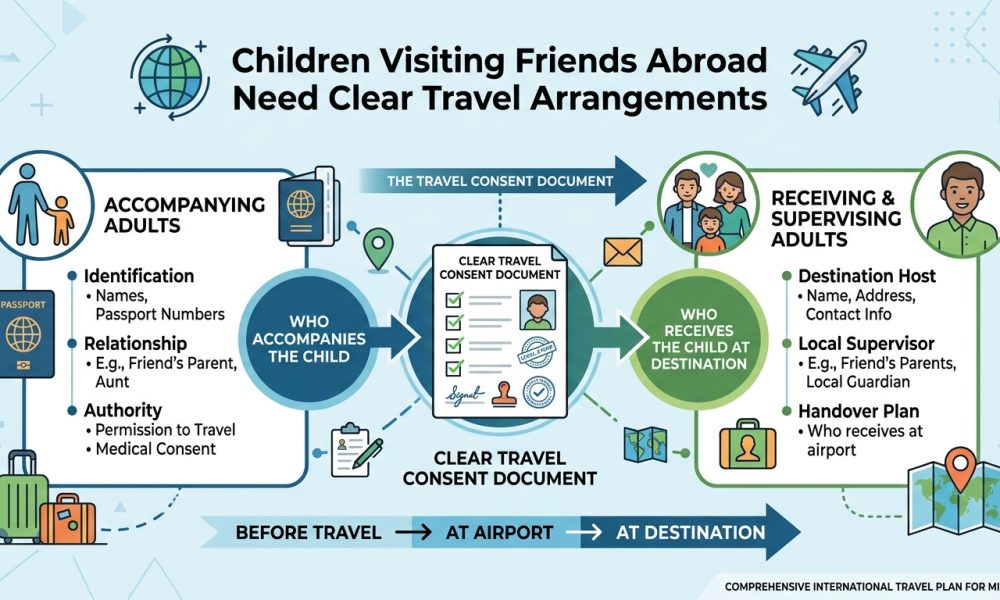
Consent documents can identify the adults accompanying a child and explain who will receive or supervise them at the destination, helping families connect permission for the journey with practical arrangements for accommodation, communication, and a safe return home.
WASHINGTON, DC, October 17, 2026: A child’s visit to friends overseas can involve several adults sharing responsibility at different stages, so clear documentation matters even when families know one another well and treat the journey as an informal holiday.
The person accompanying the flight may differ from the airport pickup contact or the adult providing accommodation. At the same time, permission to travel does not necessarily answer every question about supervision, local activities or decisions arising during the stay.
Families should therefore prepare a complete account of the arrangement, identifying who has authorized the visit, who will accompany or receive the child and how responsibility will be managed from departure through the return journey.
Begin With the Child’s Complete Itinerary
Planning should cover more than the outbound booking, with families agreeing on travel dates, the destination address, supervising adults, and return arrangements before preparing documents that might otherwise describe only part of the intended visit abroad.
A recommended written plan would distinguish the person traveling with the child from the person hosting them, ensuring that an accompanying family friend is not mistakenly presented as the adult responsible for the entire stay.
For example, a child might fly with a trusted neighbor and then spend a week with another family, requiring the documents and practical arrangements to explain both roles rather than leaving the change of supervision implicit.
This exercise also helps reveal gaps early, such as uncertainty about who will collect the child after a delayed arrival or which adult will accompany a connecting journey that was added after the original agreement.
Establish Who Can Give Permission
Before collecting signatures, the family should identify who holds the relevant parental or decision-making authority, considering current legal arrangements rather than assuming that the person purchasing the ticket can independently authorize every aspect of the journey.
Canada’s guidance recommends obtaining consent from non-traveling parents or others with decision-making responsibility and advises seeking legal advice where permission cannot be obtained or where doing so could be unsafe, recognizing that family circumstances may require individual assessment.
Where a parenting order addresses international travel, the proposed visit should be assessed against its terms, with any uncertainty resolved through appropriate advice rather than relying on an informal summary such as primary custody or usual caregiver.
The host family should receive the Information necessary to understand the agreed arrangement without being expected to resolve a dispute between adults, particularly when the question concerns whether the child may travel or remain abroad at all.
Use Consent Documents to Explain the Journey
Canada’s guidance on child travel consent letters expressly covers children traveling with friends and recommends written permission when parents or legal guardians are absent, while explaining that a consent letter is not itself a legal requirement under Canadian law.
For practical preparation, records should clearly identify the child, accompanying arrangements, and intended visit with accurate names, travel dates, and contact Information that can be checked against the booking and the adults actually involved.
A useful review would compare the consent documents with the itinerary before signing, identifying whether separate outward and return companions or different accommodation addresses require additional explanation rather than assuming one brief description covers every stage.
The document should record permission that has genuinely been given, and families should avoid describing an adult as a guardian merely because that person will supervise the visit or has been trusted with the child’s care.
Identify the Destination Host Clearly
The United Kingdom’s visitor guidance for children illustrates how destination requirements can extend to care arrangements, asking children traveling alone to provide Information about their host, accommodation, and parental permission to stay with that person.
This example demonstrates why the destination host’s role deserves attention. However, families should check the requirements of the country actually being visited rather than treat one government’s documentation expectations as a universal international standard for all children.
As a practical measure, the parent and host should confirm the address, telephone numbers, and dates directly, ensuring everyone understands whether the child will stay at one home or spend time at additional locations.
A host’s invitation may help explain the purpose and accommodation arrangements. Still, it should not be assumed to replace parental consent, any required visa, or other documents needed for the child’s nationality and journey.
Airline Services Have Their Own Handover Rules
When a child travels without an accompanying passenger, families should check the operating airline’s rules before booking, including age eligibility, available routes and the Information required about the adults delivering and collecting the child at each airport.
Air Canada’s published unaccompanied-minor guidance states that the person meeting the child must present photo Identification and sign to accept responsibility, providing a concrete example of an airline handover procedure that families must prepare for in advance.
The name provided to the carrier should accurately identify the intended collector, and any proposed replacement should follow the airline’s procedure rather than be assumed acceptable because the original host has privately approved the substitution.
An airline’s escort or handover service should be understood within its stated scope, with families arranging supervision separately after collection instead of assuming assistance during the flight extends throughout the overseas visit.
Arrival Plans Should Cover Delays and Missed Connections
A practical arrival plan should explain how the receiving adult will monitor the flight and communicate with the family, especially when a delay changes the collection time or makes the original transport arrangement difficult to maintain.
Parents should confirm the carrier’s process for disruptions involving an unaccompanied child, ask how decisions will be communicated, and what happens if the booked itinerary cannot operate, rather than relying on expectations from ordinary adult travel.
When a child travels with a friend’s parent, the adults should also agree on how to handle changes, including who can approve a revised journey and how the child’s parent or guardian will stay informed.
The child should know whom to approach for help at the airport and how to contact their family, with instructions that are simple enough to follow without requiring them to negotiate an unfamiliar handover or transportation arrangement independently.
Destination Rules Apply to the Individual Child
The State Department’s guidance on travel with minors explains that entry and exit requirements differ by country, including requirements for formal parental consent or supporting legal records, so families should research destination rules even when the host family has received other children before.
Families should check the rules based on the child’s nationality, age, and travel documents, rather than assume a friend’s successful journey means the same eligibility for another child in the same neighborhood or at the same school.
The review should include any transit country and the journey home, and parents should refer unclear requirements to the relevant authorities before departure instead of leaving the host family to obtain an answer shortly before the return flight.
A useful preparation note would identify the official Information checked and the date of review, helping parents revisit their conclusions if the route changes or new circumstances affect the child’s permission to enter or leave the destination.
Longer Stays Can Raise Additional Care Requirements
British visitor guidance sets out notification requirements for certain longer stays with people who are not close relatives, while noting differences across the United Kingdom, which explains why an extended visit may raise issues beyond standard holiday paperwork.
Families considering a lengthy stay should therefore investigate the relevant local requirements before treating the arrangement as an informal extension, particularly where schooling, ongoing supervision or care by unrelated adults becomes a significant part of the proposed visit.
The host’s willingness to provide a room does not answer those questions on its own, and an invitation should reflect the intended duration and purpose rather than describe a short holiday when a substantially longer arrangement is planned.
If the visit changes after arrival, the family should review immigration permission, consent and any applicable care obligations before extending the stay, recognizing that agreement between the adults may not be the only condition that needs attention.
Agree on Supervision During the Visit
As a practical planning measure, parents and hosts should discuss daily routines, transport, other adults in the home, and proposed activities. This helps the family understand what supervision will look like after the airport handover.
The discussion should include whether the child will spend time alone with friends, travel to another town or stay overnight elsewhere, with clear expectations about which changes require the parent’s approval before the host makes arrangements.
A hypothetical weekend excursion with another household could change both the location and the responsible adult, so the host should not assume permission for the original visit covers every additional trip or overnight stay.
The child should also have an appropriate way to speak privately with their parent or guardian so they can raise ordinary homesickness, discomfort, or a practical concern directly rather than communicating only through the supervising adult.
Keep Medical Planning Separate From Travel Permission
Families should confirm healthcare arrangements with their healthcare provider, including insurance, relevant medical Information, and necessary authorization, rather than assuming permission to cross a border settles every question about treatment abroad.
The parent and host should agree how urgent concerns will be communicated and where essential Information can be found, while confirming the limits of any authorization through appropriate advice when the circumstances or destination rules require clarification.
A practical Information sheet might list allergies, prescribed medication, and emergency contacts, but share sensitive details only with those who need them for the child’s care, and use a suitable private communication method.
For planned sporting or other activities, the family should check insurance coverage and participation requirements in advance, considering the visit’s actual activities rather than assuming a general policy automatically covers everything the host proposes.
Passports Do Not Establish Hosting or Travel Authority
Canada’s guidance on children’s travel documents identifies passports and potentially relevant supporting records, including birth certificates and documents concerning family circumstances, reinforcing that different documents can serve distinct purposes when explaining a child’s international journey.
A passport identifies its holder for travel, but families should separately establish permission and care arrangements for the visit, rather than treating possession of the booklet as evidence that any accompanying or receiving adult is authorized.
Amicus International Consulting’s guide to scanning a passport’s NFC chip and understanding the results explains document-reading and Authentication questions, which remain separate from determining who has agreed to the child’s travel or who may supervise them at the destination.
A successful electronic reading cannot resolve a parenting restriction, establish a host’s authority, or confirm the suitability of accommodation, so families should keep technical document checks within their proper scope when assembling the records for the trip.
Confirm Formats and Protect Sensitive Records
Canada recommends original signed consent letters and strongly recommends a notary as witness, while warning that foreign authorities may have different requirements, so confirm the accepted format rather than relying entirely on digital copies.
Families should check whether translations, certified copies, or other formalities are required for the specific documents involved, distinguishing official requirements from optional preparation measures. Hence, they focus effort on records that will actually support the journey.
The accompanying adult or child should have access to the necessary travel papers. At the same time,e parents keep a protected backup and share only the host-needed Information, without unnecessarily distributing full identity records through informal group messages.
A clear document arrangement should remain usable if a phone loses power or internet access is unavailable, allowing the responsible person to locate essential contacts and records without depending on a single device or online account.
Prepare the Return as Carefully as the Departure
Before the child leaves home, adults should agree on who will take them to the departure airport abroad, who will accompany any return flight, and who will receive them on arrival, including any applicable airline handover procedures.
If those arrangements change, the family should review the consent documents and destination requirements before implementing the new plan, avoiding an assumption that permission for the original itinerary automatically covers a different adult, country or return date.
A final conversation with the child should explain the journey in age-appropriate terms, including who they will meet and how to seek help, while encouraging honest answers rather than rehearsed explanations meant to hide an uncertain arrival. This connects legal permission with dependable everyday care, giving parents, companions, and hosts a shared understanding of their responsibilities and ensuring that the child’s return remains part of the plan throughout the visit.




