
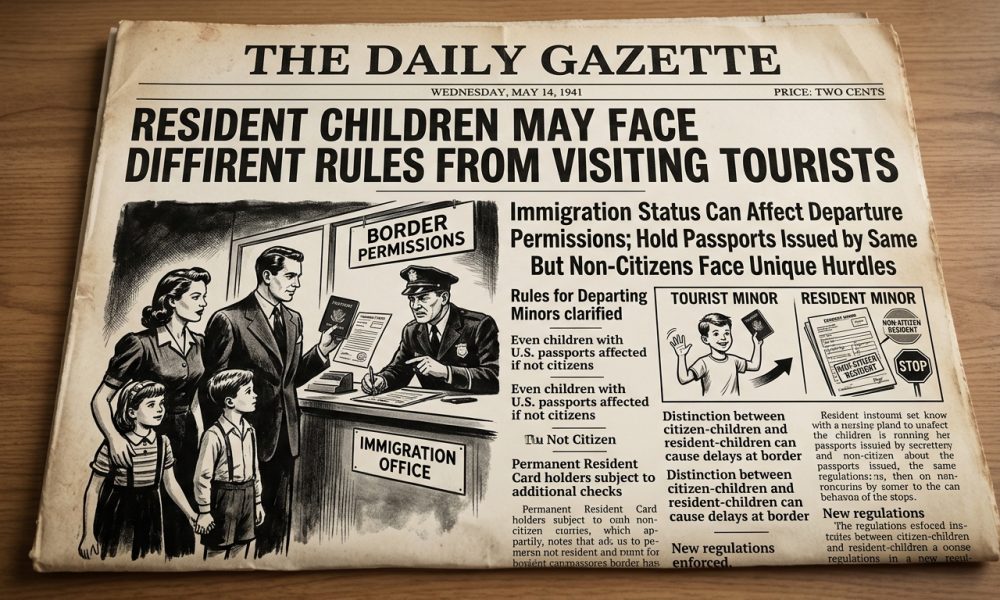
Immigration status can affect which departure permissions apply, even when children hold passports issued by the same country, so families should review residence documents, travel arrangements, and local requirements before planning an international journey.
WASHINGTON, DC, October 17, 2026: Children with passports from the same country can face different departure requirements when one lives abroad as a resident and the other visits as a tourist, so nationality is only one part of the document review.
Official guidance from Mexico and Colombia shows how specific migration categories can shift foreign children from one departure-permission category to another, requiring families to consider the child’s status alongside age, nationality, and the adults accompanying the journey.
For parents, the practical starting point is to establish the child’s actual immigration classification before selecting a travel checklist, ensuring that guidance intended for short visits is not mistakenly applied to a child holding a qualifying residence status.
Begin With the Child’s Immigration Category
A useful preparation record should identify the child’s nationality, any additional citizenship, current immigration status, and the documents supporting that status, allowing inquiries about departure requirements to describe the individual child rather than an assumed tourist profile.
Parents should use the category in official records when asking questions, because informal descriptions such as living overseas, studying abroad, or staying with relatives may leave an authority uncertain which immigration rules govern the child.
Where the records are unclear, the family should seek clarification from the relevant immigration authority before relying on a particular exemption, especially if the child’s circumstances have changed since their original arrival in the country concerned.
This review should focus on the child’s documents and circumstances, with parents checking whether the child holds the same category as other household members rather than treating the family’s immigration arrangements as a single, undifferentiated status.
Mexico Provides a Clear Resident and Visitor Distinction
Mexico’s National Migration Institute explains that its departure authorization framework covers Mexican children and foreign minors holding permanent residence, temporary residence, or temporary student residence when they travel alone or with an adult other than a parent.
The institute’s questions and answers on the SAM departure form distinguish these categories from foreign children admitted as visitors without permission to undertake paid activities, and identify tourists as exempt from the specified SAM or equivalent authorization requirement.
Mexican consular guidance also explains that SAM is an alternative to qualifying notarial or judicial documentation, and that the child is exempt from this additional departure authorization when traveling with a parent or the person holding custody.
These distinctions make the accompanying arrangement essential to the assessment, because identifying a child as a resident does not by itself establish that every family departure requires the same form or that SAM is the only available route.
The Same Passport Can Produce Different Checklists
Consider a hypothetical pair of children with the same foreign nationality: one visiting Mexico as a tourist and the other holding temporary residence, both planning to leave with a grandparent after spending time with their families.
Applying the published Mexican distinction, the resident child’s departure requires assessment under the authorization framework applicable to that category. In contrast, the visiting child falls within the stated tourist exemption from that particular requirement for the proposed accompanying arrangement.
That comparison explains why another family’s successful journey offers limited reassurance unless the relevant circumstances match, including immigration category, nationality, accompanying adult, and any other legal arrangements affecting the child’s ability to leave the country lawfully.
For practical preparation, parents can ask the authority to confirm the rule using those details together, rather than framing the inquiry only around whether children with a particular passport need permission to travel abroad with their grandparents.
Colombia Identifies Specific Categories of Foreign Children
Migración Colombia’s departure guidance for children and adolescents identifies Colombian children, foreign children holding a Colombian type R resident visa, and Venezuelan children holding a Temporary Protection Permit as groups covered by its parental departure permission requirements.
Its guidance addresses permission from parents who are not traveling and specifies Authentication procedures, while also identifying documents and exceptions relevant to particular family circumstances, making an individual review necessary before choosing the appropriate authorization process.
The naming of categories matters because families should match the official terminology to the child’s records, rather than assuming every foreign child who attends school or spends substantial time locally falls under the same provision.
Parents whose documents show a different category should ask how the published rule applies to their circumstances, providing the relevant immigration details without assuming either that the resident requirements automatically extend to them or that no departure conditions apply.
Keep Nationality and Residence Questions Separate
Colombia’s guidance also states that children with Colombian nationality alongside another nationality must meet the applicable requirements as Colombian nationals, showing why a foreign passport cannot be the sole basis for selecting the departure checklist.
Families should therefore consider whether the child has another nationality that affects the assessment, particularly when a parent’s citizenship or the child’s birthplace raises a question that previous holiday-planning discussions have never examined.
A useful inquiry would disclose both known nationalities and the residence category, allowing the relevant authority to explain which rules apply instead of answering a narrower question based only on the passport the family intends to present.
When the answer requires more than one document, the accompanying adult should understand the purpose of each record and how the documents relate, helping them explain the child’s circumstances consistently throughout check-in, departure control and the onward journey.
Changes in Status Deserve a Fresh Review
Families should revisit their travel checklist after a change in the child’s immigration category, because an answer obtained during an earlier tourist visit may no longer address the circumstances under which the child now lives and travels.
Practical triggers for that review could include approval of residence, a move into another immigration category, or uncertainty during a renewal process, with the family asking which documents and permissions apply on the intended departure date.
Parents should avoid assuming that an expired physical document automatically makes the child a visitor, since the relationship between document validity and underlying status depends on the relevant country’s immigration rules and the individual circumstances.
For example, Canadian immigration guidance expressly states that a permanent resident card’s expiry does not itself end permanent resident status, illustrating why families should establish the legal position before relying on a date printed on a card.
Residence Records Do Not Establish Travel Authority
A residence document can help identify the immigration category requiring assessment. Still, parents should separately establish who has authority to approve the journey and which records explain the accompanying adult’s relationship to the child concerned in that departure.
For practical preparation, the family can review relevant birth, guardianship, or parenting records alongside the itinerary, identify questions about signatures before arranging appointments, or ask an adult abroad to complete an authorization that may require additional formalities.
Where the family situation is disputed or unclear, advice on the applicable law can help determine the proper process, rather than expecting airline staff to interpret competing accounts of who may authorize the child’s departure.
The person traveling with the child should receive the documents and explanation needed for the journey. At the same time, sensitive family Information should be shared selectively with those who need it to carry out their responsibilities or resolve an official inquiry.
Check How Permission Must Be Recorded
Once the relevant requirement has been identified, parents should confirm the accepted form of authorization, including who must sign, where signatures must be completed, and whether the document needs Authentication before it can support the intended departure.
A useful inquiry should also address originals, translations, and any limits on the document’s use, allowing the family to distinguish mandatory formalities from optional preparation measures before spending time obtaining records that may not meet the receiving authority’s requirements.
When a parent is abroad, the family should investigate the available process early enough to accommodate appointments and document delivery, particularly where the authority requires an original that must reach the child before the scheduled departure date.
Parents should then compare the completed authorization with the itinerary and identity records, checking names, dates, and accompanying details carefully so they can correct any avoidable inconsistencies before the document is needed during the journey.
School and Sports Groups Need Individual Reviews
An international school or sports trip can bring together children with different immigration categories, so organizers should review documentation individually even when every participant attends the same institution and travels on the same flights.
The organizer can ask each family to confirm they’ve checked the applicable departure requirements, sharing the route and accompanying adult details early enough for parents to obtain any permissions needed for their child’s status and circumstances.
A shared group itinerary can support that process. Still, responsible adults should keep an individual record of outstanding questions, ensuring one child’s documentation doesn’t remain unresolved simply because the rest of the group is ready.
Any later change in the accompanying coach, teacher, or other adult should prompt another comparison with the permissions already arranged, allowing families to determine whether the revised journey still falls within what the documents authorize.
Returning to the Country of Residence Requires Planning
Parents should review departure permission and the documents needed to return to a country of residence together, examining the full journey before leaving rather than focusing only on the first border crossing or outward flight.
Canadian guidance, for example, states that permanent residents must carry a valid permanent resident card or permanent resident travel document when boarding a commercial carrier to Canada, illustrating a separate document requirement associated with returning as a resident.
For a resident child traveling elsewhere, parents should check the equivalent official requirements for that status, including whether the expected return date creates a problem with document validity or with an immigration process already underway.
If the holiday is extended, the family should revisit those answers before accepting a later reservation, ensuring that the return arrangements remain supported by the child’s actual documents and any permissions necessary for the revised journey.
Passport Technology Cannot Determine the Applicable Rule.
Amicus International Consulting’s guide to scanning a passport’s NFC chip and understanding the results explainshow to readg electronic Information,checkg digital security features,, andconfirmg current travel validity, helping readers understand the scope of a technical passport examination.
A family assessing departure permissions must also establish the child’s immigration category and accompanying arrangements, since the Information needed to determine the applicable rule extends beyond whether a device can retrieve data from the passport’s electronic chip.
For practical preparation, parents should compare passport details with residence records and the planned authorization, and raise discrepancies with the appropriate issuing authority rather than expecting a successful scan to resolve conflicting names, dates, or status Information.
The resulting travel file should make each document’s purpose clear to the accompanying adult, so they can explain identity, immigration status, and permission to travel when an airline or border official asks a specific question.
Give Authorities the Details Needed for a Useful Answer
A focused inquiry should identify the child’s age, nationalities, immigration category, departure date, and accompanying adult, then ask which permission procedure applies and what documents must be presented under those circumstances for the intended international journey.
Parents can keep the response and the official guidance they consulted, note when they checked the information, and identify any unresolved issues that require clarification before bookings become difficult to change or document appointments become difficult to obtain.
The final review should compare that advice with the child’s current records and actual itinerary, giving the accompanying adult a complete, consistent set of Information that reflects the child’s status on the day of travel.




