
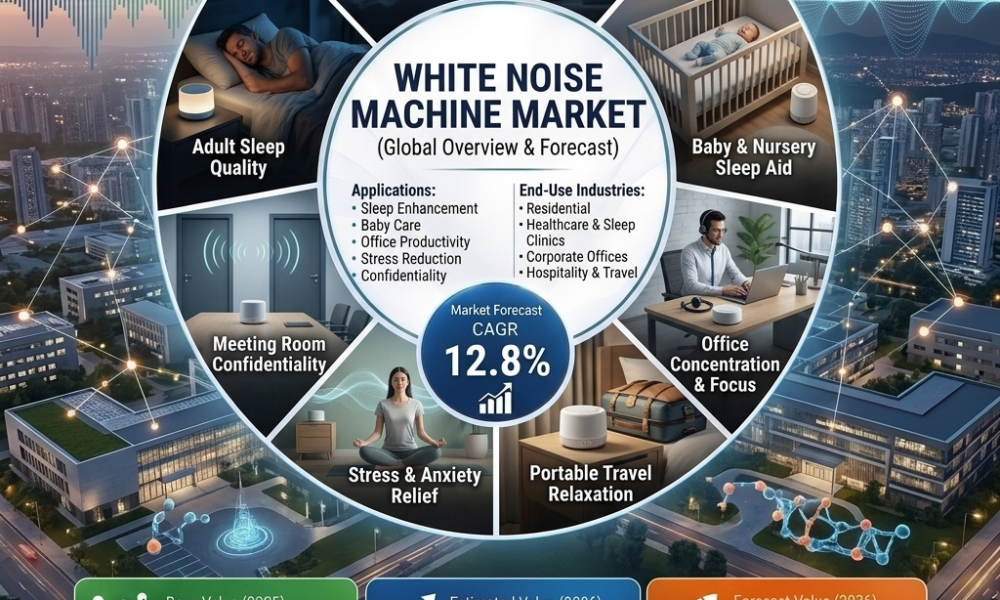
Rockville, MD., September 22, 2026 — The global white noise machine market is projected to expand from USD 1.7 billion in 2026 to USD 3.2 billion by 2036, advancing at a 6.4% CAGR during the forecast period. The market reached USD 1.6 billion in 2025, according to the latest Fact.MR assessment.
White noise machines are increasingly used for sleep routines, concentration, relaxation, privacy, and travel-related sound masking. Buyers are comparing sound options, timers, portability, night-light functions, and safety information before making purchases. This is strengthening the role of online retail while encouraging manufacturers to make product features easier to understand.
Get detailed market forecasts, competitive benchmarking, and pricing trends
Plug-in Formats and Adult Use Support Market Growth
Plug-in models remain important because many consumers use white noise machines in one fixed location. A device connected to household power can operate overnight without concerns about battery depletion. This makes the format particularly relevant to bedside and nursery applications.
Plug-in Noise Machines are projected to account for 38.5% of the product type segment in 2026. Portable models continue to expand the product range, but fixed-location use remains a major purchase case.
Adult sleep and focus routines are another important demand driver. Consumers use white noise to mask traffic, sounds from other rooms, workplace distractions, and other recurring noise sources. Travel is also creating demand for compact devices that can be carried between locations.
Adults are projected to account for 56.6% of the application segment in 2026. The report also identifies individual consumers as the leading end-user group, with a projected 30.2% share in 2026.
Online Retail and Digital Sound Generation Gain Ground
Online sales are becoming an important route to purchase because buyers can compare sound libraries, volume controls, timer functions, portability, reviews, and safety guidance before choosing a product.
The online distribution channel is projected to hold 57.3% of the market in 2026. Digital retail also gives smaller brands an opportunity to explain product specifications and differentiate their offerings.
Digital Sound Generation is expected to account for 42.8% of the technology segment in 2026. Digital systems can support multiple sound profiles, timers, and compact product designs. Smart connected models can add Bluetooth, smartphone connectivity, Wi-Fi, and other control functions.
However, the growing similarity between products creates a challenge for manufacturers. Sound quality, straightforward controls, and clear safety information are becoming important points of differentiation.
USA Leads Country Growth
The USA is projected to record the highest CAGR among the countries listed in the report, at 8.31% from 2026 to 2036. Japan follows at 7.70%, while Germany, the UK, Canada, South Korea, and Australia are projected to grow at 7.04%, 6.40%, 5.75%, 5.09%, and 4.50%, respectively.
USA demand is supported by online product discovery, adult sleep needs, and a well-developed baby-care channel. Consumers increasingly compare products through reviews and online specifications. Clear information on safe placement, product durability, and electrical safety can therefore influence purchasing decisions.
Japan is forecast to grow at 7.70% CAGR. Germany follows at 7.04%, with product safety, power reliability, and energy use remaining important considerations for buyers.
The UK is expected to expand at 6.40% CAGR, while Canada is projected to grow at 5.75%. Australia and South Korea are forecast to record CAGRs of 4.50% and 5.09%, respectively.
Safety and Price Pressure Remain Key Challenges
Product safety is an important consideration, particularly when white noise machines are used around infants and young children. Parents may be reluctant to purchase products when manufacturers do not provide clear guidance on sound levels and device placement.
The report identifies volume-safety concerns in infant and child use as a key restraint. Low-cost marketplace products also create price pressure because many devices offer similar basic features. This makes it harder for manufacturers to communicate why one product commands a higher price.
Electrical adapter reliability and product durability are additional concerns. Because many machines operate throughout the night, buyers expect dependable power components and consistent performance.
Opportunities exist in nursery-safe volume guidance, travel and remote-work bundles, and hospitality and care-facility assortments. Compact products with USB charging, timers, carrying cases, and clear warranty information can address specific use occasions.
Competitive Landscape
The competitive landscape includes HoMedics USA, Conair Corporation, Hatch Ltd., Marpac, LLC (Yogasleep), Snooz, Inc., Adaptive Sound Technologies, Inc. (LectroFan), Sweet ZZZ Mattress, and Munchkin, Inc.
Competition is shaped by product proof, channel access, sound quality, safety documentation, and buyer trust. Manufacturers are also differentiating through sound libraries, timers, smart connectivity, portability, and product-specific positioning.
According to Shambhu Nath Jha, Sr. Consultant at Fact.MR, “White noise machines continue to gain share as users look for concentration. The stronger brands are focusing on selling a safer, repeatable sleep routine with controls that ordinary households understand.”
Top Reports:
Report Scope
The study covers plug-in, portable, stuffed-animal, combination, and smart connected sound machines used for sleep, relaxation, focus, privacy, and travel-related sound masking.
The report analyzes the market by product type, application, end user, distribution channel, technology, and region. Applications include adults, sleep and insomnia management, relaxation and stress reduction, babies and kids, infant sleep support, and children’s sleep and soothing.
End-user coverage includes individual consumers, healthcare and wellness users, hospitality and travel users, corporate and workplace users, educational institutions, and care and assisted living facilities.
Technology segments include digital sound generation, mechanical sound generation, smart connected technology, multi-sound technology, and other technologies. Regional coverage includes North America, Latin America, Europe, East Asia, South Asia and Oceania, and the Middle East and Africa.
The analysis combines primary research with desk research, company disclosures, public datasets, regulatory material, technical literature, and industry records. Market sizing uses a hybrid top-down and bottom-up assessment.



