
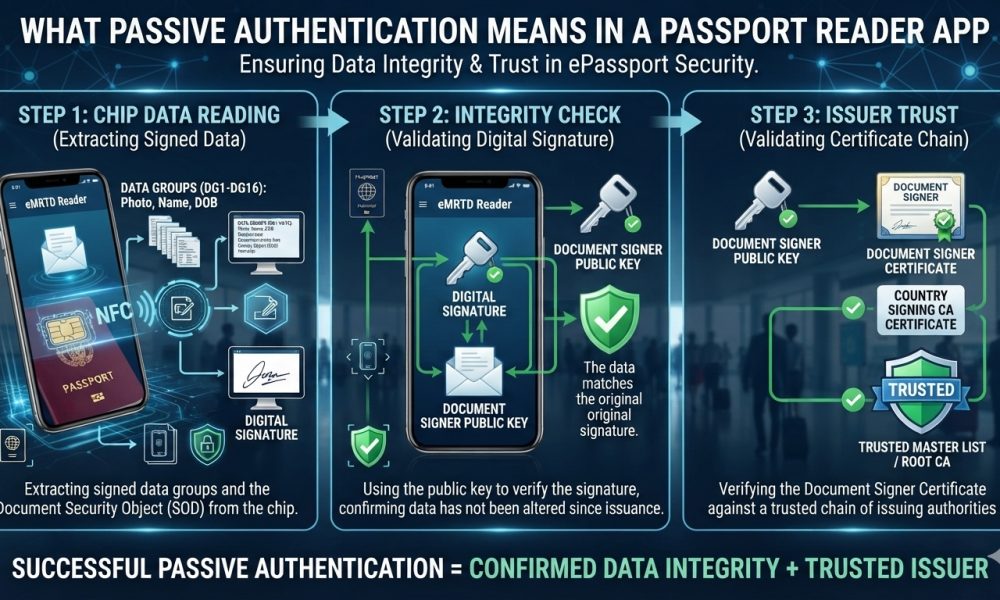
The check examines signed data integrity, with issuer trust depending on validation against appropriate trusted certificates.
WASHINGTON, DC, October 5, 2026, When a smartphone passport reader reports that an electronic passport has passed “Passive Authentication,” the result represents an important cryptographic security check, but understanding exactly what was verified requires distinguishing between the integrity of digitally signed chip data and the trustworthiness of the certificate chain used to validate that signature.
Modern electronic passports contain a contactless integrated circuit that stores standardized information, including biographical details and a digital facial Image. At the same time, cryptographic signatures allow inspection systems and compatible applications to determine whether the issuing authority has altered the protected electronic information since it digitally signed the passport’s data during personalization.
Passive Authentication Checks the Passport’s Signed Electronic Data
Under the international architecture described in ICAO Doc 9303, Passive Authentication allows a reader to examine the passport’s Document Security Object, verify its digital signature, calculate cryptographic hashes from relevant data groups stored inside the chip, and compare those calculated values against the signed hashes contained within the protected security object.
When those calculated values correspond with the signed values stored inside the chip, the reader gains strong cryptographic evidence that the protected electronic information has remained unchanged after signing, meaning an unauthorized modification to a stored portrait, passport number, name, nationality, birth date, expiration date, or another protected data element should normally disrupt the expected hash comparison.
This characteristic makes Passive Authentication fundamentally different from simply reading a passport chip, because successful communication with an NFC chip only demonstrates that the reader accessed compatible electronic data, while Authentication attempts to determine whether that data retains the cryptographic protections created by the passport’s issuing infrastructure.
The Document Security Object Plays a Central Role
Inside an electronic Machine Readable Travel Document, commonly called an eMRTD, the Document Security Object contains hashes representing protected data groups, along with the digital signature created through the issuing authority’s Document Signer infrastructure, giving compatible inspection equipment a cryptographically protected reference against which it can evaluate subsequently retrieved information.
A passport reader therefore does not merely compare visible text with electronic text during Passive Authentication, because the Application calculates fresh hashes from the chip’s relevant data groups and determines whether those values match the previously signed hashes embedded in the security structure created when the document was personalized.
If someone altered a protected data group after issuance without the appropriate issuing authority’s signing credentials, the newly calculated hash would no longer match the signed reference value, allowing the reader to identify an integrity failure even when the modified electronic information might otherwise appear visually plausible to an inexperienced user.
A Valid Signature Still Requires a Trusted Certificate Chain
The more important distinction arises when determining who created the digital signature, because cryptographic mathematics can confirm that information corresponds with a particular signing key, while establishing that the signing key legitimately belongs within a sovereign passport-issuing infrastructure requires validation through an appropriate chain of trusted certificates.
ICAO’s Public Key Infrastructure model places the Country Signing Certification Authority, commonly abbreviated CSCA, at the national trust point for electronic travel documents. At the same time, Document Signer certificates operate beneath that authority and digitally sign information placed into individual passports during the document-personalization process.
For that reason, a reader performing comprehensive Passive Authentication ideally verifies not only that the Document Security Object carries a mathematically valid signature, but also that the corresponding Document Signer certificate can be validated through a trusted CSCA certificate obtained through an appropriate and reliable trust framework.
Why Trusted Certificates Matter
A passport Application can technically verify that a signature corresponds with a certificate presented alongside electronic passport information without necessarily proving that the certificate ultimately belongs to the recognized governmental trust infrastructure of the claimed issuing country, which is why certificate management becomes essential when interpreting Authentication results.
According to documentation describing ReadID passport Authentication capabilities, electronic passport verification involves checking data hashes, validating the Document Signer certificate, and establishing appropriate trust in the country-level certificate used within the issuing infrastructure, rather than treating successful NFC communication alone as evidence of governmental issuance.
This distinction explains why two passport reader applications can sometimes display different Authentication results after scanning the same document, because applications may maintain different certificate repositories, update those repositories at different intervals, apply different certificate-path validation policies, or present incomplete certificate information to users in different ways.
The ICAO Public Key Directory Supports International Trust
The International Civil Aviation Organization operates the Public Key Directory as a key mechanism for participating authorities to exchange cryptographic material associated with electronic travel documents, helping inspection systems obtain trusted certificates and revocation information needed to validate passport signatures across national borders.
ICAO documentation explains that Country Signing Certification Authority certificates establish national trust points and that participating authorities provide relevant certificate material through the PKD framework, allowing receiving systems to validate Document Signer certificates against recognized country-level trust anchors rather than relying entirely upon certificates discovered within an individual passport.
That trust architecture matters because the security question is not merely whether somebody digitally signed the electronic information, but whether the signing credentials can be connected through an accepted certificate path to the legitimate authority responsible for issuing electronic passports for the country identified within the document.
A Green Result Should Be Interpreted Carefully
When a commercial passport reader displays a green check beside “Passive Authentication,” users should examine the Application’s explanation of that result before concluding that it has verified every possible security characteristic of the physical booklet, electronic chip, issuing record, biometric holder, and governmental database registration.
Some applications may separately display successful hash verification, Document Security Object signature verification, certificate validation, or certificate trust. In contrast, others may combine several checks into a single simplified status indicator intended primarily for consumers who do not need to examine every cryptographic component individually.
A meaningful interpretation therefore depends on whether the Application had an appropriate trusted CSCA certificate, whether the Document Signer certificate validated correctly, whether protected data-group hashes matched their signed values, and whether the software encountered certificate expiration, revocation, configuration, or trust-store limitations during its assessment.
Passive Authentication Does Not Prove the Chip Is the Original Chip
Another important limitation concerns cloning, because Passive Authentication principally protects the Authenticity and integrity of digitally signed information, while correctly copied signed data can potentially remain cryptographically valid when duplicated onto another compatible chip unless an additional mechanism proves possession of a secret uniquely associated with the legitimate original chip.
Security protocols such as Chip Authentication or Active Authentication, where supported by the document and reader, address this different problem by requiring the electronic chip to demonstrate possession of protected cryptographic information that cannot ordinarily be reproduced merely by copying readable passport data from one chip onto another.
Germany’s Federal Office for Information Security explains that Chip Authentication can help detect cloned electronic identity chips because the legitimate chip must demonstrate possession of its protected private key, illustrating why Passive Authentication and anti-cloning mechanisms answer related but fundamentally different security questions.
Electronic Verification Is Only One Layer of Passport Examination
Professional travel-document examination therefore combines cryptographic analysis with other forms of inspection rather than relying on a single green indicator from a smartphone Application, because passport security depends on physical construction, personalized printing, optical security features, electronic data, cryptographic signatures, and ultimately the identity of the person presenting the document.
As Amicus International Consulting has previously explained in its coverage of modern passport security and counterfeit detection, genuine travel documents rely upon overlapping layers designed so that defeating one element does not automatically defeat every other security measure incorporated into the passport booklet and its electronic infrastructure.
A professionally conducted assessment can therefore examine the physical passport under visible, ultraviolet, and other appropriate illumination; inspect printing and personalization characteristics; compare the Machine Readable Zone with visible information; retrieve the NFC chip contents; compare electronic and printed data; validate cryptographic signatures; and examine available anti-cloning mechanisms.
What a Failed Passive Authentication Result Can Mean
A failed result deserves investigation rather than an immediate conclusion that a passport is counterfeit, because certificate-store problems, unsupported algorithms, outdated trust material, incomplete certificate chains, software implementation differences, damaged chip data, communication problems, and genuine cryptographic inconsistencies can potentially produce different failure conditions that applications may summarize using similar warning messages.
Conversely, a successful result should not automatically be interpreted as proof that every physical feature of the booklet is genuine, that the person holding the passport is its lawful holder, that the passport remains valid in government databases, or that no additional security examination is required.
The strongest interpretation of Passive Authentication is therefore relatively precise. When the required certificate trust is properly established, and the cryptographic checks succeed, the reader has strong evidence that the protected electronic information originated through the recognized signing infrastructure and has not been altered since the issuing process applied its digital signature.
Understanding What the App Actually Verified
For consumers, compliance teams, investigators, financial institutions, immigration professionals, and identity-verification specialists, the most useful approach is to examine individual Authentication results rather than treating a passport reader’s final green or red indicator as an all-purpose determination covering every element of document Authenticity and identity verification.
Passive Authentication remains one of the foundational protections built into the modern electronic passport because it converts important information stored inside the chip into cryptographically verifiable data, allowing properly equipped readers to detect unauthorized electronic modification with a level of assurance that ordinary visual examination cannot provide on its own.
Its evidentiary value is strongest, however, when the reader also establishes an appropriate trusted path from the passport’s Document Signer certificate to the legitimate Country Signing Certification Authority, because cryptographic integrity and trusted governmental issuance are connected concepts, but not technically identical questions.




