
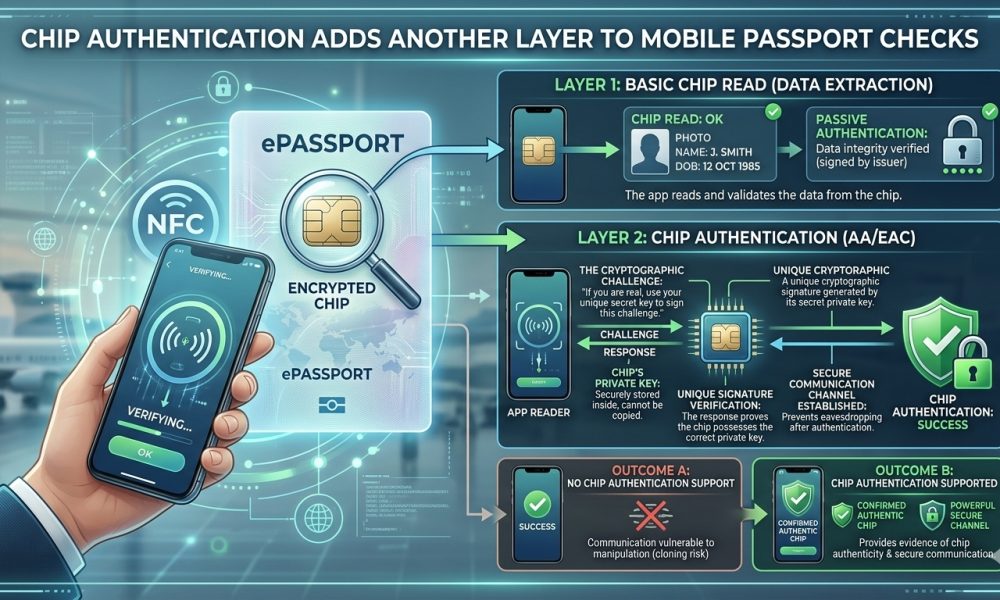
Where supported, the protocol provides evidence of chip Authenticity and helps secure communication with the reader.
WASHINGTON, DC, October 5, 2026, Modern passport verification increasingly depends on more than simply reading the electronic chip or confirming that stored information matches an issuer’s digital signature, because advanced security protocols can also test whether the chip itself possesses the cryptographic secrets expected from the original document.
Chip Authentication adds that layer by using a cryptographic key-agreement process that lets the passport chip and reader derive shared session keys while also providing evidence that the chip holds the protected private key linked to the authenticated public information stored in the electronic passport.
Chip Authentication Goes Beyond Reading Stored Data
A smartphone or inspection terminal can retrieve names, document numbers, dates, facial images, and other electronic information from a passport chip, but successful retrieval alone does not prove that the device supplying the information is necessarily the original chip personalized by the issuing authority.
Passive Authentication addresses the integrity and signed origin of electronic information. In contrast, Chip Authentication addresses a different security question by testing whether the chip can participate in a cryptographic operation that depends upon possession of a private key intended to remain securely protected inside the original integrated circuit.
ICAO describes Chip Authentication as an ephemeral-static Diffie-Hellman key-agreement protocol that provides secure communication and unilateral Authentication of the electronic Machine Readable Travel Document chip, while additionally generating strong session keys used for subsequent protected communication.
The Chip Contains a Protected Private Key
A passport supporting Chip Authentication contains a static cryptographic key pair: a public key that can be made available to the inspection system and a corresponding private key that must remain securely stored within the chip’s protected memory.
The security model depends on that private key remaining inaccessible during ordinary passport reading, because an attacker who copies readable electronic information should not automatically obtain the secret value needed to perform the same cryptographic operations as the original integrated circuit.
Germany’s Federal Office for Information Security explains that the chip-specific private key resides in an area that cannot ordinarily be read, meaning copying accessible chip contents does not also reproduce the protected secret required by Chip Authentication.
The Reader Creates Its Own Temporary Key Pair
During Chip Authentication, the inspection system receives the chip’s static public key. It then creates a temporary, or ephemeral, cryptographic key pair, after which the reader and passport independently calculate a shared secret using their respective private keys and the other party’s public information.
If both sides have the expected cryptographic material and execute the protocol correctly, they derive the same shared secret, from which they can generate encryption and message-authentication keys to protect the remainder of the communication session between the passport and inspection system.
ICAO specifies that these derived keys provide both encryption and message-authentication functions for Secure Messaging, meaning Chip Authentication does more than examine chip Authenticity because it also strengthens confidentiality and integrity Protection for information exchanged after the protocol succeeds.
Passive Authentication Remains Essential
Chip Authentication cannot be considered independently from Passive Authentication, because an inspection system must first establish that the chip’s public key has not simply been replaced with a new public key controlled by someone who also possesses the corresponding substitute private key.
Passive Authentication protects against that scenario by verifying the digitally signed security information associated with the public key, connecting the key used during Chip Authentication with passport data authenticated through the issuing authority’s Document Security Object.
ICAO states that an inspection terminal must perform Passive Authentication to verify the Authenticity of the chip’s public key, and that the chip should be considered genuine only after successful validation of the relevant Security Object.
Why This Helps Detect Simple Chip Copies
A copied electronic passport chip might reproduce readable files, signed data structures, facial images, biographical information, and certificates. Still, it should not be able to reproduce a properly protected private key that cannot be exported from the legitimate secure integrated circuit.
When the reader attempts Chip Authentication against such a copy, the duplicate cannot derive the same cryptographic shared secret unless it possesses the original private key, causing the Authentication process or subsequent Secure Messaging verification to fail under correctly implemented conditions.
BSI describes the protocol specifically as a means of detecting cloned radio-frequency chips, explaining that a copied chip cannot simply substitute another private key because the corresponding replacement public key would be detected through the digitally protected information examined during Passive Authentication.
Secure Messaging Is an Important Part of the Protocol
Chip Authentication differs from a simple yes-or-no cryptographic test because successful execution produces fresh session keys that protect subsequent communication between the document and reader, strengthening both encryption and integrity Protection during the remainder of the electronic passport interaction.
ICAO states that once Chip Authentication succeeds, Secure Messaging restarts using the newly derived encryption and message-authentication session keys, replacing or strengthening the session Protection previously established through mechanisms such as Password Authenticated Connection Establishment or Basic Access Control.
This arrangement means an Application supporting the full protocol can gain evidence of chip Authenticity while also improving Protection for information exchanged during the same session, making Chip Authentication both an Authenticity mechanism and a communications-security mechanism.
Chip Authentication Differs From Active Authentication
Active Authentication and Chip Authentication both address the risk of copied passport chips. Still, they use different cryptographic approaches and offer somewhat different security properties within the broader architecture of electronic Machine Readable Travel Documents.
Active Authentication relies upon a challenge-response procedure in which the chip proves possession of a protected private key. At the same time, Chip Authentication instead establishes a shared secret through a Diffie-Hellman key-agreement process and then uses derived session keys to protect subsequent communication.
ICAO notes that Chip Authentication additionally avoids certain transferable challenge-response characteristics and provides strong session keys, distinguishing the protocol from Active Authentication even though both mechanisms ultimately contribute evidence that the electronic information resides on the expected chip.
Not Every Passport Supports the Same Protocol
Users scanning passports with smartphones should not assume that every electronic travel document supports Chip Authentication, because countries introduced electronic passports at different times and have adopted different combinations of standardized cryptographic mechanisms across successive document generations.
A passport that lacks Chip Authentication support should therefore not automatically be considered suspicious, particularly when the document belongs to an older generation or relies upon another recognized anti-cloning mechanism within the applicable electronic passport specification.
Likewise, a consumer Application may successfully perform Passive Authentication while lacking support for Chip Authentication, meaning the absence of a Chip Authentication result can describe the Application’s capabilities rather than establish a defect in the passport itself.
Mobile Applications Can Present Different Levels of Detail
Modern smartphone passport applications increasingly expose sophisticated cryptographic information that was once available primarily to border-control equipment. However, individual products differ substantially in how clearly they distinguish chip access, Passive Authentication, Active Authentication, Chip Authentication, and certificate validation.
An Application displaying a successful Chip Authentication result should therefore be understood as reporting a specific cryptographic procedure, rather than presenting universal proof that the document has passed every physical, electronic, biometric, and governmental verification step available to a professional inspection system.
Users should examine whether the Application also completed Passive Authentication, because successful Chip Authentication receives its strongest evidentiary meaning only when the public-key material involved in the protocol has itself been authenticated through the passport’s signed electronic security structure.
Chip Authentication Does Not Verify the Holder
Even a completely successful Chip Authentication procedure does not establish that the individual presenting the passport is necessarily its lawful bearer, because the protocol authenticates the electronic chip rather than performing a biometric comparison between the passport holder and the facial portrait stored inside the document.
Holder verification requires additional procedures, such as comparing a live facial Image with the authenticated portrait stored in the chip, examining the person against the physical passport photograph, or applying other biometric and identity controls available to the inspecting organization.
For the same reason, Chip Authentication does not independently establish whether the passport has subsequently been revoked, canceled, reported lost or stolen, or subjected to another administrative restriction after issuance, because those questions can require access to governmental or international databases.
Physical Examination Still Remains Important
Electronic cryptography represents only one part of modern passport security, because contemporary travel documents also incorporate specialized substrates, laser engraving, secure printing, ultraviolet features, optically variable elements, tactile characteristics, perforations, and other physical measures intended to resist alteration and counterfeiting.
As Amicus International Consulting explains in its overview of modern passport security, reliable passport assessment depends on overlapping layers rather than relying on a single security mechanism, no matter how technically sophisticated that mechanism may be.
An examiner can therefore combine physical inspection with Machine Readable Zone analysis, NFC retrieval, Passive Authentication, supported chip-authentication procedures, facial comparison, and appropriate database checks to build a more comprehensive assessment of both the document and the person presenting it.
A Successful Result Has a Precise Meaning
When properly implemented and combined with authenticated public-key information, successful Chip Authentication provides strong evidence that the reader is communicating with a chip possessing the expected protected private key and that subsequent communication can be secured using newly derived cryptographic session keys.
That result is considerably stronger than merely confirming that an NFC device responded or that readable passport information appeared on a smartphone screen, because the protocol requires participation in a cryptographic process involving secret information that ordinary data copying should not reproduce.
For investigators, compliance professionals, identity-verification teams, border authorities, and technically informed consumers, Chip Authentication therefore represents another important layer within electronic passport verification, strengthening both confidence in the physical chip and Protection of the communication channel through which passport information is exchanged.




