
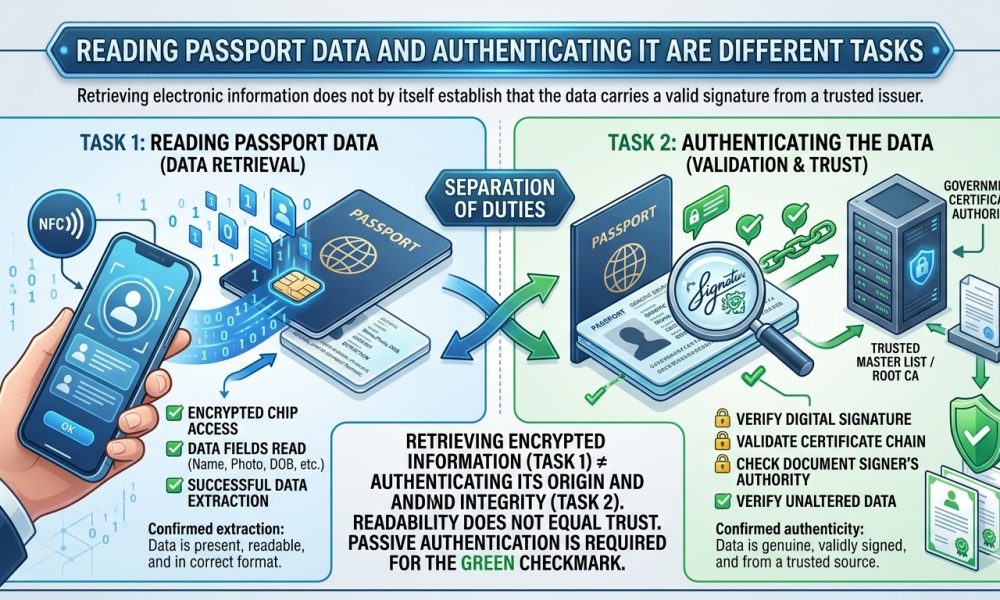
Retrieving electronic information does not by itself establish that the data carries a valid signature from a trusted issuer.
WASHINGTON, DC, October 5, 2026, When a smartphone successfully opens the electronic chip inside a modern passport and displays the holder’s photograph, name, nationality, document number, and expiration date, that successful retrieval confirms that readable electronic information was obtained, but it does not by itself establish that a trusted government authority digitally signed the information.
The distinction between reading passport data and authenticating passport data has become increasingly important as consumer applications make NFC passport scanning accessible to almost anyone with a compatible smartphone, because an impressive screen containing a portrait and biographical information can easily appear more authoritative than the underlying technical process actually demonstrates.
Reading the Chip Is the Beginning, Not the Conclusion
An electronic passport reader normally begins by obtaining information needed to establish secure communication with the contactless integrated circuit, after which the Application can retrieve standardized data groups containing biographical information, a digitally stored facial portrait, document details, and other information authorized by the passport’s electronic structure.
Completing that stage demonstrates that the Application communicated with the chip and obtained intelligible data. Still, Authentication requires additional cryptographic procedures that verify whether the information matches values protected by the digital signature created through the issuing authority’s passport-personalization infrastructure.
This difference means that an Application displaying a photograph extracted from the NFC chip has successfully retrieved data. In contrast, an Application claiming authenticated passport information must perform additional verification before it can reasonably establish that the retrieved information remains cryptographically connected to an appropriate issuing authority.
ICAO Separates Reading From Authentication
The international architecture established through ICAO Doc 9303 specifically distinguishes retrieval of electronic passport data from Passive Authentication, which examines the digitally signed Document Security Object and compares cryptographic hashes against corresponding information stored within relevant electronic data groups.
ICAO specifies that an inspection system performing Passive Authentication should build and validate a certification path from a trusted anchor to the Document Signer certificate, verify the signature protecting the Document Security Object, and compare freshly calculated hashes with signed hash values associated with the retrieved data groups.
These operations occur after the reader has obtained the relevant electronic information, which demonstrates why successfully accessing a passport chip and displaying its contents should never be treated as technically identical to authenticating the origin and integrity of those contents.
Digital Signatures Provide a Different Kind of Evidence
Cryptographic Authentication addresses whether protected electronic information remains consistent with the information signed when the document was personalized, providing a mathematical mechanism for detecting unauthorized modifications that ordinary visual comparison of names, photographs, dates, and document numbers cannot independently provide.
During Passive Authentication, the reader calculates cryptographic hashes from relevant data groups and compares those results with hash values contained within the digitally signed security object, meaning unauthorized changes to protected information should ordinarily produce a mismatch when the verification process is correctly performed.
ICAO describes this process as establishing that the contents protected through the Document Security Object remain authentic and unchanged, while also explaining that Passive Authentication does not itself prevent exact copying of electronic chip contents or substitution of the physical chip.
A Signature Must Also Be Connected to Trust
A mathematically valid digital signature provides only part of the Authentication picture, because an inspection system must also establish whether the signing certificate belongs within the legitimate certificate hierarchy maintained by the authority identified as the passport issuer.
Electronic passport infrastructure therefore relies upon Document Signer certificates and national Country Signing Certification Authority trust anchors, creating a certificate hierarchy through which receiving systems can determine whether a signing credential ultimately connects with recognized cryptographic material belonging to the claimed issuing authority.
ICAO’s current public-key infrastructure guidance requires inspection systems to validate the certificate used to verify electronically signed passport information. At the same time, trust anchors provide the trusted public keys and associated information needed to establish the issuer relationship on which that validation depends.
Why a Certificate Found on the Chip Is Not Automatically Trusted
A passport chip can contain a Document Signer certificate that helps the reader verify the document, but retrieving that certificate from the same electronic document being examined does not automatically establish that the certificate should be treated as an authoritative trust anchor.
Instead, a properly configured Authentication system must connect the Document Signer certificate through a valid certification path to independently trusted country-level cryptographic material, preventing the verification process from accepting an untrusted signing credential simply because it accompanied the data being examined.
This principle resembles other public-key systems used in secure digital communications, where possessing a certificate and successfully checking a signature is only part of the process, while determining whether the certificate ultimately connects to an independently trusted authority provides the critical element of trust.
The ICAO Public Key Infrastructure Supports Cross-Border Verification
Because passports regularly travel far beyond the country that issued them, border authorities need reliable mechanisms to obtain and maintain foreign cryptographic material, which is one reason ICAO developed an international Public Key Directory framework that supports distribution of electronic travel-document certificates and related public-key infrastructure information.
The system enables participating authorities to exchange the cryptographic material needed for international passport Authentication, helping receiving inspection systems establish trusted relationships with foreign issuing infrastructures instead of relying solely on information found inside individual documents during a border inspection.
A consumer passport Application may maintain its own collection of trusted certificates or obtain certificate information through different technical arrangements, so users should understand exactly what trust infrastructure an Application uses before interpreting an Authentication indicator as confirmation of sovereign issuance.
A Photograph From the Chip Can Still Be Useful
Retrieving the digital facial portrait remains extremely valuable because the electronic Image can be compared with the photograph visible on the physical data page. In contrast, appropriately equipped identity systems can additionally compare that stored portrait with a live photograph of the person presenting the document.
However, successful extraction of the portrait answers whether the reader obtained the Image stored electronically. In contrast, authentication asks whether that Image belongs to a protected data structure whose cryptographic signature and certificate chain can be validated against trusted issuing-authority credentials.
A passport Application that clearly separates chip access, data retrieval, Passive Authentication, certificate validation, and biometric comparison therefore provides users with considerably more meaningful information than an interface that compresses every stage into a single undifferentiated success message.
Printed and Electronic Information Should Be Compared
Electronic verification is stronger when investigators compare chip data with details on the physical document, because discrepancies in the holder’s name, document number, dates, nationality, portrait, or other corresponding fields can indicate that further examination is required.
The Machine Readable Zone provides another valuable comparison point, allowing an examiner to evaluate whether electronically retrieved data corresponds with machine-readable and visually personalized information rather than considering the chip as an isolated component disconnected from the physical passport surrounding it.
As Amicus International Consulting has explained in its examination of modern passport security, contemporary travel documents depend on overlapping physical, optical, electronic, biometric, and cryptographic protections, making comprehensive examination substantially more reliable than relying on any single security feature or Application result.
Authentication Still Does Not Answer Every Question
Even properly completed Passive Authentication should not be interpreted as proof that the passport remains currently valid for international travel, because cancellation, revocation, lost-and-stolen status, administrative restrictions, or subsequent governmental actions may require database access unavailable to an ordinary offline smartphone reader.
Similarly, cryptographic Authentication does not independently establish that the person holding the passport is its lawful bearer, which is why border systems can combine authenticated chip information with facial comparison, immigration databases, watchlists, lost-and-stolen-document systems, and other identity or security checks.
Electronic Authentication therefore provides strong evidence of a signed passport. Still, it belongs in a layered verification process rather than serving as a universal substitute for physical document examination, biometric holder verification, government status checks, or appropriate investigative Judgment.
Consumer Applications Should Be Read Carefully
Applications such as ReadID show how modern smartphones can access electronic identity-document information and perform sophisticated verification functions. However, users should still review individual result categories to determine whether a displayed success indicator reflects data access, cryptographic integrity, certificate validation, biometric comparison, or another specific test.
Two applications could read the same electronic information and still reach different Authentication conclusions if their trusted certificate repositories, certificate-validation policies, software versions, or supported security mechanisms differ, reinforcing why retrieving identical data should not automatically be confused with independently establishing identical trust.
The most useful question after scanning an electronic passport is therefore not simply whether the Application displayed the information, but whether it authenticated the signed data, validated the signing certificate through an appropriate trusted issuer chain, and clearly disclosed which additional security checks it completed or omitted.
Retrieval Provides Information, Authentication Provides Evidence
Reading an electronic passport answers the relatively straightforward question of what information the chip contains. At the same time, cryptographic Authentication addresses the far more important security question of whether protected information remains unchanged and can be connected, through trusted signing credentials, to the recognized issuing infrastructure.
Keeping those tasks separate prevents a successful NFC scan from receiving more evidentiary weight than it deserves, while allowing properly completed Authentication procedures to provide the stronger cryptographic assurance that modern electronic passports were specifically designed to make possible.
For travelers, investigators, compliance professionals, financial institutions, immigration specialists, and anyone evaluating electronic travel documents, understanding that distinction provides a more accurate foundation for interpreting passport-reader results and prevents technological convenience from being mistaken for comprehensive proof of document Authenticity.




