
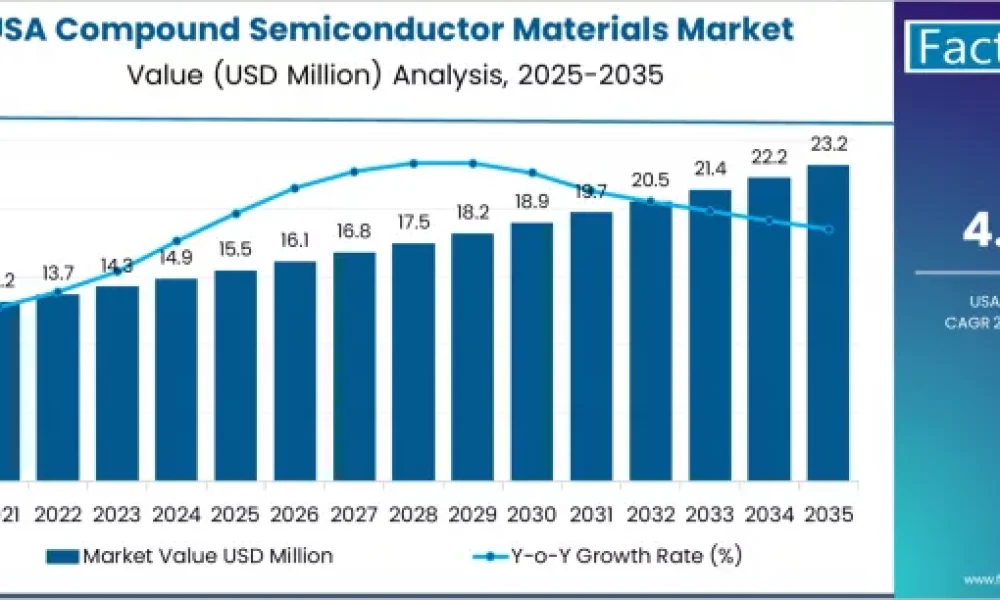
The United States compound semiconductor materials market is set to experience steady growth over the next decade, driven by rising adoption in 5G infrastructure, electric vehicles (EVs), renewable energy systems, and advanced defense electronics. According to a new analysis by Fact.MR, demand for compound semiconductor materials in the USA is projected to grow from USD 15.48 million in 2025 to approximately USD 23.16 million by 2035, registering an absolute increase of USD 7.68 million over the forecast period.
This expansion represents a total growth of 49.61%, with demand forecast to rise at a compound annual growth rate (CAGR) of 4.1% between 2025 and 2035, highlighting the strategic importance of compound semiconductors in next-generation electronic technologies.
The increasing shift toward high-performance, energy-efficient, and high-frequency semiconductor solutions is positioning compound semiconductor materials—such as gallium nitride (GaN), gallium arsenide (GaAs), silicon carbide (SiC), and indium phosphide (InP)—as critical enablers of future innovation.
To access the complete data tables and in-depth insights, request a Discount On The Report here: https://www.factmr.com/connectus/sample?flag=S&rep_id=12585
Strategic Market Drivers
5G Infrastructure and High-Frequency Communication Systems Drive Demand
The rapid rollout of 5G networks across the United States is significantly boosting demand for compound semiconductor materials. GaN and GaAs materials are widely used in RF power amplifiers, base stations, and high-frequency communication devices due to their superior power efficiency, high electron mobility, and thermal stability.
Growing investments in telecom infrastructure modernization and data transmission technologies continue to support sustained market growth.
Electric Vehicles and Power Electronics Accelerate Adoption
The U.S. transition toward electric mobility is increasing the use of SiC- and GaN-based semiconductors in EV powertrains, onboard chargers, inverters, and fast-charging stations. These materials enable:
- Higher voltage operation
- Faster switching speeds
- Improved thermal performance
- Enhanced energy efficiency
As federal and state policies promote EV adoption and domestic semiconductor manufacturing, compound semiconductor materials are gaining strategic importance.
Defense, Aerospace, and Advanced Electronics Applications
The U.S. defense and aerospace sectors remain key consumers of compound semiconductor materials for radar systems, satellite communication, electronic warfare, and avionics. Their ability to operate reliably under extreme temperatures, high power, and harsh environments makes compound semiconductors essential for mission-critical applications.
Renewable Energy and Power Grid Modernization
Compound semiconductor materials are increasingly used in solar inverters, wind power systems, and smart grid infrastructure. Their high efficiency and durability support national efforts toward energy resilience, grid modernization, and decarbonization.
United States Market Outlook
Strong Government Support for Domestic Semiconductor Manufacturing
Government initiatives such as semiconductor reshoring, R&D funding, and supply chain security programs are strengthening the domestic compound semiconductor ecosystem. Increased investments in fabrication facilities, research labs, and advanced materials processing are expected to sustain long-term demand growth.
Market Segmentation Insights
By Material Type
- Gallium Nitride (GaN) – High growth in RF, 5G, and power electronics
- Silicon Carbide (SiC) – Strong demand from EVs and renewable energy
- Gallium Arsenide (GaAs) – Widely used in telecom and optoelectronics
- Indium Phosphide (InP) – Niche applications in photonics and high-speed data transmission
By Application
- Telecommunications
- Electric Vehicles & Charging Infrastructure
- Aerospace & Defense
- Consumer & Industrial Electronics
- Renewable Energy Systems
Challenges Affecting Market Growth
High Manufacturing and Processing Costs
Compound semiconductor materials involve complex fabrication processes, increasing production costs compared to traditional silicon-based semiconductors.
Supply Chain and Material Availability
Dependence on specialized raw materials and advanced processing equipment can impact scalability and pricing stability.
Competitive Landscape
The U.S. compound semiconductor materials market is moderately consolidated, with players focusing on:
- Advanced material innovation
- High-purity wafer development
- Domestic production expansion
- Strategic partnerships with EV, telecom, and defense OEMs
Key Industry Focus Areas
- GaN and SiC wafer scaling
- High-efficiency power devices
- Integration with next-generation electronics
- Supply chain localization
Future Outlook: Steady Growth Driven by High-Performance Electronics
Over the next decade, demand for compound semiconductor materials in the United States will be shaped by:
- Expansion of 5G and future wireless technologies
- Rising EV and charging infrastructure deployment
- Growth in defense and aerospace electronics
- Increasing focus on energy efficiency and power density
- Government-backed semiconductor innovation initiatives
As the U.S. continues to prioritize technological leadership, energy efficiency, and advanced electronics manufacturing, compound semiconductor materials are expected to play a vital role in supporting sustainable and high-performance innovation through 2035.
Have a specific Requirements and Need Assistant on Report Pricing or Limited Budget please contact us – [email protected]
About Fact.MR
Fact.MR is a global market research and consulting firm, trusted by Fortune 500 companies and emerging businesses for reliable insights and strategic intelligence. With a presence across the U.S., UK, India, and Dubai, we deliver data-driven research and tailored consulting solutions across 30+ industries and 1,000+ markets. Backed by deep expertise and advanced analytics, Fact.MR helps organizations uncover opportunities, reduce risks, and make informed decisions for sustainable growth.



