
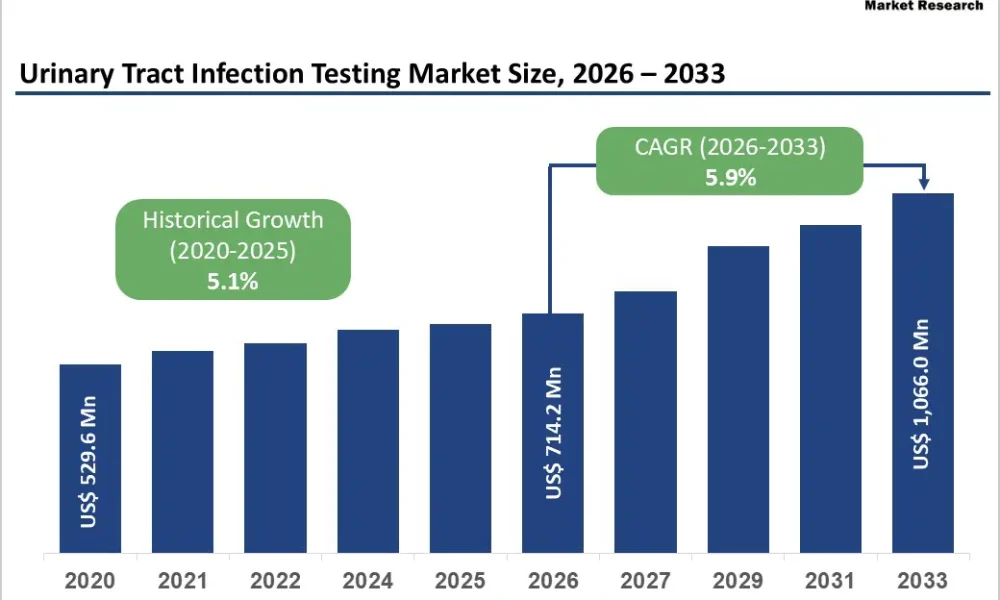
The global urinary tract infection (UTI) testing market is witnessing robust growth, driven by the increasing prevalence of UTIs and advancements in diagnostic technologies. UTIs, one of the most common bacterial infections worldwide, predominantly affect women and elderly populations, creating a substantial demand for reliable diagnostic solutions. The market is projected to reach US$ 1,066.0 million by 2033, up from an estimated US$ 714.2 million in 2026, reflecting a CAGR of 5.9% between 2026 and 2033. The growth is underpinned by rising awareness regarding early detection, technological innovations in rapid and point-of-care testing, and a global healthcare focus on reducing antimicrobial resistance through accurate diagnostics.
Among testing methods, urinalysis remains the leading segment, commanding a 46% share of the market in 2025. Its popularity stems from its cost-effectiveness, rapid turnaround, and wide clinical adoption as a first-line diagnostic tool. Geographically, North America dominates the market, accounting for 37% of the global share, due to advanced healthcare infrastructure, robust reimbursement systems, and high patient awareness about UTI management. Meanwhile, Asia Pacific is emerging as the fastest-growing region, fueled by expanding healthcare infrastructure, rising prevalence of UTIs, increased government spending, and accelerated adoption of point-of-care diagnostic solutions.
Download Your Free Sample & Explore Key Insights: https://www.persistencemarketresearch.com/samples/33937
Key Highlights from the Report
• The global UTI testing market is projected to reach US$ 1,066.0 million by 2033.
• North America holds 37% of the market share, led by the U.S.
• Urinalysis is the dominant testing method with a 46% market share.
• Rapid antimicrobial susceptibility testing is emerging as the fastest-growing segment.
• Asia Pacific is the fastest-growing regional market, driven by healthcare expansion.
• Point-of-care and home-based testing solutions present significant growth opportunities.
Market Segmentation
The UTI testing market is segmented by testing methodology, product type, and end-user categories. Testing methodologies include urinalysis, urine culture, and susceptibility testing, each serving distinct clinical requirements. Urinalysis dominates due to its rapid results and affordability, while urine culture and susceptibility testing are experiencing faster growth, driven by the need for precise antibiotic therapy in the era of rising antimicrobial resistance.
Product segmentation includes diagnostic kits, reagents, and instruments. Test kits and reagents, such as dipsticks and chemical reagents, constitute the largest market share, owing to their accessibility in hospitals, clinics, and home-testing environments. Instruments and automated analyzers, though representing higher-value segments, are essential for high-throughput laboratories and hospitals seeking accurate, integrated diagnostic solutions.
End-user segmentation focuses on hospitals, diagnostic laboratories, clinics, and home-care applications. Hospitals and diagnostic laboratories are the primary consumers due to their capacity for large-volume testing and advanced infrastructure. Home-based and point-of-care testing is emerging rapidly, offering convenience, privacy, and immediate results, which align with the growing trend of telemedicine integration and patient-centered healthcare delivery.
Regional Insights
North America leads the global UTI testing market, primarily driven by sophisticated healthcare infrastructure, advanced laboratory capabilities, and widespread public awareness of UTI management. The U.S. dominates regional growth due to strong regulatory support, robust reimbursement systems, and ongoing investments in automation and AI-driven diagnostic technologies. Hospitals and clinical laboratories are increasingly adopting integrated urinalysis systems for faster, accurate results, while point-of-care and home-based testing solutions are gaining traction.
Asia Pacific is the fastest-growing region, with China, India, and Japan spearheading market expansion. Growth is fueled by healthcare modernization, rising urban populations, and increasing government investment in diagnostic technologies. Lower production costs and skilled workforce availability enhance regional manufacturing competitiveness. The adoption of point-of-care testing and rapid diagnostic kits is accelerating, particularly in clinics and laboratories serving semi-urban and rural areas. ASEAN countries are also emerging as promising markets due to rising healthcare awareness and infrastructure development.
Get Custom Insights Designed for Your Business: https://www.persistencemarketresearch.com/request-customization/33937
Market Drivers
The UTI testing market is primarily driven by the rising prevalence of urinary tract infections worldwide. Annually, approximately 150 million people are affected, with women aged 20-40 and elderly populations being particularly susceptible. Comorbid conditions like diabetes and urinary incontinence further exacerbate risk, driving the demand for early and accurate diagnostic solutions. Technological advancements, including automated urinalysis systems, digital microscopy, and point-of-care platforms, are enhancing diagnostic accuracy and reducing turnaround times. Integration of artificial intelligence and machine learning into diagnostic instruments allows for error reduction, improved throughput, and enhanced patient outcomes, significantly fueling market growth.
Market Restraints
Despite growth potential, the market faces constraints from diagnostic accuracy limitations and regulatory challenges. Conventional dipstick tests, though widely used, exhibit variable sensitivity and specificity, often resulting in false negatives or inconclusive results. Urine culture methods, while accurate, require 24-72 hours for definitive results, creating delays in treatment and contributing to empirical antibiotic prescriptions, which can drive antimicrobial resistance. High costs of automated systems and stringent regulatory requirements for FDA approval pose adoption barriers, particularly in emerging markets with limited healthcare budgets. Inconsistent reimbursement policies further constrain investment in advanced diagnostic technologies.
Market Opportunities
Emerging opportunities in point-of-care testing and home-based diagnostic solutions are transforming the UTI testing landscape. Integrated test-and-treat kits, combining rapid diagnostics with telehealth consultations, are gaining popularity among consumers seeking convenience and privacy. Rapid antimicrobial susceptibility testing technologies, including PCR-based diagnostics and bacterial impedance cytometry, enable faster pathogen identification and personalized antibiotic selection, addressing antimicrobial resistance challenges. These innovations support improved clinical outcomes and cost-effective healthcare delivery, particularly in regions with established telemedicine infrastructure and growing awareness of home-based healthcare solutions.
Checkout Now & Download Complete Market Report: https://www.persistencemarketresearch.com/checkout/33937
Company Insights
• ACON Laboratories Inc. – Focused on developing rapid diagnostic kits and point-of-care solutions.
• Cardinal Health Inc. – Provides comprehensive laboratory equipment and testing solutions.
• Danaher Corporation – Offers automated urinalysis systems and integrated diagnostics platforms.
• SYSMEX CORPORATION – Specializes in high-throughput automated urinalysis instruments.
• Abbott Laboratories – Engages in advanced diagnostic solutions including AI-enhanced testing.
• Bio-Rad Laboratories – Provides reagents and instruments for UTI testing and molecular diagnostics.
• Roche AG – Develops innovative diagnostic analyzers and automated laboratory platforms.
• LabCorp (Laboratory Corporation) – Offers diagnostic testing services including UTI analysis.
Recent Developments:
In November 2025, Visby Medical launched the first FDA-authorized at-home PCR test for sexually transmitted infections, delivering results within 30 minutes.
The FDA cleared the VersaTREK Compact System in February 2025, a rapid antimicrobial susceptibility testing device, facilitating timely and targeted antibiotic therapy.
Conclusion
The urinary tract infection testing market is poised for significant growth, driven by rising UTI prevalence, technological innovation, and increasing demand for rapid, accurate diagnostics. Urinalysis continues to dominate, while urine culture and susceptibility testing are gaining momentum due to the growing emphasis on personalized treatment and antimicrobial stewardship. North America maintains market leadership through advanced healthcare infrastructure and strong regulatory support, whereas Asia Pacific represents the fastest-growing market, driven by healthcare modernization and rising disease awareness. Opportunities in point-of-care and home-based testing platforms, coupled with rapid antimicrobial susceptibility technologies, are set to redefine diagnostic practices, improve patient outcomes, and enhance global healthcare delivery. Major players like Abbott Laboratories, Danaher Corporation, and Roche AG are actively expanding their portfolios, leveraging innovation and strategic investments to capture market share in this evolving landscape.




