
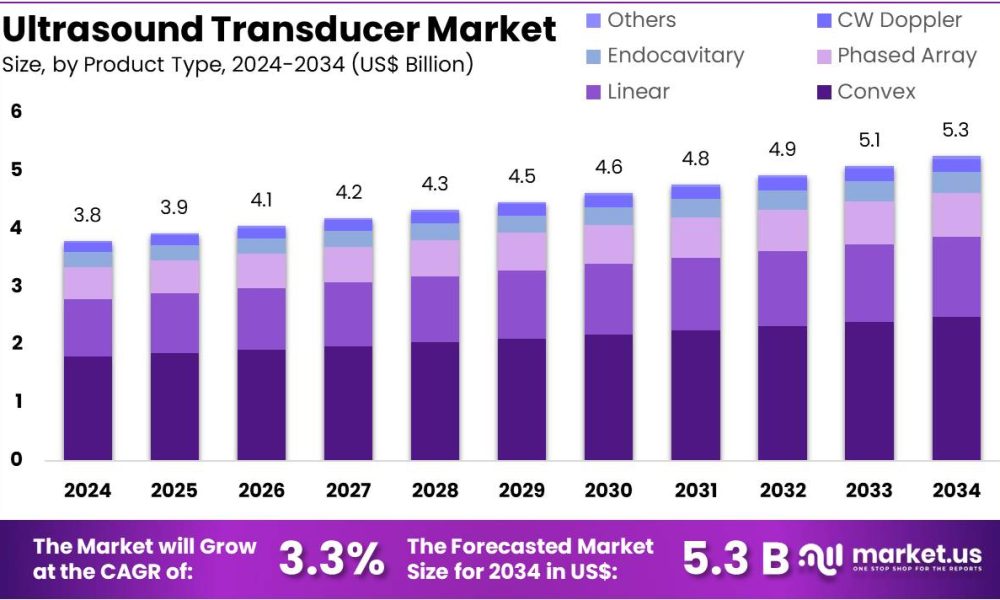
The Global Ultrasound Transducer Market is projected to reach US$ 5.3 billion by 2034, rising from US$ 3.8 billion in 2024 at a CAGR of 3.3% during 2025 to 2034. North America remains dominant with over 38.8% share, valued at US$ 1.5 billion in 2024. Growth is driven by increasing demand for non-invasive diagnostic procedures. These transducers are widely used in applications such as cardiology, obstetrics, and emergency medicine. Rising use of point-of-care ultrasound and improvements in imaging resolution are further supporting market expansion globally.
The surge in portable ultrasound systems is accelerating the adoption of point-of-care diagnostics. In 2023, GE Healthcare reported a 19% increase in compact ultrasound sales. The FDA also cleared 25% more point-of-care devices compared to 2022. Mayo Clinic observed a 40% rise in emergency department usage of portable ultrasound systems. WHO’s 2024 strategy promotes portable ultrasound in resource-limited settings. Portable systems reduce reliance on expensive imaging, cutting advanced imaging needs by 30% while improving access and cost-efficiency across healthcare systems.
However, high costs of advanced ultrasound systems hinder wider adoption. Philips’ premium transducers cost between US$ 15,000 and US$ 50,000, limiting accessibility for smaller hospitals. The American Hospital Association’s 2024 survey revealed that 45% of rural hospitals postponed ultrasound equipment upgrades due to budget limits. Although demand is rising, reimbursement for ultrasound procedures rose just 2% in Medicare’s 2023 fee schedule. Additionally, a 14% increase in key component prices has been reported since 2022, further straining affordability in emerging markets.
AI integration in ultrasound imaging is unlocking new growth avenues. Siemens Healthineers recorded a 28% revenue increase in AI-enabled ultrasound systems in 2023. The FDA cleared 12 AI-based imaging algorithms that year, indicating regulatory support and strong demand. Clinical findings show AI can improve diagnostic accuracy by 22% and reduce scan times by 30%. Governments are also investing heavily—India’s 2024 health budget allocated US$150 million to AI in imaging. This shift, along with trends in wireless and disposable probes, is shaping the future of ultrasound diagnostics.
Key Takeaways
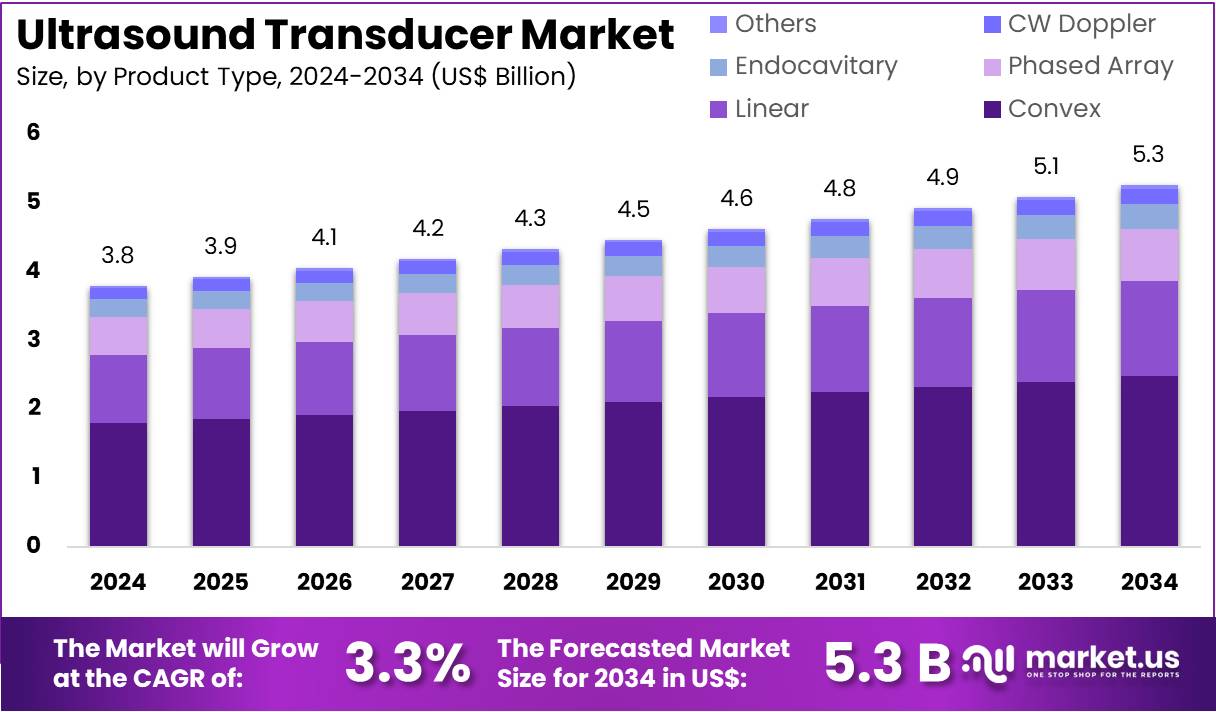
- In 2024, the ultrasound transducer market recorded US$ 3.8 billion in revenue and is projected to grow at a CAGR of 3.3% through 2034.
- By 2034, the global ultrasound transducer market is anticipated to reach a valuation of approximately US$ 5.3 billion, reflecting sustained industry expansion.
- Convex ultrasound transducers led the product segment in 2024, commanding a dominant market share of 47.2% due to their broad clinical applications.
- General imaging emerged as the top application segment, accounting for 41.7% of the market share, driven by rising demand in routine diagnostics.
- Hospitals and clinics represented the largest end-user group in 2024, contributing 56.8% of total revenue, attributed to high equipment adoption and patient volume.
- North America maintained its leadership position with a commanding 38.8% market share in 2024, supported by advanced healthcare infrastructure and technology adoption.
Get Sample: https://market.us/report/global-ultrasound-transducer-market/request-sample/
Regional Analysis
North America leads the ultrasound transducer market, holding a 38.8% revenue share. Growth is driven by rising clinical demand and technology innovation. The American College of Radiology reported a 9% increase in ultrasound exams in 2023. The US FDA approved 15 new transducer models between 2022 and 2023. The American Hospital Association noted a 12% rise in ultrasound system acquisitions. GE Healthcare increased transducer component output by 14%. Portable ultrasound sales surged by 25%, reflecting a shift toward compact systems in clinical and emergency care.
The Asia Pacific region is projected to register the highest CAGR during the forecast period. Growth is driven by expanding healthcare infrastructure and rising imaging demand. China’s National Health Commission reported an 18% rise in imaging procedures in 2023. India installed 5,200 new ultrasound units, marking a 22% increase. Japan reported an 11% increase in cardiac ultrasound applications. Manufacturers boosted production capacity by 30%. Indonesia invested US$150 million in diagnostic upgrades, signaling robust growth in ultrasound adoption across the region.
Segmentation Analysis
In 2024, the convex transducer segment led the ultrasound transducer market, capturing a 47.2% share. This dominance is attributed to its broad field of view and deeper tissue penetration. Convex transducers are widely used in obstetrics, gynecology, and abdominal imaging. Their ability to provide an ideal balance between image resolution and depth enhances diagnostic accuracy. With rising demand for improved imaging in deep-tissue diagnostics, healthcare providers increasingly prefer convex transducers. This segment is expected to maintain strong growth as clinical demand for non-invasive and precise diagnostics continues to rise.
The general imaging application segment accounted for 41.7% of the market share. This is driven by its broad applicability across multiple diagnostic areas, such as musculoskeletal evaluations, abdominal assessments, and trauma imaging. The growing incidence of chronic conditions, including liver and kidney diseases, supports this trend. Additionally, general imaging transducers are commonly used in routine health check-ups. Advancements in ultrasound technology that enhance image clarity and accuracy are likely to further strengthen this segment’s position in the global market.
Hospitals and clinics held a dominant 56.8% revenue share in the end-user segment. This growth is supported by the increased integration of advanced diagnostic tools in clinical settings. The rising volume of patients undergoing non-invasive procedures is fueling demand for ultrasound transducers in these facilities. Hospitals, especially those with imaging and diagnostic specialties, are prioritizing early disease detection. As healthcare infrastructure expands and providers aim for better diagnostic outcomes, the use of ultrasound technology in hospitals and clinics is expected to grow steadily over the forecast period.
By Product Type
- Linear
- Convex
- Phased array
- Endocavitary
- CW Doppler
- Others
By Application
- Cardiovascular
- General Imaging
- Musculoskeletal
- OB/GYN
- Vascular
- Others
By End-user
- Hospital & Clinics
- Diagnostic Center
- Ambulatory Surgery Centers
Key Players Analysis
Key players in the ultrasound transducer market emphasize innovation, portfolio expansion, and customer engagement to support market growth. Investments are directed toward developing high-performance transducers with enhanced imaging resolution, quicker processing, and ergonomic designs. These improvements are aimed at increasing diagnostic accuracy across clinical applications. Companies are also introducing specialized transducers for areas such as obstetrics, cardiology, and musculoskeletal imaging. Strategic collaborations with healthcare providers and diagnostic centers support broader adoption. Moreover, expanding into emerging markets offers significant growth potential due to increasing healthcare infrastructure and diagnostic needs.
Philips Healthcare, based in Amsterdam, Netherlands, is a prominent player in the ultrasound transducer market. The company provides a wide range of transducers tailored for diverse imaging applications. Philips focuses on improving image clarity and diagnostic performance through advanced features. Continued investments in research and development drive integration of technologies such as 3D imaging and portable systems. Through innovation and global partnerships, Philips maintains a competitive edge. Its strategic collaborations with healthcare providers globally support strong market presence and continued leadership in the medical imaging segment.
Leading Key Players in the Ultrasound Transducer Market
- Siemens Healthineers AG
- Koninklijke Philips N.V.
- GE HealthCare
- FUJIFILM Holdings Corporation
- Esaote SPA
- Carestream Health
- CANON MEDICAL SYSTEMS CORPORATION
- Analogic Corporation
Buy Directly: https://market.us/purchase-report/?report_id=145254
Conclusion
In conclusion, the ultrasound transducer market is expected to grow steadily in the coming years. This growth is mainly driven by the rising need for non-invasive and accurate diagnostic tools. The increased use of portable ultrasound systems and point-of-care diagnostics is supporting wider adoption across healthcare settings. Advancements in imaging technology, especially the integration of AI, are improving diagnostic accuracy and efficiency. Although high equipment costs remain a barrier, ongoing innovation and investments in emerging markets are opening new opportunities. As hospitals and clinics continue to prioritize early diagnosis and patient care, the demand for reliable and high-quality ultrasound transducers is expected to remain strong worldwide.
Get in Touch with Us:
Market.us (Powered By Prudour Pvt. Ltd.)
Address: 420 Lexington Avenue, Suite 300, New York City, NY 10170, United States.
Contact No: +1 718 874 1545 (International), +91 78878 22626 (Asia).
Email: [email protected]
View More



