
Overview
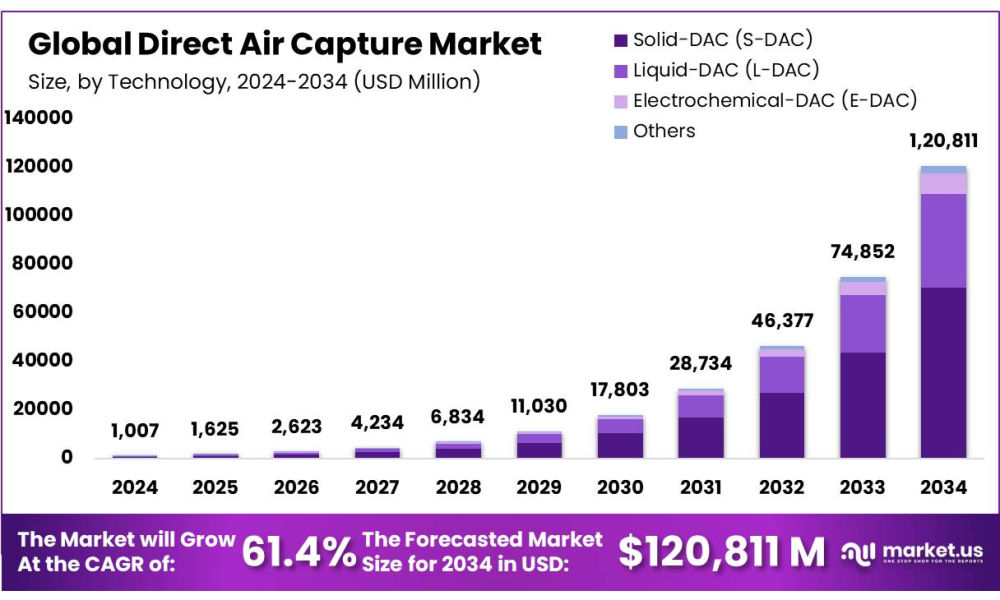
The global Direct Air Capture market is poised for substantial growth, projected to rise from USD 1,007.1 billion in 2024 to approximately USD 120,811 billion by 2034, reflecting an exceptionally high compound annual growth rate (CAGR) of 61.4% during the forecast period from 2025 to 2034. North America is expected to maintain its dominance, accounting for 48.3% of the global market share, driven by strong policy support and technological advancements.
DAC is a cutting-edge carbon removal technology designed to capture carbon dioxide (CO₂) directly from the atmosphere, regardless of proximity to emission sources. Unlike traditional carbon capture methods typically implemented at industrial sites or power plants, DAC employs advanced systems such as mechanical air contactors and chemical sorbents to extract CO₂. Once captured, the CO₂ can be either permanently stored in geological formations or utilized in sectors such as synthetic fuels, chemicals, construction materials, and beverage carbonation. This makes DAC particularly valuable for offsetting emissions in hard-to-decarbonize sectors, including aviation, maritime shipping, and agriculture.
The market is being propelled by global efforts to meet net-zero or net-negative emission targets, alongside expanding policy incentives. In the United States, the 45Q tax credit is offering significant support, while the European Union is advancing new carbon removal frameworks. Since 2020, approximately USD 4 billion has been committed to DAC research, development, and deployment, while leading DAC firms have raised around USD 125 million in private capital, indicating growing investor confidence and strong momentum in the sector.
Click here to get a Sample report copy@ https://market.us/report/direct-air-capture-market/free-sample/
Key Takeaways
- The global direct air capture market was valued at USD 1,007.1 million in 2024.
- The global direct air capture market is projected to grow at a CAGR of 61.4 % and is estimated to reach USD 120,811 million by 2034.
- Among technology, Solid-DAC (S-DAC) accounted for the largest market share of 58.3%.
- Among energy sources, electricity accounted for the majority of the market share at 68.3%.
- By number of collectors, less than 10 collectors accounted for the largest market share of 46.4%.
- By application, Carbon Capture, and Storage (CCS) accounted for the majority of the market share at 82.1%.
- Among end-use, oil & gas accounted for the largest market share of 34.5%
- North America is estimated as the largest market for direct air capture with a share of 48.3% of the market share.
Factors Affecting the Growth of the Direct Air Capture Market
- Climate Commitments and Net-Zero Targets: The global push toward achieving net-zero or net-negative carbon emissions by mid-century is one of the most significant drivers of the Direct Air Capture market. As governments, corporations, and international organizations strengthen their climate goals, Direct Air Capture is being recognized as a necessary tool for removing residual emissions from hard-to-decarbonize sectors like aviation, agriculture, and shipping.
- Strong Policy Support and Incentives: Government policies and financial incentives are playing a crucial role in accelerating the development and deployment of DAC technologies. In the United States, the 45Q tax credit offers significant per-tonne rewards for CO₂ captured and sequestered, while the Inflation Reduction Act (IRA) includes funding and incentives for carbon removal. Similarly, the European Union is advancing carbon removal certification frameworks to encourage market-based adoption.
- Increasing Investment and Private Sector Engagement: Since 2020, over USD 4 billion has been allocated to the research, development, and deployment of Direct Air Capture technologies. Additionally, private companies have raised nearly USD 125 million, demonstrating growing investor confidence in the scalability and commercial potential of Direct Air Capture. This influx of funding is facilitating technology innovation, cost reduction, and infrastructure development.
- Technological Advancements and Scalability: Continuous improvements in capture media, energy efficiency, and modular design are helping make Direct Air Capture systems more scalable and cost-effective. Advances in solid sorbents, chemical looping, and renewable-powered DAC units are further expanding deployment opportunities across various geographies.
Segmentation Analysis
Technology Analysis: In 2024, the Solid-DAC (S-DAC) segment led the direct air capture market, accounting for 58.3% of total revenue. Solid-DAC systems utilize solid adsorbents such as amine-based chemisorbents, metal-organic frameworks (MOFs), and zeolites, which enable effective CO₂ capture at ambient temperatures with relatively low energy consumption during the regeneration process. The modular nature of solid-DAC units allows for flexible deployment and scalability, making it more commercially viable and attractive for widespread application. These features contribute to its dominant position in the DAC technology landscape.
Energy Source Analysis: Electricity emerged as the leading energy source for DAC systems in 2024, commanding a market share of 68.3%. This dominance is driven by the increasing availability of low-carbon and renewable electricity, which aligns with the sustainability goals of minimizing emissions associated with DAC operations. Electrically powered DAC systems, especially those used in Solid-DAC configurations, offer higher scalability and easier integration with solar and wind energy, making them the preferred choice for both environmental and cost-efficiency reasons.
Number of Collector Analysis: The segment with less than 10 collectors held a leading position in 2024, capturing 46.4% of the market share. This trend reflects the early-stage nature of many DAC installations, which typically begin on a smaller scale to control costs and validate performance. These smaller units require lower capital investment, are easier to deploy, and are suitable for pilot projects or localized carbon removal strategies. Their flexibility and lower financial risk make them a practical solution for businesses seeking to reduce emissions without extensive infrastructure changes.
Application Analysis: Carbon Capture and Storage (CCS) dominated the direct air capture market in 2024 with a commanding 82.1% share. The preference for CCS is rooted in its ability to provide permanent storage of captured CO₂ in deep geological formations, aligning with long-term climate goals and carbon neutrality targets. While Carbon Capture, Utilization, and Storage (CCUS) offers additional benefits through industrial reuse of CO₂, CCS remains the favored solution for large-scale, durable carbon removal, supported by robust policy frameworks and financial incentives from governments worldwide.
End-Use Analysis: The oil & gas industry emerged as the largest end-use segment for direct air capture market in 2024, holding a 34.5% market share. The sector is leveraging DAC technologies to reduce its carbon footprint and comply with increasingly stringent environmental regulations. A key application within the industry is enhanced oil recovery (EOR), where captured CO₂ is injected underground to increase extraction while enabling long-term carbon sequestration. The industry’s existing infrastructure and consistent demand for CO₂ make it a central driver in the expansion and commercialization of DAC solutions.
Market Segments
By Technology
- Solid-DAC (S-DAC)
- Liquid-DAC (L-DAC)
- Electrochemical-DAC (E-DAC)
- Others
By Energy Source
- Electricity
- Heat
By Number of Collectors
- Less than 10 collectors
- More than 10 collectors
By Application
- Carbon Capture, and Storage (CCS)
- Carbon Capture Utilization and Storage (CCUS)
By End-Use
- Oil & Gas
- Food and beverage
- Automotive
- Chemicals
- Healthcare
- Others
To Purchase this Premium Report@ https://market.us/purchase-report/?report_id=117179
Geopolitical Impact Analysis
The introduction of a 10% universal import tariff in the U.S., along with steeper rates such as 54% on Chinese goods and 20% on EU imports, is raising costs and disrupting supply chains for the global Direct Air Capture (DAC) industry. These tariffs are increasing capital and operational expenses by affecting the import of key components like sorbents, membranes, and compressors—critical to DAC systems.
The proposed Foreign Pollution Fee Act (FPFA) further adds to policy uncertainty, prompting some firms to consider relocating operations to more stable regions, with Canada emerging as a key alternative. These trade actions are weakening U.S. competitiveness in DAC technology, slowing foreign investment, and risking delays in the deployment of carbon removal infrastructure.
Market Dynamics
The Direct Air Capture (DAC) market is gaining momentum as global efforts intensify to reach net-zero emissions. According to the IEA, DAC is expected to capture over 85 million tonnes of CO₂ annually by 2030, rising to around 980 million tonnes by 2050. The IPCC estimates DAC could contribute up to 310 gigatons of CO₂ removal by 2100.
Government support is expanding, with Canada investing CAD 8 billion through its Net Zero Accelerator and the U.S. offering tax credits of up to USD 180 per tonne for DAC projects. Companies like Amazon have also committed to purchase 250,000 tonnes of CO₂ removal, boosting private investment. However, adoption is restrained by high costs—ranging between USD 250 to USD 600 per tonne—and heavy energy demands, limiting accessibility for SMEs.
Despite this, synthetic fuels made from DAC-captured CO₂ present a significant opportunity, especially for aviation and shipping. Initiatives like the U.S. SAF Grand Challenge and the EU’s ReFuelEU Aviation plan—targeting 28% synthetic fuel use by 2050—are driving demand. Emerging DAC technologies, including electro-swing adsorption and membrane-based systems, are also shaping future growth by offering potential cost and efficiency improvements.
Market Key Players
- Avnos, Inc.
- Capture6
- Carbon Capture Inc.
- Carbon Collect Limited
- Carbon Engineering ULC
- Carbyon
- Global Thermostat
- Heirloom Carbon Technologies
- Immaterial
- Infinitree LLC
- Mission Zero Technologies
- Mosaic Materials Inc.
- Noya PBC
- Octavia carbon
- RepAir Carbon
- Skytree
- Soletair Power
- Southern Green Gas Limited
- Spiritus
- Sustaera Inc.
- Climeworks AG
- Carbon Xtract Corporation
- Other Key Players
Regional Analysis
In 2024, North America led the global direct air capture (DAC) market, commanding a substantial 48.3% share. This dominance is fueled by strong governmental backing for climate change mitigation, favorable policy frameworks, and increasing levels of public-private investment. The region is home to high-emission sectors such as aviation, power, and energy, making it a priority zone for large-scale decarbonization efforts. Both the United States and Canada have committed to achieving net-zero emissions by 2050, which requires not only reducing emissions but also actively removing carbon dioxide from the atmosphere. As a result, DAC technologies are gaining traction as a key strategy to meet these goals.
According to EMF 37 models, the U.S. may need to capture between 100 million to 2 billion tonnes of CO₂ per year through DAC by 2050 to meet its climate targets. This demand has led to the implementation of supportive financial instruments such as the U.S. 45Q tax credit, which incentivizes CO₂ capture and permanent storage. In addition, significant funding is being allocated by the U.S. Department of Energy for the creation of regional DAC hubs. Canada, on the other hand, is advancing DAC through national programs like the Net Zero Accelerator, which commits CAD 8 billion, and the Climate Action and Awareness Fund, investing CAD 206 million to support carbon removal technologies.
Conclusion
In summary, cyclopentane position as a low-GWP, high performance intermediate places it at the forefront of environmentally driven market trends. Stakeholders are advised to continue investing in purification technologies, strengthen regional supply chains, and expand into high-growth regions with supportive regulatory frameworks. These strategic measures are anticipated to sustain cyclopentane’s growth trajectory and align with global energy and environmental objectives.
Get in Touch with Us:
Market.us (Powered By Prudour Pvt. Ltd.)
Address: 420 Lexington Avenue, Suite 300 New York City, NY 10170, United States
Send Email: [email protected]
Refer More Reports:
Trans-2, 6-Dimethylmorpholine Market
Italy Power Purchase Agreement Market
2-Fluoro-4-Methylphenol Market



