
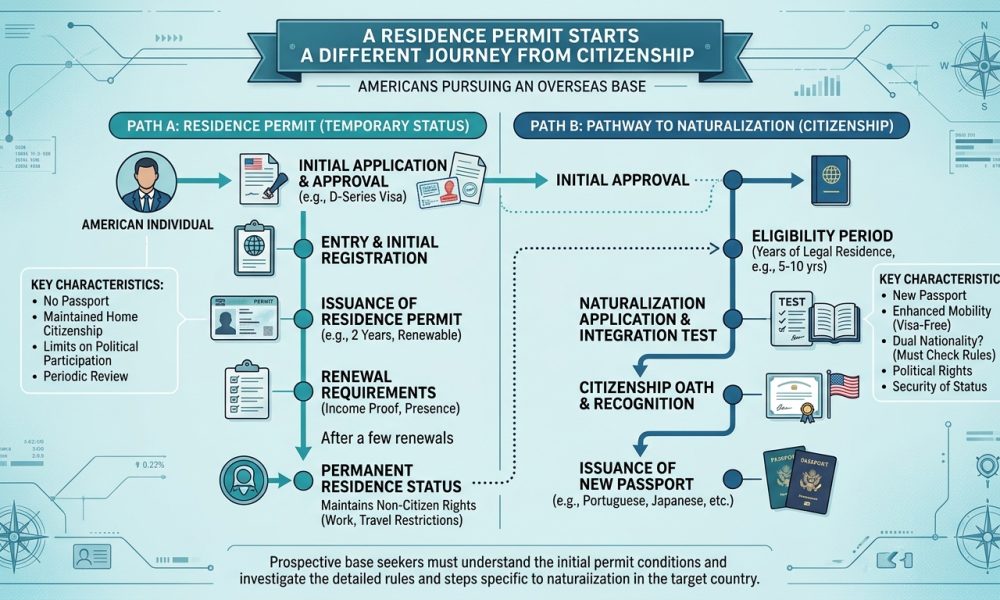
Americans pursuing an overseas base need to understand the status they would initially receive and investigate any additional steps involved in a potential naturalization application.
WASHINGTON, DC, October 31, 2026. Wealthy Americans exploring long-term residence abroad are discovering that obtaining a foreign residence permit can provide valuable international flexibility. Still, the legal process begins rather than ends when immigration authorities approve an individual’s application to live in another country.
From Mexico and Panama to Portugal, Greece, Thailand and Malaysia, internationally mobile families are comparing immigration programs that provide varying degrees of residential security while investigating whether those arrangements can eventually support permanent residence, naturalization and the issuance of a second passport.
For retirees, entrepreneurs, investors and affluent households, the attraction often involves establishing another place to live without immediately abandoning American citizenship, financial connections or existing family responsibilities, particularly when international mobility forms part of a broader long-term strategy.
However, the distinction between temporary residence, permanent residence and citizenship can create substantial misunderstandings when applicants assume that maintaining an immigration card for several years automatically establishes entitlement to nationality or guarantees approval of a passport application.
According to AMICUS INTERNATIONAL CONSULTING, which advises internationally mobile clients on lawful relocation, second citizenship and overseas planning, prospective applicants should identify the exact legal status they will receive and understand the separate requirements governing any future naturalization application.
The difference matters because a residence permit may authorize an individual to live overseas while remaining subject to renewal requirements, immigration restrictions, and government review. In contrast, citizenship establishes a separate legal relationship with the country under its nationality legislation.
For Americans considering international relocation in 2026, the essential question is not simply which country offers convenient residence permission, but whether the available legal pathway genuinely supports their intended lifestyle, family responsibilities and eventual nationality objectives.
Why Residence Permits Are Attracting International Interest
Overseas residence programs have become a major part of international financial and lifestyle planning, particularly among Americans seeking more mobility where they live, operate businesses, access healthcare, and build long-term connections.
An American entrepreneur may want a residence permit allowing extended stays in Mexico. At the same time, a retired executive may consider Thailand because of its private healthcare infrastructure, residential amenities, and established international communities.
For other applicants, the goal is to maintain a second home in Europe or Latin America while keeping the ability to travel regularly between the United States and another country as professional circumstances require.
The growing conversation is reflected in Google News coverage of second residency, golden visas and citizenship pathways, where international immigration programs frequently appear alongside discussions about financial diversification, overseas property and long-term residential flexibility.
However, the opportunities described in these discussions can involve substantially different legal rights, making it important to distinguish programs that provide temporary immigration permission from those that establish permanent residence or recognized citizenship.
For wealthy Americans, obtaining residence permission may be an important first step toward international. Still, its value is uncertain, but its long-term value depends on whether it remains legally sustainable and compatible with personal objectives.
A Residence Permit Provides Immigration Permission, Not Nationality
A residence permit generally authorizes a foreign national to live within a country’s territory under conditions set by immigration legislation, which may include financial qualifications, employment, investment, retirementincome,, or recognized family relationships.
Depending on the jurisdiction, successful applicants may receive a physical residence card, an electronic authorization, or a visa permitting extended residence. However, the rights and restrictions associated with each arrangement can differ considerably.
A person holding a Mexican temporary residence card, for example, remains a foreign national until Mexican citizenship is acquired or otherwise recognized through an appropriate legal process administered by the relevant authorities.
Similarly, an American holding a long-term Thai immigration visa does not automatically become a Thai citizen, regardless of the document’s validity period or the financial commitments associated with obtaining the authorization.
The distinction matters most when residence permits are promoted as steps toward a second passport, since nationality eligibility may depend on additional legal requirements that remain separate from the original immigration application.
For prospective residents, the most useful starting point is understanding what the permit authorizes, how it can be maintained, and whether the status can contribute to future citizenship eligibility.
Temporary Residence Is Often the Beginning of the Process
Temporary residence programs commonly accommodate foreign nationals who satisfy specific eligibility requirements, allowing individuals to establish an authorized residential connection without immediately obtaining the more durable rights associated with permanent immigration status.
An applicant may qualify through retirement income, independent financial resources, employment sponsorship, family relationships, or an approved investment, depending on the categories recognized under the destination country’s legislation.
These arrangements can provide meaningful benefits, including the ability to remain overseas for extended periods, establish accommodation and access certain services while complying with local immigration requirements.
However, temporary residence may require periodic renewal, continued financial eligibility, maintaining qualifying employment, or compliance with limits on permitted activities and time spent outside the country.
For an American business owner, a temporary residence arrangement may provide sufficient flexibility to manage international travel while maintaining commercial operations and personal relationships in the United States.
For someone whose ultimate objective involves citizenship, however, temporary residence should be assessed based on whether the relevant nationality legislation recognizes that immigration category as qualifying residence for naturalization.
Permanent Residence Is a Separate Legal Milestone
Permanent residence generally provides a more durable immigration position than temporary residence, allowing qualifying foreign nationals to maintain a long-term residential connection under the destination country’s laws.
However, the term permanent does not necessarily mean immigration status can never be lost, particularly when authorities impose conditions related to lengthy absences, serious legal violations, or other statutory circumstances.
Permanent residents may gain broader employment rights or access to certain public services, depending on domestic legislation, but they ordinarily remain foreign nationals without the full rights associated with citizenship.
For wealthy Americans who primarily want a dependable second home, permanent residence may provide the intended benefits without the additional obligations or eligibility requirements of naturalization.
Other applicants may treat permanent residence as an intermediate stage toward nationality, particularly where immigration legislation requires a period of established residence before individuals become eligible to apply for citizenship.
The key question is whether permanent residence is the desired outcome or another stage in a longer legal process that may require additional documentation, physical presence, and government approval.
Citizenship Establishes a Different Relationship With the Country
Citizenship generally establishes a recognized legal relationship between an individual and a sovereign state, potentially providing nationality-based rights of entry, residence and access to a national passport under applicable domestic legislation.
Unlike ordinary residence permission, citizenship is not simply an administrative authorization to remain temporarily, although nationality can still involve responsibilities and legal consequences that applicants must understand before acquiring it.
Naturalization requirements may include qualifying residence, language proficiency, knowledge of national history, evidence of lawful conduct, and formal procedures through which government authorities determine whether to grant nationality.
Some individuals may already qualify for citizenship through birth or ancestry, while others must complete years of authorized residence before becoming eligible to submit a naturalization application.
These differences explain why citizenship by descent, ordinary naturalization, and investment residence programs should not be treated as interchangeable arrangements simply because all can appear in international passport discussions.
For internationally mobile Americans, the practical value of citizenship depends on the rights it provides and whether those rights support the applicant’s intended residential, financial and family circumstances.
Mexico Illustrates the Difference Between Residence and Naturalization
Mexico offers an instructive example because Americans may qualify for temporary or permanent residence under applicable immigration categories while facing separate requirements when pursuing Mexican nationality.
The country’s ordinary naturalization framework generally requires at least five years of qualifying residence immediately preceding the application. However, legislation provides shorter periods for certain individuals who satisfy recognized statutory exceptions.
The Mexican government’s official naturalization requirements explain the importance of establishing qualifying immigration residence and submitting documents that support the applicant’s identity, lawful status, and eligibility under the nationality framework.
Applicants may need to submit properly authenticated civil records, current immigration documentation, passport information, evidence concerning travel history, and other materials requested during the government review process.
Mexico’s nationality rules also contain requirements involving Spanish language ability, national history and cultural integration, with certain exceptions applying according to an applicant’s circumstances and the relevant legislation.
An American who maintains a residence card while spending substantial time outside Mexico should therefore review the rules governing absences and qualifying residence before assuming that five calendar years establishes citizenship eligibility.
European Residence Programs Require Separate Nationality Planning
European immigration programs illustrate why prospective applicants should distinguish the right to maintain a residence permit from the additional conditions necessary to obtain citizenship through naturalization after a qualifying period.
Portugal’s investment residence framework gained international recognition because it offered qualifying investors immigration flexibility with relatively limited physical presence obligations. However, citizenship eligibility remains governed by nationality legislation rather than investment program marketing.
Portugal introduced substantial nationality reforms effective May 19, 2026, increasing ordinary naturalization residence periods to ten years for nationals of countries outside the European Union and Portuguese-speaking community, subject to applicable transitional provisions.
For Americans considering new Portuguese residence applications, those changes make it especially important to examine the naturalization framework separately from the conditions governing investment residence and the financial commitments needed to maintain immigration authorization.
Greece offers another example because qualifying investment residence can provide useful residential rights without automatically establishing the genuine residence, integration and other conditions that may be necessary for eventual Greek naturalization.
An American investor who maintains a European residence permit while spending most of the year elsewhere should therefore examine whether the arrangement supports the intended nationality outcome rather than assuming permit renewals establish citizenship eligibility.
Asian Long-Term Visas Often Serve Different Purposes
Thailand and Malaysia offer immigration arrangements that can accommodate qualifying foreign nationals interested in retirement, international business activities, or extended residential flexibility without necessarily providing a direct route toward citizenship.
Thailand’s Long-Term Resident Visa program includes categories for wealthy individuals, qualifying pensioners and specified professional groups, with immigration privileges potentially extending over ten years when applicants satisfy the relevant requirements.
Thailand Privilege memberships offer another form of extended immigration permission, while retirement categories accommodate qualifying applicants who meet age, financial, and administrative conditions under the country’s immigration framework.
However, extended visa validity does not automatically confer Thai permanent residence or nationality, so individuals seeking citizenship must follow a separate legal process involving residence history and additional statutory requirements.
Malaysia’s My Second Home program similarly provides long-term immigration privileges through different membership categories, but participation should not be confused with automatic Malaysian permanent residence or eligibility for nationality.
For Americans whose primary goal is a comfortable retirement or extended residence, these arrangements may offer substantial practical benefits even when eventual citizenship is neither realistic nor necessary.
Physical Presence Can Determine Future Citizenship Eligibility
One of the most important distinctions in naturalization planning is the difference between holding legal immigration status and showing that the applicant actually met the residence requirements set by nationality legislation.
Some countries recognize qualifying legal residence over a prescribed period, while others impose physical presence conditions, habitual residence requirements, or limits on the time an applicant may spend abroad.
An American who maintains an apartment overseas and renews the associated residence card may therefore have a different legal position from someone who genuinely establishes their principal household within the destination country.
Immigration authorities may examine travel histories, residential records and other evidence when determining whether applicants have satisfied the conditions governing continued residence or a subsequent citizenship application.
For internationally mobile entrepreneurs, frequent travel can complicate these calculations because professional obligations may require substantial periods away from the country where an individual hopes eventually to naturalize.
Applicants should set realistic residence schedules before choosing a jurisdiction, especially when their long-term nationality goals depend on maintaining a continuous or sufficiently substantial connection to the destination.
Naturalization Usually Requires More Than Completing a Residence Period
Completing a qualifying residence period generally marks an eligibility milestone rather than automatic citizenship, since applicants may still need to meet language, conduct, civic knowledge, and documentary requirements.
Some countries administer examinations to assess language proficiency or familiarity with national history, while others review criminal records, immigration compliance, and evidence that the applicant meets applicable statutory standards.
A person who has maintained lawful residence for the required number of years may therefore remain a foreign national until the government completes its procedures and formally grants or recognizes citizenship.
For Americans who expect an immediate passport after satisfying the minimum residence period, these additional administrative stages can create significant differences between anticipated timelines and actual outcomes.
The appropriate planning process should distinguish the earliest date an applicant may become eligible to apply from the later date on which nationality might actually be acquired.
Only after citizenship has been lawfully recognized can the individual seek the corresponding national passport under the issuing country’s applicable identity and travel document procedures.
Government Documentation Supports Every Stage of the Process
A legitimate transition from foreign residence to citizenship requires appropriate documentation that establishes identity and status, and compliance with the legal requirements governing the specific pathway.
Depending on the jurisdiction, applicants may need authenticated birth certificates, valid passports, residence cards, marriage records, criminal history documentation and evidence establishing the relevant period of qualifying residence.
Government authorities may also require applicants to provide travel histories, language examination results, or other materials supporting the information in their nationality applications and accompanying declarations.
For individuals maintaining residences across several countries, organizing these documents early can reduce administrative difficulties when records issued by different governments contain inconsistent names, dates, or other identifying information.
However, correct discrepancies through authorized procedures rather than concealing them, since reliable identity documentation and accurate residence histories are essential to legitimate immigration and nationality applications.
A genuine passport must ultimately reflect citizenship recognized by the issuing government, not merely the possession of immigration documents or the completion of an overseas investment transaction.
Property Ownership Does Not Automatically Establish Immigration Rights
Americans purchasing homes abroad should understand that real estate ownership and immigration permission fall under separate legal frameworks, even when certain countries offer residence programs tied to qualifying investments.
An individual may lawfully own an apartment in Bangkok, a residence in Mexico, or a property in Europe without automatically gaining the right to remain indefinitely in that jurisdiction.
Some authorized investment residence programs recognize particular property transactions, but eligibility depends on the exact legislation, investment conditions, and documentation requirements in effect when the application is submitted.
A substantial property purchase therefore should not be treated as a substitute for examining immigration eligibility, particularly when the buyer intends to occupy the residence throughout retirement.
The issue becomes even more important when citizenship is the eventual objective, because owning property does not necessarily establish physical presence, integration, or other conditions required for naturalization.
For affluent Americans, the strongest approach involves evaluating the property as an investment and lifestyle decision while independently confirming the immigration rights necessary to support its intended use.
Family Members May Follow Different Immigration and Citizenship Rules
International residence programs often allow qualifying spouses and dependent children to accompany the principal applicant, but eligibility requirements and the long-term rights available to family members can differ.
Children may face age restrictions, continuing dependency conditions, or separate educational requirements, particularly when a residence arrangement remains in place over several years before naturalization becomes possible.
The situation can become more complicated when a dependent child reaches adulthood before the principal applicant completes the qualifying period necessary to pursue citizenship.
A spouse may also need to satisfy separate language, residence or documentary requirements, depending on whether nationality is sought independently or through a recognized family-related pathway.
Families should therefore review each household member’s immigration status before assuming that approval of the principal applicant automatically establishes equivalent permanent residence or citizenship rights for everyone.
For wealthy Americans planning international mobility across generations, these distinctions can affect education, retirement arrangements,, and familymembers’ abilitys to establish independent lives abroad.
A Second Passport Does Not Automatically Replace American Citizenship
Americans considering naturalization abroad should understand that acquiring another nationality does not automatically terminate United States citizenship, although the laws of the country granting citizenship may impose additional restrictions.
The United States generally recognizes that its citizens may hold another nationality, but individuals must still comply with applicable American legal responsibilities and the laws of their other country.
Some countries restrict dual nationality or require applicants to address existing citizenship before naturalization, making this issue especially important when the applicant intends to retain an American passport.
Dual nationals may also encounter additional requirements involving national Identification documents, military obligations, or the use of particular passports when entering and departing countries where they hold citizenship.
Acquiring another nationality may provide meaningful residential and travel rights, but those rights should not be confused with complete freedom from existing legal or financial responsibilities.
For applicants seeking an additional citizenship primarily for family security or mobility, evaluate the destination’s treatment of dual nationality before committing to a lengthy residence strategy.
Tax Residence Is Another Separate Legal Consideration
Immigration residence and tax residence are frequently discussed together, but the legal tests governing these statuses can differ considerably, creating financial consequences that prospective residents should investigate before relocating.
A person may hold an immigration permit without satisfying the destination country’s tax residence requirements, while another individual may become a tax resident through physical presence or other recognized connections.
American citizens generally remain subject to federal taxation on worldwide income, so foreign residence and eventual citizenship alone are insufficient to eliminate existing United States tax obligations.
Foreign bank accounts, investment structures and certain overseas business activities may also create additional financial reporting responsibilities, regardless of whether the individual holds temporary residence, permanent residence or another nationality.
For wealthy families, tax planning should therefore accompany immigration and citizenship analysis, particularly when substantial investments, retirement income or business operations involve multiple countries.
The goal is to establish legally compliant financial arrangements that remain workable throughout the residence period and after any eventual naturalization application is approved.
Five Questions Americans Should Ask Before Applying for Residence
Prospective applicants can avoid misunderstandings by considering several fundamental questions before selecting an overseas residence program, especially when the ultimate goal is to obtain another passport through lawful naturalization.
1. What Legal Status Will the Government Initially Grant?
Applicants should determine whether the immigration arrangement provides temporary residence, permanent residence, or another type of authorization, since the rights and obligations accompanying each category can differ substantially.
2. Does This Residence Category Qualify Toward Citizenship?
Prospective citizens should confirm whether their specific immigration status counts toward naturalization eligibility, recognizing that some long-term visa arrangements provide residency rights without a direct path to citizenship.
3. How Much Time Must Actually Be Spent Overseas?
Applicants should examine minimum presence requirements, permitted absences, and rules governing continuity of residence, particularly when professional responsibilities or family commitments require frequent international travel.
4. What Additional Naturalization Requirements Must Be Completed?
Identify language proficiency, civic examinations, criminal history documentation, and other statutory conditions early, because completing the required residence period does not automatically guarantee citizenship approval.
5. Can the Family Maintain the Arrangement Over Several Years?
Applicants should evaluate immigration renewal expenses, housing, healthcare, taxation, and family eligibility before committing resources to an arrangement that may require substantial financial and residential obligations over time.
Immigration Policy Changes Can Affect Long-Term Plans
International residence and citizenship planning often involves commitments lasting several years, leaving applicants vulnerable to changes in eligibility requirements, investment conditions,, and nationality legislation beforethey reach their objectivesd.
A residence program that offers attractive financial or administrative terms when an individual first applies may operate under substantially different conditions by the time naturalization becomes possible.
Governments can amend qualifying residence periods, revise documentation requirements, or change the economic conditions associated with particular immigration categories, sometimes introducing transitional provisions for existing applicants.
For wealthy Americans, these developments highlight the importance of distinguishing rights already granted from future opportunities that remain subject to legislation and government approval.
A sustainable international strategy should allow flexibility when legal requirements change, rather than relying entirely on predictions about future naturalization timelines or the continued availability of specific immigration incentives.
Applicants should review current government requirements periodically and seek qualified advice before making significant financial commitments based on the assumption that existing nationality rules will remain unchanged indefinitely.
Second Passport Planning Begins With Lawful Eligibility
For Americans whose ultimate objective is to obtain another nationality, evaluate international residence as one component of a broader legal process rather than an automatic route to an additional passport.
AMICUS INTERNATIONAL CONSULTING advises that individuals exploring lawful second passport and citizenship planning should distinguish immigration authorization, qualifying residence, and formal nationality recognition before selecting a destination or committing substantial financial resources.
An applicant may maintain residence for several years while remaining ineligible for citizenship because applicable nationality legislation requires additional physical presence, language proficiency, or other statutory conditions.
Conversely, an individual with a legitimate citizenship claim through ancestry may qualify under an entirely different legal process without relying on an ordinary investment residence arrangement.
The most appropriate pathway depends on the applicant’s personal circumstances, existing nationality rights, and willingness to satisfy the requirements imposed by the destination country’s government.
For internationally mobile families, identifying the right legal pathway early can prevent misunderstandings about what residence status provides and what further steps remain necessary.
A Trial Residence Can Help Determine Whether Citizenship Makes Sense
For Americans unfamiliar with a prospective destination, spending an extended period there under appropriate immigration permission can provide useful information before establishing a permanent household or pursuing a lengthy naturalization strategy.
A country that seems attractive on a short vacation may present different challenges with healthcare, language, transportation, family integration, and access to professionalservices in everydayy life.
Retirees may find that an overseas residence offers the lifestyle they want without requiring citizenship, while entrepreneurs may find that permanent relocation conflicts with their existing business responsibilities.
Families with children may place greater importance on educational continuity and long-term stability, particularly when future naturalization eligibility depends on maintaining meaningful residence within the destination.
A trial period can also help applicants establish realistic financial expectations before purchasing property or entering arrangements involving substantial investment commitments and continuing immigration expenses.
The objective is to determine whether the destination genuinely supports the intended lifestyle before treating citizenship as the inevitable or necessary final stage of international residence.
The Future of International Residence Depends on Understanding Each Step
Americans exploring overseas residence in 2026 face an increasingly diverse range of immigration opportunities, but the legal differences between temporary permission, permanent settlement, and citizenship remain fundamental to successful planning.
A residence permit can provide meaningful international flexibility, allowing qualifying individuals to establish another household, access services and spend extended periods abroad while maintaining their existing nationality.
Permanent residence may offer greater long-term stability, but it generally remains an immigration position rather than complete membership in the country’s national community through recognized citizenship.
Naturalization introduces a separate legal process involving qualifying residence, documentary evidence, and government review, with the exact requirements determined by the destination’s nationality legislation.
For wealthy Americans, the strongest international strategy starts with identifying the desired legal outcome, then evaluating whether the available immigration pathway can realistically support it.
A residence permit can open the door to a new life abroad. Still, citizenship requires a separate legal journey built on qualifying residence, accurate documentation, and compliance with the laws of the country granting nationality.
For Americans considering a second home, permanent relocation or an additional passport, lasting international flexibility depends on understanding exactly what the first immigration approval provides and what must happen before a future naturalization application can succeed.




