

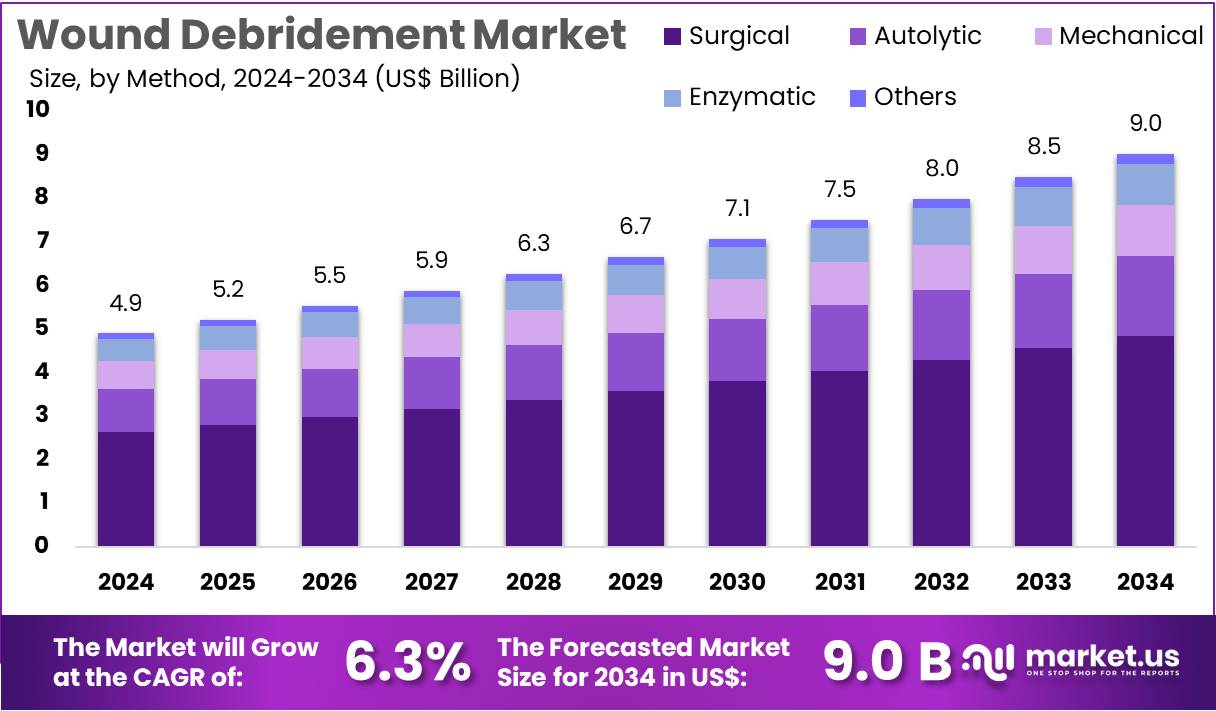
The Global Wound Debridement Market is projected to grow from US$ 4.9 billion in 2024 to US$ 9 billion by 2034, expanding at a CAGR of 6.3% during the forecast period. North America currently leads the market with over 43.1% share, accounting for US$ 2.1 billion in value. Growth is primarily driven by the rising prevalence of chronic wounds and diabetic ulcers. Effective wound management, particularly debridement, is vital for preventing infections and promoting faster healing, leading to increasing demand for advanced wound care solutions worldwide.
Awareness of advanced wound care and the benefits of debridement in improving recovery times is growing steadily. Technological advancements in wound debridement, such as enzymatic agents, hydrogels, and mechanical systems, offer more effective treatment options. Healthcare professionals prefer minimally invasive approaches that reduce pain and infection risks while enhancing patient comfort. The increasing elderly population, particularly in developed regions, is further fueling demand, as older adults are more prone to chronic wounds and delayed healing, thus requiring efficient wound care solutions.
The increasing prevalence of diabetes and vascular diseases continues to boost demand for advanced wound debridement systems. According to the American Diabetes Association, over 37 million Americans had diabetes in 2023, with many developing chronic foot ulcers. These conditions often require regular debridement. Major players like Smith & Nephew and Molnlycke have expanded their product lines and reported growth in enzymatic and hydrosurgical systems. Moreover, aging populations in Japan and Europe are contributing to higher demand for specialized wound care and debridement technologies.
Despite strong market potential, high treatment costs and reimbursement issues are restraining growth. Enzymatic debridement treatments may cost between US$ 350 and US$ 800 per session, while reimbursement from Medicare often covers only 60–75% of the cost. Emerging markets face greater challenges, with limited access to advanced technologies due to out-of-pocket expenses. Additionally, rising denial rates from private insurers for biologic debridement agents present another financial burden. These limitations are hampering wider adoption, especially in resource-limited healthcare systems.
Telemedicine is emerging as a key opportunity in the wound debridement market. Remote wound monitoring platforms and digital tools are driving demand for home-based debridement solutions. The integration of disposable debridement products with mobile apps has seen notable success. In 2023, virtual wound consultations increased sharply, and new insurance policies now support tele-wound care services. These trends are improving accessibility, especially in rural areas. Additionally, interest in biosurgical and enzyme-based agents continues to rise, offering efficient and biologically targeted care that aligns with global healthcare advancements.
Key Takeaways
- In 2024, the global wound debridement market generated approximately US$ 4.9 billion in revenue, expected to reach US$ 9.0 billion by 2033.
- The market is growing at a compound annual growth rate (CAGR) of 6.3% over the forecast period from 2024 to 2033.
- Medical gauzes led the product type segment in 2024, accounting for a dominant market share of 51.8%.
- Other product categories include gels, ultrasonic devices, surgical devices, ointments & creams, and miscellaneous wound care products.
- Surgical wound debridement methods held the highest market share among all methods in 2024, securing 53.7% of total revenue.
- Additional debridement methods include autolytic, enzymatic, mechanical, and other emerging techniques.
- Diabetic foot ulcers emerged as the top application area, capturing 47.5% of the wound debridement market’s revenue in 2024.
- Other application areas include pressure ulcers, venous leg ulcers, burn wounds, and a range of other chronic wounds.
- Hospitals represented the leading end-user group in 2024, contributing 59.4% of the market’s overall revenue.
- The end-user landscape also consists of homecare settings and other healthcare providers offering wound care services.
- North America held the largest regional market share in 2024, accounting for 43.1% of the global wound debridement market.
Get Sample: https://market.us/report/global-wound-debridement-market/request-sample/
Segmentation Analysis
The medical gauzes segment led the wound debridement market in 2024, capturing a 51.8% share. This dominance is driven by the growing demand for effective wound care products. Medical gauzes aid in wound healing by creating a suitable environment for tissue regeneration. They are widely used in wound dressings and help remove necrotic tissue during debridement. Their versatility and ease of use make them a preferred choice, especially in treating chronic wounds. Advancements in gauze formulations designed to improve healing are expected to further support market expansion.
The surgical method held a significant 53.7% market share, supported by increasing patient preference for efficient debridement procedures. Surgical debridement removes large volumes of necrotic tissue in one session, making it ideal for severe wounds. Conditions like diabetes and vascular disease are contributing to this trend. Technological innovations, including minimally invasive surgical techniques, are anticipated to boost adoption. Moreover, the growing number of surgeries worldwide is expected to enhance demand for reliable and effective wound care solutions.
The diabetic foot ulcers application segment recorded strong growth, accounting for 47.5% of market revenue. This is attributed to the rising global incidence of diabetes and the associated risk of foot ulcers. Diabetic foot ulcers often require frequent and targeted debridement to promote healing and avoid complications. The development of specialized debriding agents and wound dressings supports this segment’s expansion. Increased clinical focus on managing diabetic wounds efficiently is expected to further drive demand for advanced debridement solutions tailored to these complex conditions.
Hospitals held a dominant position in the end-user segment, generating 59.4% of market revenue. Hospitals are essential for managing chronic and complex wounds due to their advanced infrastructure and specialized care. The increasing volume of surgical procedures and chronic illnesses has led to higher demand for hospital-based wound debridement. Continuous technological advancements and improved wound management protocols are also encouraging hospitals to invest in better solutions. As healthcare systems evolve, the role of hospitals in wound care delivery is expected to grow significantly.
By Product Type
- Gels
- Ultrasonic Devices
- Surgical Devices
- Ointments & Creams
- Medical Gauzes
- Others
By Method
- Autolytic
- Surgical
- Mechanical
- Enzymatic
- Others
By Application
- Pressure Ulcers
- Venous Leg Ulcers
- Diabetic Foot Ulcers
- Burn Wounds
- Others
By End-user
- Hospitals
- Homecare
- Others
Key Players Analysis
Key players in the wound debridement market focus on innovation, partnerships, and global expansion to support market growth. Companies invest in developing advanced products such as enzymatic treatments, specialized debridement tools, and smart dressings. These products aim to improve wound healing, reduce infection risks, and enhance patient outcomes. Collaborations with healthcare providers and research bodies help improve product efficiency and drive clinical adoption. Targeting emerging markets with rising healthcare demand also presents new growth avenues for manufacturers in this segment.
Regulatory compliance and customization are key strategies used to strengthen market presence. Companies aim to meet strict standards while offering tailored solutions that suit specific wound types and patient needs. Smith & Nephew, based in Watford, England, is a major player in advanced wound management. The firm produces a wide range of debridement tools and technologies. With its strong global footprint, Smith & Nephew continues to grow through acquisitions, product innovation, and clinical collaborations, reinforcing its leadership in the wound care industry.
Leading Key Players in the Wound Debridement Market
- Smith & Nephew
- Molnlycke Health Care AB
- Medline Industries
- Lohmann & Rauscher
- Integra LifeSciences
- ConvaTec Group
- Braun SE
- 3M
Buy Directly: https://market.us/purchase-report/?report_id=145240
Regional Analysis
North America held the largest share in the wound debridement market, contributing 43.1% of total revenue. This dominance is supported by the increasing incidence of chronic wounds and adoption of advanced technologies. The CDC reported that foot ulcers now impact 15% of diabetic patients, rising from 13% in 2022. Hospital-acquired pressure injuries rose by 12% from 2022 to 2023, as per the American Hospital Association. These factors are boosting demand for effective debridement methods across hospitals, clinics, and home healthcare services in the region.
In 2023, the U.S. FDA approved five new enzymatic debridement products, expanding clinical treatment options. Medicare data revealed a 9% increase in reimbursement claims for debridement procedures, reflecting growing utilization. The U.S. Veterans Health Administration invested US$ 350 million in wound care programs in 2024, further supporting market growth. Combined with public and private sector engagement, these developments ensure continued advancement in wound care delivery across North America’s healthcare infrastructure.
The Asia Pacific region is projected to witness the highest CAGR in the forecast period. This growth is driven by rising diabetes prevalence and increased investments in healthcare infrastructure. India recorded a 22% rise in diabetic foot ulcer cases from 2022 to 2023. China’s updated wound care guidelines and Japan’s aging population, which led to a 17% increase in chronic wound cases, are also contributing. Australia allocated US$ 120 million for wound care research in 2024, while South Korea saw a 14% increase in wound care reimbursements, signaling greater clinical adoption across the region.
Conclusion
In conclusion, the global wound debridement market is showing steady growth due to rising cases of chronic wounds, diabetic ulcers, and aging populations. Hospitals and healthcare providers are increasingly adopting advanced wound care solutions to support faster healing and prevent infections. New technologies, such as enzymatic agents and surgical tools, are making treatments more effective and patient-friendly. Although high treatment costs and limited reimbursement continue to pose challenges, expanding access to telemedicine and digital wound care platforms is opening new opportunities. With growing awareness and government support, the demand for innovative debridement methods is expected to rise, especially in emerging healthcare markets across Asia and other developing regions.
Get in Touch with Us:
Market.us (Powered By Prudour Pvt. Ltd.)
Address: 420 Lexington Avenue, Suite 300, New York City, NY 10170, United States.
Contact No: +1 718 874 1545 (International), +91 78878 22626 (Asia).
Email: [email protected]
View More



