
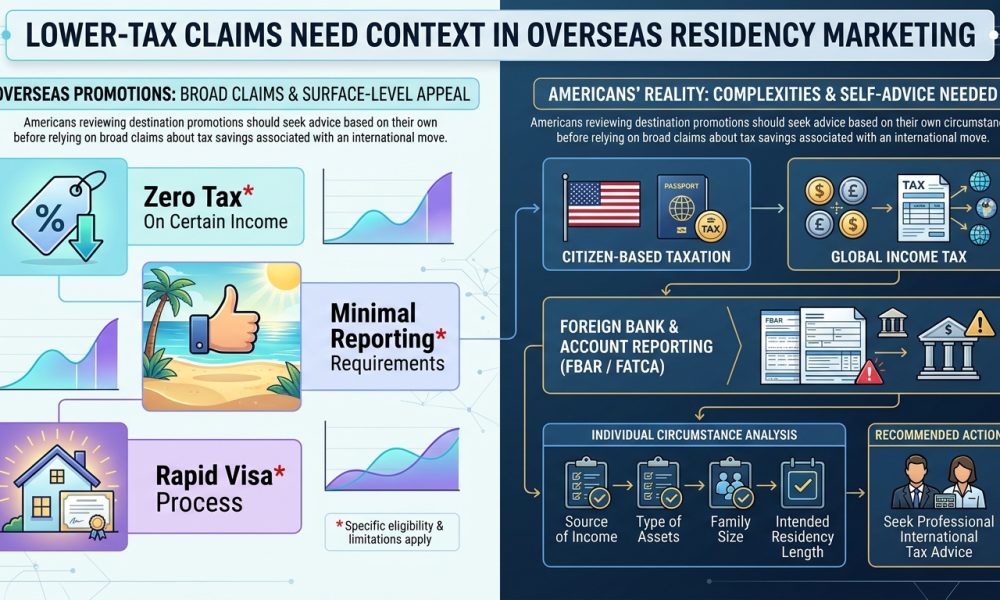
Americans reviewing destination promotions should seek advice based on their circumstances before relying on broad claims about tax savings tied to an international move.
WASHINGTON, DC, October 31, 2026. Wealthy Americans exploring overseas residency are encountering a growing marketplace of relocation opportunities promoted through attractive tax arrangements, favorable investment conditions, and promises of greater financial flexibility. Still, the actual benefits can differ significantly from the advantages presented in international marketing campaigns.
From Panama and Costa Rica to Thailand, Malaysia, Portugal, and the United Arab Emirates, internationally mobile individuals compare destinations where local tax policies may appear attractive, particularly when substantial investment income, retirement assets, or international business interests influence their financial decisions.
However, establishing residence in another country does not automatically eliminate American tax obligations, and favorable local arrangements can become considerably more complicated when citizenship, income sources, banking regulations and international reporting responsibilities are considered together.
According to AMICUS INTERNATIONAL CONSULTING, which advises internationally mobile clients on lawful relocation, second citizenship and overseas planning, Americans should evaluate foreign tax incentives within a comprehensive legal and financial framework rather than treating advertised tax advantages as guaranteed personal savings. This distinction matters for wealthy families because international financial arrangements often span multiple jurisdictions and involve substantial investment portfolios and reporting obligations that remain relevant even after individuals establish legitimate residence outside the United States.
For Americans considering relocation in 2026, the central question is not simply which country advertises the lowest tax rate, but whether moving there will produce a lawful, practical, and sustainable financial outcome after accounting for all applicable obligations.
Why Lower-Tax Destinations Attract Wealthy Americans
International relocation has become a prominent consideration among affluent Americans seeking greater flexibility over where they live, conduct business,s and manage investments, particularly when substantial household expenses and changing financial circumstances influence their long-term decisions.
Countries that offer favorable treatment of selected income categories can appeal to retirees, entrepreneurs,s and investors with substantial assets who seek comfortable living environments, international transportation connections, and access to dependable professional services.
An American business owner considering Panama may be interested in its territorial approach to income taxation. At the same time, a financially independent individual evaluating the United Arab Emirates may focus on the country’s broader tax environment and residential opportunities.
However, these arrangements operate under different legal systems, and favorable domestic tax provisions do not determine whether an American citizen will achieve equivalent savings after accounting for U.S. tax responsibilities.
The subject continues to attract attention in Google News coverage of Americans exploring lower-tax countries and overseas residency, where international residence opportunities and financial planning increasingly appear alongside retirement and lifestyle discussions.
For prospective movers, the key distinction is separating a country’s general tax environment from the obligations tied to their citizenship, investments, business activities, and intended pattern of residence.
American Citizenship Creates Continuing Tax Responsibilities
One of the most important considerations for Americans exploring foreign residence is that United States citizens generally remain subject to federal taxation on worldwide income, regardless of whether they live in another country.
An American residing in Thailand, Mexico,,or Panama mmaystill rreceive investmentdistributions, retirement ppayments, or business income that must be evaluated uunder U.S. taxlaw, even when local treatment differs.
The Internal Revenue Service’s official guidance for U.S. citizens and resident aliens abroad explains that worldwide income reporting generally continues after relocation. However,h qualifying exclusions and foreign tax credits may affect the resulting liability.
This distinction can undermine simplistic marketing claims that obtaining an overseas residence permit automatically removes American taxation, particularly when the applicant continues to hold substantial financial assets or generate income from multiple countries.
A foreign residence card establishes a specific immigration status under the destination country’s laws, but it does not automatically change an individual’s American citizenship or eliminate federal tax responsibilities.
For wealthy Americans, international planning should therefore begin with a clear understanding of existing obligations before considering whether a foreign jurisdiction offers meaningful additional financial benefits.
Tax Residence and Immigration Residence Are Different
International relocation marketing sometimes treats residence permission and tax residence as the same legal status, even though immigration authorities and tax administrations often apply different eligibility tests.
A person may hold a renewable residence permit without satisfying the requirements for tax residence, while another individual may become a tax resident after spending sufficient time in a country.
Tax residence can depend on physical presence, habitual residence, available accommodation, economic connections, and other factors established under domestic legislation, making the outcome dependent on individual facts.
An American maintaining a home in California while spending extended periods in Mexico may therefore need to examine both Mexican tax residence and continuing obligations arising under American federal and state law.
Similarly, purchasing property in Portugal does not necessarily establish Portuguese tax residence, while actual relocation and changes in personal circumstances may create obligations that require formal evaluation.
The most useful approach is to examine immigration permission, tax residence, and citizenship separately before determining how the overall international arrangement will affect the household’s finances.
Territorial Tax Systems Require Careful Interpretation
Some international destinations operate tax systems that distinguish between income arising within their territory and income originating abroad, creating potential advantages for particular categories of internationally mobile residents.
Panama is frequently associated with territorial taxation, making it relevant to business owners and investors who want to understand how different income sources may be treated under the country’s domestic legislation.
However, determining where income originates can involve complex legal considerations, particularly when professional services, commercial operations, or investment activities span multiple countries and involve different financial institutions.
An American entrepreneur managing an international business from Panama should not assume that every payment received from a foreign customer automatically qualifies for favorable treatment under Panamanian law.
The actual analysis may involve the location of business activities, contractual arrangements, management responsibilities,s and the legal characterization of income received through companies operating internationally.
Even where income receives favorable treatment locally, American federal tax obligations can remain relevant, making territorial taxation only one component of a broader financial assessment.
The United Arab Emirates Presents a Different Tax Environment
The United Arab Emirates attracts internationally mobile entrepreneurs and affluent individuals through its commercial infrastructure, modern residential developments, ts and tax framework, including the absence of a general federal personal income tax on ordinary individual earnings.
Dubai and Abu Dhabi offer international transportation connections, financial services and premium residential environments, making them relevant to Americans whose business interests extend across multiple regions.
However, the country’s tax arrangements include corporate taxation and other rules that can apply to qualifying business activities, meaning the absence of a general personal income tax does not eliminate every possible liability.
An American operating a business from Dubai may need to review corporate tax obligations, licensing requirements, and how income is classified under different commercial structures.
American citizenship also creates ongoing federal tax considerations, so the destination’s domestic tax framework does not automatically determine an individual’s overall financial obligations.
For prospective residents, the key question is whether the overall international structure provides benefits after accounting for immigration costs, business expenses, reporting requirements, and U.S. taxation.
Portugal Demonstrates How Tax Incentives Can Change
Portugal provides an important example of why international tax planning should not rely on historical promotional materials, especially when governments revise incentive programs or change eligibility conditions.
For years, Portugal’s Non-Habitual Resident framework attracted international attention through special tax treatment available to qualifying individuals who established residence under the applicable legislation.
However, Portugal ended general access to its former regime for most new entrants beginning in 2024, while establishing a more targeted incentive framework associated with qualifying scientific research and innovation activities.
Certain existing beneficiaries and eligible transitional applicants may retain rights under earlier provisions, but new residents should not assume that historical arrangements remain available on identical terms.
An American considering Portugal in 2026 must therefore examine current eligibility, foreign income treatment and applicable tax rules rather than relying on examples involving people who relocated several years earlier.
The broader lesson is that financial incentives can change during the lifetime of an international residence arrangement, making flexibility and accurate legal advice important components of long-term planning.
Italy Shows Why High-Income Planning Requires Individual Analysis
Italy also offers arrangements to attract qualifying individuals transferring their tax residence from abroad, including a special fixed annual tax regime for certain foreign-sourced income.
However, the annual charge under this regime has increased since its introduction, and the financial advantage depends heavily on the applicant’s income composition, eligibility, and anticipated residence circumstances.
A wealthy investor receiving substantial qualifying foreign income may evaluate the arrangement differently from a retired American whose financial resources consist primarily of pensions, domestic investments and modest annual distributions.
Even when the Italian regime provides favorable local treatment, Americans must still evaluate their federal obligations because U.S. citizenship continues to create worldwide income-reporting responsibilities.
Families considering Italy should also account for residence requirements, property costs, professional fees, and the treatment of spouses or other family members included in the intended arrangements.
A recognized tax incentive does not mean every wealthy American will benefit, especially when the program’s fixed costs outweigh the potential savings.
Thailand’s Tax Rules Require Special Attention
Thailand remains attractive to Americans considering retirement, international business opportunities, and long-term residence, but its tax environment requires careful evaluation rather than assumptions based on low local living costs.
The country maintains rules on tax residence and foreign-sourced income, with important considerations for when qualifying income is brought into Thailand under applicable legislation and administrative guidance.
Individuals spending at least 180 days in Thailand during a calendar year may meet the country’s domestic tax residence threshold, making their actual presence an important part of financial planning.
However, the treatment of particular income depends on factors including when it was earned, its source, applicable exclusions and any relevant treaty provisions or administrative guidance.
An American receiving retirement payments, investment distributions or business income should therefore obtain qualified advice before assuming that transferring funds into a Thai bank account carries no tax consequences.
The appropriate assessment should also consider visa eligibility, banking requirements, and the financial arrangements necessary to support a lawful long-term residence.
Malaysia’s Tax Treatment Depends on Income and Residence
Malaysia offers another example of how overseas tax arrangements must be examined alongside immigration eligibility, particularly when Americans consider long-term residence through the Malaysia My Second Home framework.
The country has rules governing the taxation of domestic and foreign-sourced income, including provisions, exemptions, and conditions that may change with legislative decisions and the taxpayer’s circumstances.
A qualifying residence arrangement does not automatically determine how investment earnings, retirement income or business distributions will be treated when funds are received from overseas.
Applicants should also distinguish between financial deposits required under immigration programs and income that may become subject to tax under the country’s applicable legislation.
For Americans maintaining substantial assets outside Malaysia, tax planning should address the timing, source and nature of income rather than assuming that every foreign transfer receives identical treatment.
Assess the financial benefits of Malaysian residence alongside immigration costs, property requirements, and ongoing American reporting obligations.
The Foreign Earned Income Exclusion Has Specific Limits
Americans living and working abroad may qualify for the foreign earned income exclusion, which can reduce the amount of eligible foreign employment or self-employment income included in federal taxable income.
For the 2026 tax year, the maximum exclusion is $132,900 per qualifying individual, although eligibility depends on satisfying the applicable foreign tax home and residence or physical presence requirements.
The exclusion generally applies to qualifying earned income rather than ordinary investment returns, so it is important to distinguish compensation for personal services from dividends, interest, and other passive income.
An affluent American receiving most household income from an investment portfolio may therefore receive substantially different benefits than a professional earning qualifying employment income overseas.
Applicants must also understand that excluded income generally remains reportable on the relevant tax return and that qualification involves more than simply possessing a foreign residence permit. Calculate the practical value of the exclusion using actual income sources and filing circumstances rather than assuming every individual living overseas receives the maximum benefit.
Foreign Tax Credits May Provide Different Relief
Foreign tax credits can help qualifying taxpayers reduce double taxation when eligible foreign income taxes are imposed on income that is also subject to United States taxation.
However, the credit depends on the nature of the foreign tax, the income involved, applicable limitations and other technical requirements, making personalized calculations important for internationally mobile Americans.
A person living in a country with substantial income taxation may face foreign tax credit considerations that differ significantly from those of someone living in a jurisdiction with comparatively low personal taxes.
Taxpayers must also account for restrictions on claiming credits relating to income excluded through the foreign earned income exclusion, preventing the same income from generating incompatible forms of relief.
For wealthy households receiving wages, business profits and investment income from different jurisdictions, coordinating exclusions and credits can become a complicated part of annual financial planning.
The right strategy depends on the taxpayer’s full income profile, not the isolated tax rate advertised by a destination country.
Investment Income Can Change the Entire Calculation
Affluent Americans frequently receive substantial income through dividends, interest, capital gains, rental properties, and business ownership, making their financial circumstances different from those of salaried employees relocating overseas.
These income categories may be treated differently under foreign tax legislation, U.S. federal rules, and applicable tax treaties, requiring a more detailed assessment than ordinary employment income.
An investor maintaining an American brokerage account while living in Panama may face a different tax outcome from an entrepreneur operating an active business through a foreign company.
Similarly, selling appreciated investments after establishing residence abroad may create obligations that depend on timing, ownership structure,e and the relevant laws of multiple jurisdictions.
A lower advertised personal income tax rate does not necessarily determine how capital gains, foreign investment distributions, or corporate profits will be taxed.
For high-net-worth families, income composition can matter more than the headline tax rate when evaluating potential savings from international relocation.
Foreign Companies Do Not Automatically Reduce American Taxes
International business structures often come up in overseas relocation marketing, especially when entrepreneurs consider establishing companies in jurisdictions with different corporate tax arrangements or commercial incentives.
However, American tax rules can apply to foreign corporations and their United States owners, including provisions affecting controlled foreign corporations and certain categories of company income.
Creating a foreign company does not automatically convert American taxable income into exempt foreign earnings, particularly when ownership, management, and business activities remain connected to the United States.
Business owners may also face local licensing requirements, corporate taxation, payroll obligations,s and administrative expenses in the jurisdiction where the company operates.
A legitimate international structure can support business expansion and investment objectives, but it must be evaluated according to commercial substance and applicable legal responsibilities.
Promotional claims that a foreign corporation automatically eliminates personal taxation should therefore be scrutinized before an applicant transfers assets or changes existing business arrangements.
Foreign Banking Comes With Reporting Responsibilities
Americans establishing residence abroad may need local bank accounts to manage rent, property expenses, healthcare payments, and other household obligations associated with everyday international living.
However, foreign financial accounts can create United States reporting responsibilities, including the Foreign Bank Account Report when aggregate account values exceed the applicable threshold during a calendar year.
For FBAR purposes, the general reporting threshold is more than $10,000 in aggregate foreign financial accounts at any point during the year, rather than $10,000 in each account.
Certain taxpayers may also need to file Form 8938 when specified foreign financial assets exceed the applicable thresholds, with requirements that differ by filing status and residence circumstances.
These reporting obligations can exist even when foreign accounts produce little income, so it’s important to distinguish financial disclosure requirements from income tax calculations.
For affluent Americans, accurate recordkeeping and coordinated professional advice should remain central to international banking arrangements.
State Tax Residence Can Complicate Overseas Moves
American federal tax responsibilities are only part of the analysis because individuals moving overseas may also need to determine whether their former state still treats them as residents.
State rules differ considerably, and domicile, physical presence, available housing, and continuing personal connections may influence whether a person remains subject to state income taxation.
An American leaving California while maintaining substantial residential and professional ties may need a different analysis from an individual departing a state without a broad individual income tax.
Simply obtaining a foreign residence card or spending several months abroad may not establish a change in domicile under the relevant state legislation.
Families should also review how the state treats rental income, business interests, and other income sources connected to the state after an international move.
Complete the appropriate assessment before relocation, rather than assuming an international address automatically resolves every domestic tax question.
Property Ownership Can Create Additional Tax Obligations
Purchasing a home overseas may support a preferred lifestyle, but foreign property ownership can introduce financial obligations involving transfer taxes, annual property charges and potential taxation of rental income.
The applicable rules depend on the destination country, property classification, and whether the residence is occupied personally, rented to third parties, or held through a legal entity.
Americans maintaining property in both countries must also consider the expenses ofexpenses of two households, including insurance, management, and professional services.
A foreign property that appears attractive because of its purchase price may become less economical once you include transaction costs and ongoing tax obligations.
Selling the property later can create additional considerations involving capital gains, currency movements and reporting responsibilities in more than one jurisdiction.
International real estate should therefore be assessed as both a lifestyle commitment and a potentially complex financial asset.
A Second Passport Does Not Automatically Eliminate Tax Obligations
For some wealthy Americans, international relocation forms part of a broader strategy involving permanent residence, personal security, and the possibility of acquiring another nationality through an authorized legal process.
However, possessing a second passport does not automatically terminate American citizenship or remove federal tax obligations, particularly when the individual remains a United States citizen subject to worldwide income taxation.
AMICUS INTERNATIONAL CONSULTING advises that Americans evaluating lawful second passport and citizenship planning should distinguish nationality rights, immigration status,s and tax residence before treating an additional passport as a financial planning solution.
A person may lawfully acquire citizenship in another country while retaining American citizenship, meaning the individual can possess two nationalities without eliminating the responsibilities associated with either.
Renouncing American citizenship involves a separate legal process and can have significant tax consequences, including potential expatriation tax rules for individuals who meet the applicable conditions.
For most internationally mobile Americans, the appropriate question is how to maintain compliant financial arrangements while benefiting from legitimate overseas residence and nationality opportunities.
Family Trusts and Estate Planning Require Coordination
Affluent families often maintain trusts, investment companies and other estate planning arrangements designed to manage assets, support beneficiaries and provide continuity across generations.
International relocation can complicate these structures when trustees, beneficiaries, or individuals controlling financial arrangements become residents of different countries.
Foreign trust classification, reporting obligations,s and the treatment of distributions can depend on detailed United States tax rules and the laws governing the trust’s administration.
A structure that operates effectively while every relevant person resides in the United States may require additional evaluation when family members establish substantial connections abroad.
Families should therefore review existing estate planning documents, beneficiary arrangements and financial reporting obligations before assuming that relocating internationally will preserve their current tax treatment.
The appropriate approach is to maintain legitimate structures supported by clear documentation and professional advice rather than relying on generalized claims that foreign trusts automatically provide tax advantages.
Retirement Income Deserves Separate Examination
Americans considering retirement overseas often receive income through Social Security benefits, pensions, individual retirement accounts, and other arrangements that may receive different tax treatment depending on the destination.
Foreign tax rules on pension distributions can differ from those that apply to ordinary investment income, and treaty provisions may affect how certain retirement payments are treated.
A destination advertising favorable tax conditions for foreign income may not provide identical benefits for every retirement arrangement, particularly when the taxpayer receives several different categories of payments.
Americans should also consider required distributions, withholding arrangements, and the ongoing responsibilities of maintaining retirement accounts while living abroad.
For households planning permanent retirement, long-term tax projections should account for expected changes in income rather than relying solely on circumstances in the first year overseas.
The financial objective is sustainable retirement income supported by compliant tax planning and realistic household expenses.
Tax Treaties Can Affect Individual Outcomes
International tax treaties may contain provisions addressing double taxation, residence conflicts, and the treatment of particular income categories, making them relevant to Americans with financial connections in multiple countries.
However, treaty benefits depend on specific eligibility conditions and may be limited by provisions preserving the United States’ ability to tax its citizens.
An American resident of a treaty country should not assume that every type of income receives favorable treatment simply because a bilateral tax agreement exists.
Different provisions may apply to employment compensation, pensions, investment income, and business profits, requiring a detailed review of the applicable treaty language.
Some destinations do not have a comprehensive income tax treaty with the United States, making reliance on assumed treaty protections particularly risky.
Qualified international tax professionals can help determine which provisions apply and how they interact with the taxpayer’s actual residence, citizenship, and income circumstances.
Five Questions Americans Should Ask Before Relocating for Tax Reasons
Americans considering an international move mainly for advertised tax advantages should review their financial circumstances before choosing a country or committing substantial resources to immigration and property arrangements.
1. Will American Federal Tax Obligations Continue?
Prospective residents should start by determining how U.S. worldwide income taxation applies to their wages, investments, retirement distributions, and business interests after establishing lawful residence abroad.
2. Will the Destination Treat Them as Tax Residents?
Applicants should examine physical presence rules, domicile considerations,s and other domestic requirements that determine whether the destination country will impose tax obligations on their income or assets.
3. Which Income Categories Receive Favorable Treatment?
Families should distinguish employment income, investment returns, pensions, capital gains and business profits because favorable treatment for one category does not necessarily extend to every source of household income.
4. What Additional Reporting and Professional Costs Will Arise?
Foreign bank account reporting, company filings, trust administration and cross-border tax preparation can create recurring obligations that should be included when calculating the potential financial advantages of international residence.
5. Will the Arrangement Remain Practical if Tax Rules Change?
Applicants should consider whether the destination remains attractive for healthcare, family life, security, ty and everyday living if a government modifies the tax incentive that originally influenced the relocation decision.
The Lowest Tax Rate May Not Provide the Greatest Value
For affluent Americans, the financial advantages of international residence must be weighed against housing, healthcare, education, insurance, and the cost of maintaining personal connections with the United States.
A country offering comparatively favorable income taxation may have expensive housing, substantial immigration requirements or limited access to the specialized services a household requires.
Conversely, a destination imposing higher local taxes may offer infrastructure, educational opportunities and healthcare arrangements that better support the family’s actual circumstances.
An entrepreneur who needs frequent access to American clients may value geographic convenience more than a modest reduction in local taxes.
Retirees may prioritize long-term medical access and residential stability, particularly when health insurance and travel expenses could outweigh expected tax savings.
The most appropriate destination therefore depends on the full financial and lifestyle picture, not a single advertised tax advantage.
Professional Advice Should Begin Before Relocation
International tax planning becomes considerably more difficult when individuals establish residence, purchase property, or transfer assets before understanding how their actions affect financial obligations across multiple jurisdictions.
A coordinated assessment should involve qualified professionals familiar with United States taxation and the destination country’s legal framework, particularly when substantial investment portfolios or business structures are involved.
The review should identify existing income sources, residency considerations, reporting obligations, and the practical consequences of maintaining financial relationships in more than one country.
Families should also consider whether immigration eligibility, healthcare arrangements, and property ownership fit their intended long-term plans rather than focusing exclusively on immediate tax outcomes.
Appropriate documentation and realistic financial projections can help prevent misunderstandings when tax authorities or financial institutions review overseas residence arrangements.
Professional advice aims to establish a lawful, sustainable structure based on actual circumstances rather than speculative savings promoted through generalized relocation advertisements.
The Future of Overseas Tax Planning Requires Realistic Expectations
Americans evaluating international residence in 2026 are encountering an increasingly diverse range of destinations offering different combinations of immigration opportunities, financial arrangements and lifestyle benefits.
However, lower local tax rates should not be interpreted as guarantees of reduced total taxation, particularly when American citizenship, foreign financial accounts and continuing business interests create additional obligations.
A successful international plan must account for how income is earned, where activities occur, which jurisdictions claim taxing rights, and whether available exclusions or credits apply.
For wealthy families, financial security also depends on keeping accurate records, maintaining appropriate professional relationships, and choosing destinations that are practical as government policies and personal circumstances change.
International relocation can provide meaningful flexibility and legitimate financial opportunities, but those advantages require careful assessment rather than assumptions based on advertising or historical descriptions of favorable tax programs.
The strongest overseas financial strategy is not simply choosing the country with the lowest advertised tax rate, but establishing a lawful arrangement that balances tax obligations, residential security, financial flexibility, and the family’s long-term needs.
For Americans considering a second home, international residence, or eventual additional citizenship, the lasting value of relocation depends on understanding the full legal and financial consequences before moving, ensuring attractive tax claims translate into real benefits rather than unexpected obligations.




