
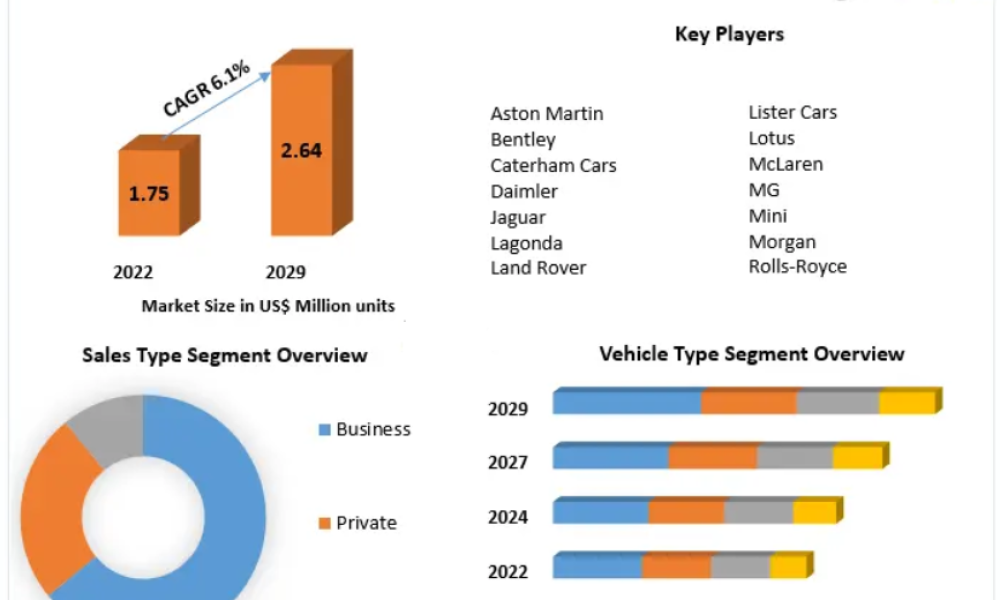
As per a recent study released by Maximize Market Research, titled, “Automotive Market in UK,” The UK automotive market stood at 1.75 million units in 2022 and is projected to expand at a CAGR of 6.1%, reaching around 2.64 million units by 2029.
Automotive Market in UK Overview:
The UK automotive market covers new vehicle sales across passenger cars, light commercial vehicles (LCVs), heavy commercial vehicles (HCVs), and electric vehicles (EVs). Over the past decade, the sector has navigated shifts in consumer demand, regulatory pressures, electrification, supply chain constraints, and changing trade relations. As the British automotive industry evolves, it continues to be a critical part of national manufacturing, employment, and technology deployment.
In recent years, the UK automotive market has also embraced electrification trends, digitalization, and connectivity. Automakers are increasingly integrating advanced driver assistance systems (ADAS), vehicle-to-everything (V2X) connectivity, and powertrain transitions, all while managing the challenges of regulatory compliance, import/export balance, and consumer sentiment.
Download a Free Sample Report Today :https://www.maximizemarketresearch.com/request-sample/86645/
Automotive Market in UK Dynamics
One of the key drivers fueling growth in the UK automotive market is the accelerating adoption of electric and low-emission vehicles. With stronger emissions standards, government incentives, and consumer awareness around sustainability, EV adoption is shaping demand and pushing manufacturers to retool and invest in new platforms. This regulatory push, combined with investment in charging infrastructure and battery technology improvements, is helping overcome prior adoption bottlenecks.
Another important growth factor is the modernization of vehicle portfolios (e.g. SUVs, crossovers, premium segments) and increasing demand for connectivity, software-enabled features, and mobility services. Consumers increasingly expect smarter vehicles with digital features, over-the-air updates, and integrated apps, which raises the value-per-unit and potentially drives replacement cycles. However, challenges persist: supply chain constraints (especially in semiconductors, battery raw materials), cost pressures (energy, labor), post-Brexit trade and tariff complexities, and residual consumer caution in macroeconomic uncertainty.
Automotive Market in UK Outlook and Future Trends :
Looking ahead to 2023–2029 and beyond, the UK automotive market is expected to maintain a steady upward trajectory, reflecting recovery from disruption, technology adoption, and sustained consumer demand. The expansion toward 2.64 million units by 2029 suggests both pent-up demand and successful transitions to newer vehicle types. As electrification becomes more mainstream, the share of EVs in new sales is likely to climb significantly.
Emerging trends that may define the next phase include the growth of vehicle subscription and mobility-as-a-service (MaaS) models, deeper integration of software-defined vehicles, advanced connected features (5G, autonomous driving assistance), and modular electrified architectures. Battery cost declines, second-life battery reuse, and standardization of EV components will help push adoption further. Also, circular economy mechanisms (recycling, remanufacturing) will gain importance in the automotive value chain.
Automotive Market in UK Regional Insights:
Within the UK, regional variation in automotive market development is influenced by factors such as industrial clusters, infrastructure, consumer incomes, and regulatory environments. Central England is indicated as a key region likely to hold a large share of automotive activity, benefiting from proximity to manufacturing bases, parts suppliers, and access to transport networks.
Regions such as the Midlands, North West, and Scotland house significant auto manufacturing, component supply, and testing facilities, and are expected to remain focal zones for both vehicle production and adoption. Southern regions (including commuter belts around London) may show stronger demand for premium and urban mobility vehicles. Scotland, Wales, and Northern Ireland could see differentiated uptake patterns depending on local incentives, grid readiness for EV charging, and consumer awareness programs.
Additionally, the success of vehicle adoption and sales in different parts of the UK will depend on local infrastructure (charging networks, grid capacity), incentives or local policies, regional economic strength, and dealer / service support. Regions with strong industrial bases, connectivity to ports and logistics, and skilled labor pools are better positioned to benefit from investment and growth in the automotive sector.
Automotive Market in UK Segmentation
by Vehicle Type
Passenger Cars
LCVs
HCVs
Electric Vehicles
by Sales Type
Business
Private
Fleet
Some of the current players in the Automotive Market in UK are:
1. Aston Martin
2. Bentley
3. Caterham Cars
4. Daimler
5. Jaguar
6. Lagonda
7. Land Rover
8. Lister Cars
9. Lotus
10. McLaren
11. MG
12. Mini
13. Morgan
14. Rolls-Royce
About Maximize Market Research:
Maximize Market Research is one of the fastest-growing market research and business consulting firms serving clients globally. Our revenue impact and focused growth-driven research initiatives make us a proud partner of majority of the Fortune 500 companies. We have a diversified portfolio and serve a variety of industries such as IT & telecom, chemical, food & beverage, aerospace & defense, healthcare and others.
Contact Maximize Market Research:
MAXIMIZE MARKET RESEARCH PVT. LTD.
⮝ 3rd Floor, Navale IT park Phase 2,
Pune Banglore Highway, Narhe
Pune, Maharashtra 411041, India.
✆ +91 9607365656
🖂 [email protected]




