
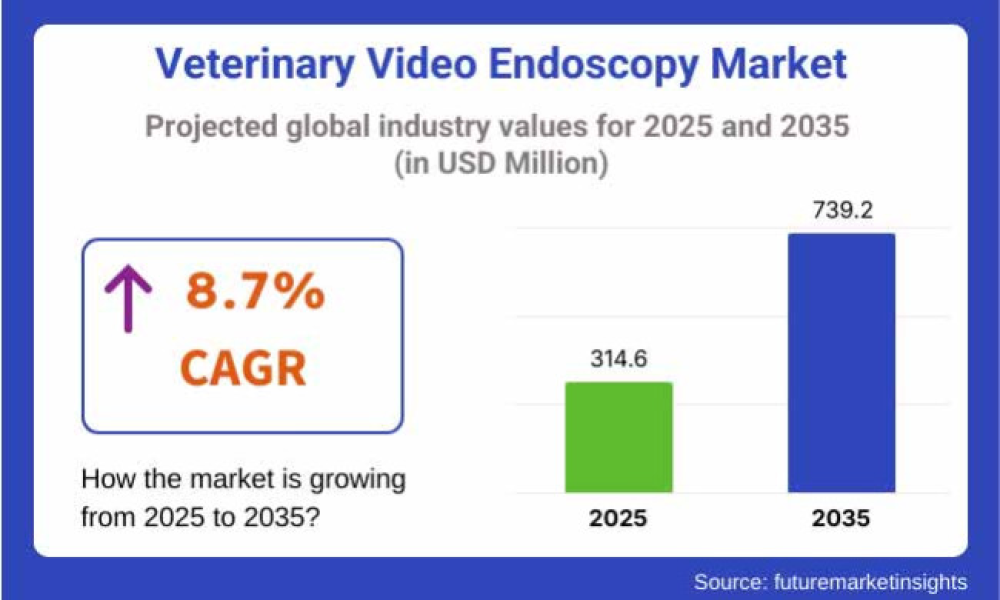
The Veterinary Video Endoscopy Market in the U.S. is positioned for notable expansion from 2025 to 2035, supported by sustained interest in minimally invasive diagnostics, rising procedure volumes, and rapid innovation in imaging technologies. With the global industry valued at USD 314.6 million in 2025 and projected to reach USD 739.2 million by 2035, the U.S. remains a critical contributor to this upward trajectory.
Explore trends before investing – request a sample report today!
https://www.futuremarketinsights.com/reports/sample/rep-gb-16901
Across veterinary hospitals and specialty clinics, demand for flexible and rigid endoscopy systems is strengthening as practitioners seek improved diagnostic accuracy and faster patient recovery times. The expansion of high-definition imaging, robotic-assisted modalities, and AI-driven anomaly detection is reshaping clinical workflows while improving precision in both diagnostic and surgical procedures.
Growing adoption of capsule and wireless endoscopes is expected to further boost accessibility, lowering risk profiles and enhancing comfort for animals undergoing gastrointestinal and respiratory assessments. Increased veterinary service utilization and rising pet insurance coverage are accelerating acceptance of advanced endoscopic tools.
Overview of the U.S. Veterinary Video Endoscopy Market
Steady momentum in the U.S. market is driven by broad acceptance of minimally invasive procedures and continued innovation in imaging technologies. Veterinary hospitals, specialized clinics, and equipment manufacturers are primary beneficiaries, particularly as AI-assisted endoscopy solutions challenge older diagnostic approaches.
Key growth themes include:
- Increased companion animal healthcare spending
- Rising prevalence of chronic diseases requiring early intervention
- High concentration of advanced veterinary education and specialty centers
- Expanding infrastructure supporting minimally invasive diagnostics
Key Market Dynamics Shaping Growth
- Solutions Outlook
In 2025, gastrointestinal video endoscopy accounted for more than 46% of industry revenue. Growth is anchored by demand for: - High-resolution endoscopy equipment
- Biopsy tools, insufflation needles, and other consumables
- Cloud-based PACs integrations for improved storage and analysis
- AI-supported visualization for enhanced diagnostic accuracy
- Product Type Trends
Rigid endoscopes held a 45% share in 2025, while flexible endoscopes continue to lead due to their versatile application in gastrointestinal, respiratory, and urinary diagnostics. Additional trends include: - Early but rising interest in capsule endoscopy
- Expansion of robot-assisted tools for complex surgical interventions
- Development of hybrid endoscopes combining flexibility and precision
Subscribe for Year-Round Insights → Stay ahead with quarterly and annual data updates –
https://www.futuremarketinsights.com/reports/brochure/rep-gb-16901
- Animal Type Demand
Endoscopy adoption is rising across: - Large animals requiring respiratory and gastrointestinal diagnostics
- Small animals such as dogs and cats demanding minimally invasive care
- Livestock animals benefiting from early disease detection
- Exotic species and zoo animals supported by specialized veterinary centers
- Application Insights
Diagnostics account for more than 73% of endoscopy demand, primarily driven by the need for: - Real-time visualization
- Early disease detection
- AI-assisted imaging accuracy
Surgical and interventional procedures are also growing as minimally invasive techniques replace traditional open surgeries.
- Procedure Adoption
Commonly performed procedures include: - Gastroduodenoscopy, colonoscopy, bronchoscopy, and tracheoscopy
- Laparoscopy and thoracoscopy for minimally invasive surgeries
- Otoscopy, rhinoscopy, and arthroscopy for specialty care
End-User Trends
Veterinary clinics are adopting portable systems, while specialty hospitals invest in advanced endoscopic platforms for complex interventions. Academic institutes continue to expand training programs, widening practitioner expertise and enabling broader adoption across the U.S.
Key end-user industry drivers include:
- Increased funding and training
- Greater affordability of portable systems
- Stronger OEM and service partnerships
Strategic Imperatives for Stakeholders
- Invest in AI and robotic endoscopy to improve diagnostic precision
- Expand accessibility in emerging regions through portable, affordable systems
- Strengthen R&D and distribution partnerships to accelerate innovation and enhance service delivery
Key Watchlist Priorities
- Expand AI-powered imaging capabilities
- Optimize cost structures for price-sensitive segments
- Strengthen service networks and OEM partnerships
For the Boardroom
The sector is entering a high-growth phase as clinics embrace robotics, AI-powered diagnostics, and flexible pricing models. Leadership teams should focus on:
- Digital-first strategies
- Expanded R&D pipelines
- Regionalized deployment strategies tailored to cost, training, and infrastructure dynamics
Why Choose FMI – Empowering Decisions that Drive Real-World Outcomes:
https://www.futuremarketinsights.com/why-fmi
About Future Market Insights (FMI)
Future Market Insights, Inc. (ESOMAR certified, recipient of the Stevie Award, and a member of the Greater New York Chamber of Commerce) offers profound insights into the driving factors that are boosting demand in the market. FMI stands as the leading global provider of market intelligence, advisory services, consulting, and events for the Packaging, Food and Beverage, Consumer Technology, Healthcare, Industrial, and Chemicals markets. With a vast team of over 400 analystsworldwide, FMI provides global, regional, and local expertise on diverse domains and industry trends across more than 110 countries.
Contact Us:
Future Market Insights Inc.
Christiana Corporate, 200 Continental Drive,
Suite 401, Newark, Delaware – 19713, USA
T: +1-347-918-3531



