
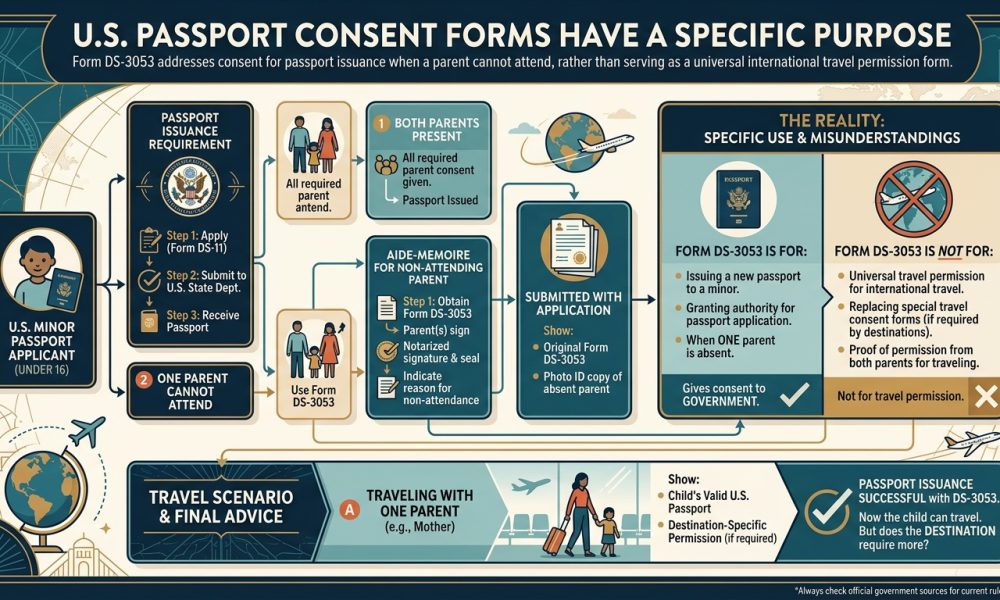
Form DS-3053 addresses consent for passport issuance when a parent cannot attend, not as a universal international travel permission form.
WASHINGTON, DC, October 15, 2026 — American parents applying for passports for their children should understand that Form DS-3053 serves a specific administrative purpose: it allows a parent or legal guardian who cannot attend an Application appointment to provide documented consent for the issuance of a United States passport.
The form, officially titled Statement of Consent: U.S. Passport Issuance to a Child, is frequently confused with parental permission letters used for international travel. However, these documents address different legal questions and are not automatically interchangeable.
Current guidance from the U.S. Department of State distinguishes consent to issue a passport from permission for a minor to travel internationally, particularly when a foreign government requires authorization from a parent not accompanying the journey.
These differences matter most for separated and divorced parents, families living in different countries, children traveling with grandparents, and households managing international custody or guardianship arrangements.
Understanding how DS-3053 works can help families submit accurate passport applications and avoid misunderstandings about whether an issued passport automatically grants permission for every subsequent international journey.
Form DS-3053 Authorizes Passport Issuance
Form DS-3053 documents consent from a parent or legal guardian who cannot attend the appointment when an Application for a child’s United States passport is submitted.
According to the U.S. Department of State’s official instructions for passports issued to children under sixteen, both parents or legal guardians generally must appear with the child or provide the required authorization before the government can issue the document.
When one parent cannot attend but still shares relevant parental authority, DS-3053 provides a standardized way to communicate that individual’s approval to passport officials.
Submit the form with Form DS-11, the passport Application itself, and ensure it meets the State Department’s requirements for signatures, notarization, Identification, and valid consent.
Its purpose is therefore to authorize the issuance of a government Identification and travel document, not to approve a particular airline reservation, destination, or international departure.
Passport Issuance and International Travel Are Separate Decisions
The distinction between passport issuance and permission to travel is fundamental because a valid passport establishes that a child has an official travel document without necessarily resolving every question about parental authority.
A parent who signs DS-3053 consents to passport issuance under the terms of that form, but the signature should not automatically be interpreted as blanket permission for another parent to undertake unrestricted international journeys.
Travel authorization may depend on custody orders, parenting agreements, the destination country’s laws, or specific requirements for children traveling with one parent or an unrelated adult.
For example, a parent may agree that a child should have a passport for Identification and future travel opportunities while maintaining legally enforceable conditions for specific international journeys.
Families should therefore distinguish the administrative decision to obtain a passport from the separate legal authority necessary to undertake international travel under the circumstances of each proposed trip.
Children Under Sixteen Generally Require Both Parents’ Approval
United States passport procedures establish special safeguards for children younger than sixteen, generally requiring the child to appear in person with both parents or legally recognized guardians when applying.
This framework aims to reduce unauthorized passport issuance while ensuring that adults with relevant parental authority participate in the Application or provide legally acceptable consent.
When both parents attend the appointment, they can ordinarily provide the required Identification and sign the Application under the authorized passport acceptance agent’s instructions.
When one parent cannot appear, the government accepts specified alternatives, including a properly completed DS-3053 or documentary evidence establishing that the applying parent possesses sole authority.
Do not interpret this requirement as a universal rule for every child younger than eighteen, because applicants aged sixteen and seventeen follow a different parental awareness framework.
The Non-Applying Parent Must Complete the Consent Statement
When DS-3053 is required, the parent or guardian who cannot attend the child’s passport appointment completes the relevant declaration and provides the authorization described in the form.
The individual must generally sign the statement before an authorized notary public so passport officials can verify that the declaration was executed through a recognized witnessing procedure.
The parent must also provide a photocopy of the ID presented during notarization so that the government can verify the identity evidence associated with the signature.
The form must identify the child and the individual authorized to submit the passport Application, with all Information accurately corresponding to the supporting records.
A parent should not sign an incomplete form or rely on another adult to insert substantive Information after notarization, since inaccurate or improperly executed statements can delay processing.
DS-3053 Has a Limited Submission Period
The Department of State currently requires DS-3053 and comparable notarized consent statements to be submitted within 90 days after they are signed or notarized.
This requirement matters for families whose parents live in different cities or countries because a statement obtained months before the appointment may no longer meet the government’s submission requirements.
Parents should therefore coordinate the notarization date with the planned passport Application appointment rather than completing the consent long before the necessary supporting documents are available.
The State Department also recognizes electronically notarized consent statements where permitted under applicable state law, provided the applicant submits the required printed documentation.
Families should verify current procedural requirements before applying because a previously valid notarized statement remains acceptable only as long as the parent’s underlying consent has not changed.
Parents Living Abroad May Use Consular Notarial Services
Internationally mobile families often face situations where one parent lives outside the United States and cannot attend the child’s passport Application appointment.
The Department of State explains that parents in these circumstances may need to have DS-3053 notarized at a United States embassy or consulate, depending on the country and applicable notarial requirements.
This arrangement lets an absent parent document consent without traveling to the United States solely to attend the passport appointment.
However, families should verify appointment availability, identity requirements, and accepted notarization procedures with the responsible diplomatic mission rather than assuming every foreign notary’s certification meets U.S. passport requirements.
Consular notarization concerns the Authenticity and execution of the passport-issuance consent, not authorization for a child to enter or depart any country on a future itinerary.
Sole Legal Authority Can Eliminate the Need for DS-3053
A parent with sole legal authority to apply for a child’s passport may qualify to submit the Application without obtaining a DS-3053 from the other parent.
The Department of State accepts qualifying evidence, including a court order granting sole legal custody or exclusive authority to apply for the child’s passport.
Other recognized records can include a certified birth certificate identifying only one parent, a relevant adoption decree, or a death certificate establishing that another parent has died.
The key distinction is that the applying parent must establish the authority recognized under passport regulations, not merely state that the other parent is absent.
Carefully review a divorce decree or parenting agreement because physical custody and the legal authority to obtain a passport are not necessarily the same.
DS-5525 Addresses Different Family Circumstances
The Department of State also maintains Form DS-5525 for situations where a parent or guardian cannot locate or involve another individual who shares the relevant authority.
Known as the Statement of Special Family Circumstances, DS-5525 lets the applying parent explain the circumstances that prevent obtaining ordinary parental consent.
However, submitting the statement does not guarantee approval because passport authorities may request additional evidence and determine whether the circumstances satisfy the governing requirements.
The government may also examine relevant court orders, Protection arrangements, incarceration documentation, or other records explaining why the second parent cannot participate.
Families should not treat DS-5525 as a convenient replacement for DS-3053 when they can reasonably obtain ordinary consent through the standard procedure.
Applicants Aged Sixteen and Seventeen Follow Different Rules
The parental consent framework changes when a child turns sixteen because the Department of State generally requires evidence that at least one parent or legal guardian knows about the passport Application.
Parents may establish awareness by attending the appointment, signing a statement, or providing other recognized evidence of knowledge of the Application.
Passport officials can request a notarized DS-3053 in particular circumstances, but the form is not automatically required for every sixteen- or seventeen-year-old applicant.
This distinction matters because the two-parent consent framework primarily applies to children younger than sixteen, while older teenagers have different Application requirements.
Parents should therefore determine the applicant’s age and the corresponding State Department procedures before preparing documents intended for a younger child’s passport Application.
A Third Party May Apply With Proper Authorization
Some children attend passport appointments with grandparents, other relatives, or legally recognized representatives because neither parent can personally accompany the Application.
The Department of State permits qualifying third-party applications when the appropriate notarized parental or guardianship consent is supplied together with necessary Identification and supporting evidence.
Both parents ordinarily must authorize the arrangement unless the person providing consent can establish sole legal authority or another recognized exception applies.
DS-3053 may be used for this purpose, as it also helps establish permission for a designated adult to submit the Application on behalf of the legally responsible individuals.
However, authorizing a grandparent to apply for a passport is not the same as authorizing that grandparent to accompany the child internationally without separate permission where applicable.
A Child’s Passport Does Not Automatically Establish Parental Travel Consent
Once a passport is issued, the child has an official document establishing American nationality and identity for the purposes recognized under United States passport law.
However, the passport does not necessarily disclose the full extent of parental decision-making rights or establish whether a particular journey complies with custody orders and foreign departure authorization requirements.
A parent may therefore have the child’s passport but still need to obtain permission required under a judicial order or another country’s laws.
Similarly, a child traveling with an unrelated adult may need documentation explaining the accompanying person’s authority, even though the child’s passport remains valid.
The practical lesson is that passport issuance and permission to depart internationally should be evaluated separately whenever parental responsibility or destination-specific travel rules make the distinction relevant.
Foreign Countries May Require Separate Consent Letters
The U.S. Department of State’s guidance on international travel with minors explains that the United States does not generally require proof of permission from both parents for a minor to travel internationally. However, foreign governments may impose additional requirements.
Some destinations require a signed, notarized letter from an absent parent when a child travels with only one parent. In contrast, others require government-issued departure permits or recognize specific custody documentation.
These requirements depend on the child’s nationality, residence, destination, and accompanying adults, not on a previously completed American passport Application form.
A DS-3053 submitted months earlier for passport issuance does not automatically satisfy a foreign government’s requirement for permission covering a particular international journey.
Families should therefore review the destination’s current rules instead of relying solely on documentation accepted when the child’s passport was issued.
Parenting Orders Can Establish Additional Restrictions
Court orders concerning custody, parental responsibility, relocation, and international travel may impose obligations that operate independently of the United States passport Application process.
A parent can authorize passport issuance while still being entitled to participate in later decisions about whether the child may travel internationally or change habitual residence.
Some parenting orders require advance written permission for international journeys, while others assign travel decision-making authority to one parent or prohibit travel to particular destinations.
Courts must evaluate these provisions based on their legal wording and the applicable jurisdiction, rather than treating them as automatically satisfied by the existence of a passport.
When restrictions or disagreements affect the journey, parents should seek appropriate legal advice before relying on standard passport documents as evidence of permission to depart.
Mexico and Other Countries Use Separate Departure Procedures
Several countries maintain specialized authorization frameworks that differ substantially from the United States DS-3053 passport issuance procedure.
Mexico’s Formato SAM applies to specified minors departing without a parent or legally recognized guardian, while Brazil permits qualifying parental travel authorization to be incorporated into passports issued to children.
France requires an Autorisation de sortie du territoire in defined circumstances involving minors habitually residing in France who travel without a person exercising parental authority.
Italy also maintains accompaniment declaration requirements for Italian children younger than fourteen traveling internationally without a parent or equivalent legal representative.
These different systems demonstrate why a document designed for one country’s passport administration should not automatically be presented as a substitute for another country’s child departure authorization.
Passport Security and Parental Permission Serve Different Purposes
Modern electronic passports incorporate digitally protected identity Information and physical security features intended to help authorities authenticate documents and establish the identity of legitimate holders.
Some countries also include parental Identification details in children’s passports, supporting the examination of family relationships without automatically authorizing every possible international journey.
Amicus International Consulting examined this distinction in Mexico’s Children’s Passports Include Parents’ Photos to Strengthen Travel Security, describing how supplementary parental Information can strengthen child travel Identification safeguards.
However, electronic Authentication and parental photographs do not, on their own, establish an accompanying adult’s authority or satisfy every consent requirement imposed by a foreign jurisdiction.
The same principle applies to DS-3053 because American passport officials accept it as permission to issue a passport under the relevant procedure, not as unrestricted international travel authorization.
Families Should Protect Information Submitted With Consent Forms
Passport consent forms and accompanying Identification records contain sensitive personal Information, including children’s identifying details and government-issued documents belonging to parents or guardians.
Families should therefore obtain official forms through legitimate government sources and avoid submitting passport copies or notarized Identification records through unfamiliar commercial websites.
If a parent lives abroad, coordinating notarization and document delivery can reduce unnecessary exposure while preserving the records required for a lawful Application.
Parents should also use the current version of the form and ensure the details match the child’s Application and supporting documentation.
Careful document handling supports identity Protection without changing the underlying requirement that consent must originate from an individual possessing the necessary legal authority.
An Accurate Checklist Prevents Confusion
Families preparing a child’s American passport Application should first determine whether the applicant is under 16 or falls under the different parental consent procedures for older teenagers.
They should then determine whether both parents can attend, whether an absent parent can provide a DS-3053, or whether a recognized legal exception requires different supporting documentation.
Separately, families planning an international journey should review parental consent requirements imposed by the departure country, destination, and any relevant transit jurisdictions.
This two-stage approach helps prevent the common mistake of treating a passport Application form as permanent permission for every future international journey.
Accurate preparation also helps parents distinguish legally required documents from additional evidence that may be useful when traveling with children.
Conclusion: DS-3053 Is a Passport Issuance Document
Form DS-3053 has a defined role in the United States passport Application system, allowing qualifying parents and legal guardians who cannot attend an appointment to provide documented consent to issue a child’s passport.
The form supports the government’s parental authorization procedures, particularly for applicants younger than sixteen. However, it is not a universal parental consent letter for international departure or entry into foreign countries.
Parents should distinguish DS-3053 from DS-5525, evidence of sole legal authority, parenting orders, and destination-specific travel consent documents because each addresses different legal or administrative circumstances.
For American families, understanding these distinctions can reduce unnecessary paperwork, prevent misinterpretation of previously signed documents, and support compliance with child travel safeguards established by foreign governments.
Ultimately, lawful international family travel requires accurate Identification, appropriate parental authority, and compliance with applicable destination requirements, none of which should be assumed automatically satisfied merely because a United States passport was properly issued.




