
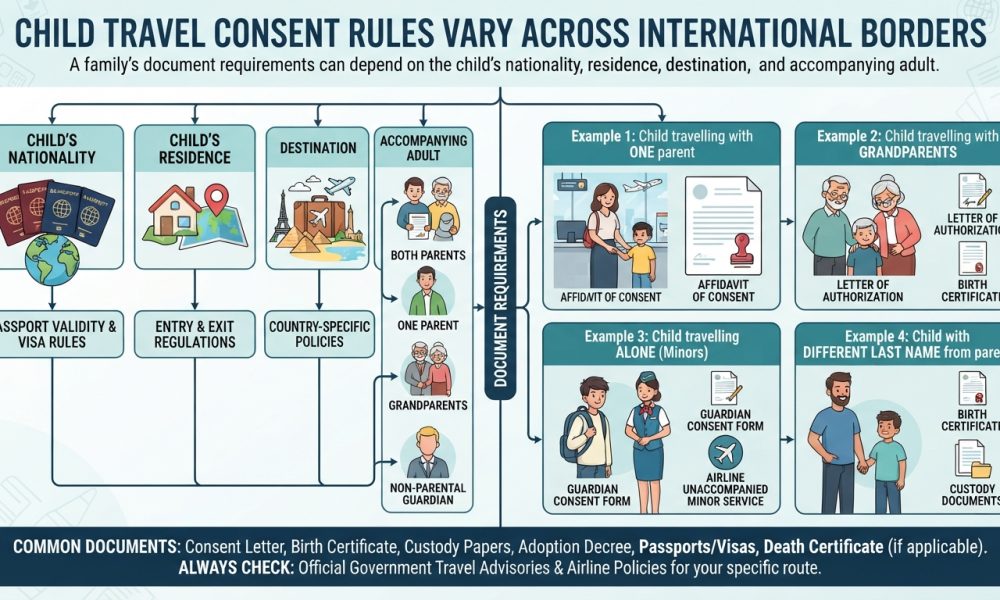
A family’s document requirements can depend on the child’s nationality, residence, destination, and accompanying adult.
WASHINGTON, DC, October 15, 2026 — Families traveling internationally with children may encounter different parental consent and Identification requirements depending on the child’s citizenship, country of residence, destination, accompanying adult, and whether the journey involves entering or departing a country that maintains special safeguards for minors.
Although passports establish identity and nationality, governments may require additional evidence demonstrating that a child has permission to travel, particularly when the minor is accompanied by only one parent, another relative, a legal guardian, or an unrelated adult.
Official guidance from the United States, Canada, and Mexico shows how international requirements differ: some governments recommend parental consent letters, others establish formal departure authorization procedures, and many recognize separate rules for custody, guardianship, and legal responsibility.
These differences matter most for American families traveling with dual-national children, separated parents, grandparents, school groups, or individuals whose legal relationship to an accompanying minor isn’t immediately clear from their Identification documents.
For parents and guardians, understanding the distinction between recommended documentation and legally mandatory authorization can help prevent unnecessary travel complications while supporting safeguards designed to protect children from international parental abduction and other unauthorized movements.
Child Travel Requirements Are Not Uniform Worldwide
International travel rules for minors reflect the immigration legislation, family law, and child Protection procedures established by individual governments, so no single parental consent document is automatically accepted in every country.
A child traveling from the United States to another destination may face different procedures when leaving America, entering the foreign country, and then departing for the return journey.
Some jurisdictions require formal permission from an absent parent, while others recommend carrying evidence of consent unless specific custody or immigration circumstances require additional documentation.
Nationality and residence can also affect the rules, particularly when children hold citizenship in the country they are leaving or possess a residence status subject to specific departure requirements.
Families should therefore review each international border on their itinerary instead of assuming the standards at their original departure airport apply throughout the journey.
The United States Does Not Generally Require Both Parents’ Permission
The United States does not generally require that every minor departing internationally present evidence of consent from both parents. However, individual circumstances and foreign destination requirements can create additional documentation considerations.
According to the U.S. Department of State’s official guidance on international travel with minors, families should carry evidence of their legal relationship with accompanying children and check any parental permission requirements the destination country imposes.
The department recognizes that certain foreign jurisdictions require signed, notarized consent from an absent parent or documentation establishing sole legal custody before a child can lawfully enter or depart.
A parent traveling alone with a child may therefore meet ordinary United States departure requirements but still face difficulties at a foreign border if the destination maintains stricter authorization procedures.
The practical distinction is that American passport issuance and United States departure rules do not replace the child Protection requirements established by foreign governments.
Canada Recommends Consent Letters Without Making Them Universally Mandatory
Canada takes a different approach by strongly recommending that children traveling internationally without one or both parents or legal guardians carry a written consent letter identifying the individuals authorizing the journey.
Under Canadian government guidance, Canadian law does not universally require such a letter, but airline personnel, Canadian border officers, or foreign immigration authorities may request it.
The recommendation also applies to children traveling with one parent, relatives, family friends, school groups, or other adults responsible for accompanying them internationally.
A signed letter can help establish that the proposed travel has been authorized, although it does not automatically satisfy additional legal requirements imposed by another country.
This distinction is important because a recommended document can provide practical reassurance without becoming a universal statutory prerequisite for every child crossing the Canadian border.
Consent Letters Should Identify the Child and Accompanying Adult
When preparing a parental consent letter, families should include sufficient Information to identify the child, the adults authorizing travel, and the person responsible for accompanying the minor during the journey.
Common details include the child’s full name, the parents’ or guardians’ names and contact Information, the accompanying adult’s identity, the destination, and the intended travel dates.
Where both parents share decision-making responsibility but only one will travel, the absent parent may provide authorization, subject to any relevant court orders or legal restrictions.
For children traveling with grandparents, teachers, or other adults, documentation may need to identify the parents or guardians granting permission and explain the relationship between the child and the accompanying traveler.
Families should avoid assuming that an informal statement with only the child’s name will meet every destination’s requirements, especially when a government prescribes a specific authorization format.
Notarization May Be Recommended or Legally Required
Some countries require parental consent documents to be notarized, authenticated, or prepared through designated government procedures, while others accept ordinary signed letters as supporting evidence.
A notarized document can help establish that the person granting permission appeared before an authorized official and signed the declaration under the applicable witnessing procedures.
However, notarization does not, by itself, determine whether the person signing has legal authority to authorize travel, especially when custody rights are disputed or limited by court orders.
Certain destinations may also require certified translations or other forms of document Authentication before recognizing consent issued in another country.
Parents should therefore verify the destination’s specific requirements instead of treating notarization as a universal substitute for legal permission or government-prescribed documentation.
Mexico Applies Formal Departure Rules to Certain Children
Mexico provides a significant example of nationality-based departure requirements because its immigration authorities maintain a special authorization procedure for certain minors leaving the country alone or accompanied by an adult who is not their parent or legal guardian.
The Mexican National Migration Institute’s official guidance on the Formato SAM explains that the system applies to qualifying Mexican minors and foreign minors holding specified residence status in Mexico.
The procedure allows parents or legally authorized guardians to document permission for an eligible child to travel internationally alone or with a third-party adult.
Mexican authorities also recognize specified alternative legal authorization documents, demonstrating that the government maintains a formal departure framework rather than relying exclusively on informal parental consent letters.
These rules illustrate why a child who entered Mexico without unusual documentation may still need additional authorization before leaving under different accompanying arrangements.
Mexico’s Formato SAM Requires Official Validation
The Mexican Formato de Salida de Menores, commonly called Formato SAM, involves completing the prescribed Application and presenting supporting Identification and family documentation to the National Migration Institute.
The procedure generally includes Information concerning the child, the person authorized to grant travel permission, the intended journey, and any adult accompanying the minor.
Mexican immigration officials review the documentation and validate the form according to applicable procedures, and the authorization serves as evidence that the required departure permission has been established.
The service is provided without a government processing charge, but applicants must complete the documentary and administrative steps required for official validation.
Families should complete the procedure well before departure, rather than assuming an unsigned or unvalidated form will meet the requirements for qualifying minors.
Mexican Citizens and Foreign Residents Can Face Different Requirements
Mexico’s departure authorization procedures also show why a child’s citizenship and immigration residence status can affect the documentation required for international travel.
The Formato SAM framework applies to qualifying Mexican minors, including dual nationals recognized as Mexican citizens, and certain foreign children holding temporary or permanent residence status.
By contrast, foreign minors entering Mexico as ordinary tourists are not automatically subject to the same SAM departure requirement merely because they are younger than eighteen.
Mexican guidance also distinguishes children traveling alone or with third parties from qualifying children accompanied by a parent or legally recognized guardian, creating additional differences according to the accompanying adult.
Parents should therefore determine both the child’s legal status in Mexico and the identity of the person accompanying the child before deciding whether a formal departure authorization is necessary.
Dual Nationality Can Create Additional Legal Obligations
Children with more than one citizenship may face different entry and departure requirements depending on which country recognizes them as nationals and which passport they must present.
A child born in the United States to parents holding another nationality may acquire additional citizenship through descent, potentially creating obligations under the laws of the parents’ country of origin.
These obligations may include using a national passport, obtaining specific departure authorization, or meeting family law requirements that do not apply to typical foreign tourists.
Parents should not assume that presenting an American passport automatically removes obligations imposed by another country that legally recognizes the child as its citizen.
The appropriate assessment must consider genuine nationality, applicable residence status, and the country’s rules governing children departing without all individuals possessing parental authority.
Separated and Divorced Parents May Need Court Documents
International travel becomes more legally complicated when parents are separated or divorced because parenting agreements and court orders may establish specific rules concerning international travel, residence, and decision-making responsibility.
A parent with physical custody does not necessarily have exclusive authority to authorize international travel, especially when the other parent retains relevant legal rights under the applicable family law.
Depending on the circumstances, supporting documentation may include parenting orders, custody judgments, written agreements, or legally valid consent from the other person exercising parental responsibility.
Where a court expressly restricts international travel or requires permission before departure, an ordinary consent letter cannot override the relevant judicial decision.
Families with unresolved custody disputes should seek qualified legal advice before arranging international travel, rather than assuming that possession of the child’s passport grants unrestricted permission to depart.
Different Family Names Do Not Establish a Lack of Relationship
Parents and children may legitimately have different surnames after marriage, divorce, adoption, or other recognized family circumstances so that additional relationship documentation can help during international border checks.
A birth certificate may help explain the legal relationship between a child and an accompanying parent whose surname differs from the name appearing in the child’s passport.
In some circumstances, marriage certificates, legal name-change records, or adoption documentation may provide further context when immigration authorities examine the relationship.
However, different surnames do not automatically require additional legal authorization, and families should distinguish proof of relationship from permission granted by an absent parent.
Accurate supporting documents can help resolve questions without treating ordinary differences in family names as evidence of improper travel arrangements.
Grandparents and Other Relatives May Need Permission
Children traveling with grandparents, aunts, uncles, or other relatives may require additional documentation because the accompanying adult’s family relationship does not necessarily establish legal authority to authorize international movement.
Some destinations require written parental consent when a minor travels with anyone other than a parent or legally recognized guardian, even if the accompanying person is a close relative.
The document may need to identify the accompanying adult, describe the travel arrangements, and provide contact Information for the parent or guardian granting authorization.
If the child will be handed over to another adult upon arrival, families should also confirm whether the airline or destination imposes requirements for the person responsible for receiving the minor.
These considerations are particularly important for extended family visits involving multiple countries and changes in the adults accompanying the child.
School Groups and Unaccompanied Minors Have Separate Procedures
Children participating in international school trips, sporting competitions, cultural exchanges, and other organized activities may require consent documentation identifying the adults responsible for supervising the group.
Schools and travel organizers may also request emergency contact details, medical Information, and parental authorization for particular activities, although these administrative records do not necessarily replace government-required exit permissions.
Airlines maintain separate policies for unaccompanied minors, including age restrictions, supervision services, fees, and Identification requirements for adults meeting children at their destinations.
A child permitted to travel alone under an airline’s commercial procedures may still require authorization under the immigration laws of the country of departure or arrival.
Parents should consequently verify both transportation requirements and government procedures before arranging international travel without an accompanying legal guardian.
Passport Identification and Parental Consent Are Different Safeguards
Modern passport systems increasingly incorporate additional Identification safeguards intended to strengthen the reliability of travel documents issued to children and support the examination of family relationships at international borders.
Mexico’s electronic passport developments provide an example because Information identifying parents or legally recognized guardians can appear within documentation issued to minors, supporting authorities examining the child’s identity and family circumstances.
Amicus International Consulting examined these features in Mexico’s Children’s Passports Include Parents’ Photos to Strengthen Travel Security, outlining how supplementary parental Identification can contribute to broader child travel security procedures.
However, parental photographs or names in an authentic passport do not, by themselves, establish that the identified individuals have approved a particular international journey.
Passport Authentication, proof of legal relationship, custody authority, and permission to travel remain distinct questions that may require different records under the applicable national legislation.
International Child Protection Requires Attention to Legal Authority
Parental travel consent requirements are partly designed to reduce the risk of unauthorized international movement, including situations involving disputed custody or the wrongful removal or retention of children across borders.
However, a consent letter is not an absolute safeguard against international parental abduction, and the absence of a letter does not necessarily establish wrongdoing when the applicable law does not require one.
Governments may consider court orders, family relationships, legal guardianship, and other relevant circumstances when determining whether international movement is properly authorized.
The Hague Convention on the Civil Aspects of International Child Abduction provides a framework for addressing certain wrongful removals and retentions between participating countries. Still, it does not replace ordinary immigration or parental consent requirements.
Families should therefore distinguish preventative travel documentation from the separate legal procedures available when an international custody or child abduction dispute arises.
Families Should Verify Requirements for Every Border Crossing
A child traveling internationally may face separate documentation checks when leaving the country of residence, entering the destination, crossing an intermediate border, and returning home.
Each jurisdiction may define a minor differently, recognize different forms of parental responsibility, and prescribe specific documentation for children traveling without all relevant adults.
Families should therefore verify current requirements with the responsible immigration authority or diplomatic mission in each country involved, paying particular attention to nationality-based obligations and formal departure procedures.
Families should also review travel arrangements when the accompanying adult changes, since permission prepared for one itinerary may not authorize a materially different journey.
If special custody circumstances or disputed legal authority exist, qualified legal advice may be necessary before relying on a standard travel consent letter.
Conclusion: Child Travel Consent Depends on More Than a Passport
International child travel consent requirements vary considerably because governments establish different safeguards based on nationality, residence, accompanying adults, and the legal relationships governing parental responsibility.
United States guidance emphasizes destination-specific requirements and does not impose a general two-parent consent rule for international departure. At the same time, Canada recommends written authorization, even though Canadian law does not universally require such letters.
Mexico provides a contrasting example through its formal departure authorization procedure for qualifying Mexican and foreign-resident minors traveling alone or with third-party adults.
For families, accurate preparation requires understanding whether the relevant document establishes identity, parental relationship, legal custody, or permission for a particular international journey.
Ultimately, parents and guardians should verify each destination’s current requirements, obtain valid authorization when needed, and recognize that a valid child’s passport does not automatically satisfy every legal condition for crossing international borders.




