
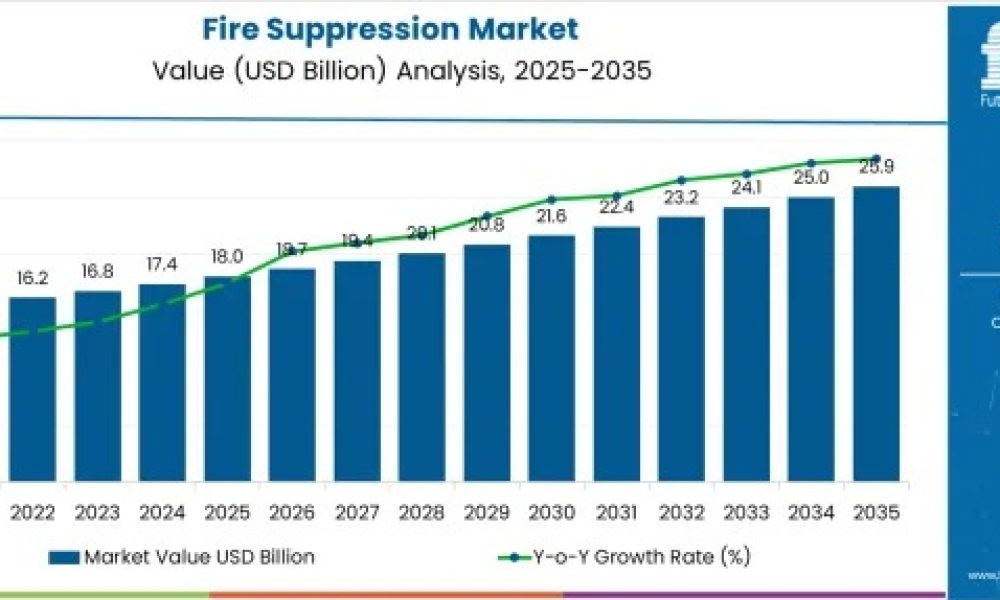
The global Fire Suppression Market is on a steady upward trajectory, moving from an estimated USD 18.0 billion in 2025 to USD 25.9 billion by 2035. This reflects a predictable CAGR of 3.7%, supported by increasingly stringent safety codes, heightened investments in industrial facilities, and the modernization of aging infrastructure worldwide. Unlike markets that fluctuate with cyclical demand, fire suppression demonstrates structural resilience, driven by regulatory compliance and essential safety needs in residential, commercial, and industrial environments.
Subscribe for Year-Round Insights → Stay ahead with quarterly and annual data updates:
https://www.futuremarketinsights.com/reports/sample/rep-gb-22518
As global infrastructure expands and risk-awareness strengthens, industries are integrating advanced suppression solutions such as clean agents, dry chemicals, and IoT-compatible systems. Post-2030, a mild acceleration in market value is expected as connected, eco-friendly suppression systems become mainstream in high-risk facilities, including data centers, chemical plants, and logistics hubs.
Steady Growth Sustained by Safety Mandates and Industrial Expansion
Historical performance between 2020 and 2024 shows a gradual increase from USD 15.0 billion to USD 17.4 billion. This stability lays the foundation for future demand—particularly from sectors such as manufacturing, transportation, energy, and commercial construction, which increasingly require adherence to global safety and insurance mandates.
Governments and regulatory bodies across North America, Europe, and Asia-Pacific are reinforcing codes for the installation of certified suppression systems. These include water mist, gaseous agents, and dry chemical technologies, each chosen based on environmental considerations and asset sensitivity.
Growing fire incidents in industrial clusters, coupled with stricter compliance audits, are also accelerating retrofits. Modern suppression units offer faster activation, minimal residue, and enhanced compatibility with digital building management systems—all now considered essential for risk mitigation and operational continuity.
Key Segment Highlights: Fire Sprinklers Lead with 56% Revenue Share
The fire sprinkler category remains the backbone of fire suppression, accounting for 56% of market revenue by 2025. Their reliability, low maintenance needs, and broad adoption across commercial, industrial, and residential sectors continue to position them as the preferred solution worldwide.
Capacity-range segmentation reveals that 5–15 unit systems command a dominant 39% share, largely due to their suitability for small and mid-sized infrastructures such as office parks, warehouses, and transit facilities. These systems offer optimal coverage with practical scalability—supporting both new installations and retrofit projects.
Dry chemical suppression agents are projected to claim 42% of the market, driven by their suitability for electrical environments, high knock-down efficiency, and versatility across industrial and mission-critical applications. Their fast response time and wide fire classification range make them indispensable for energy, manufacturing, and data-driven sectors.
Regional Growth Insights: China and India Drive Global Momentum
The global market’s CAGR of 3.7% masks stronger growth pockets:
- China (5.0% CAGR) is accelerating adoption through stringent fire safety mandates in EV battery plants, megastructures, and industrial parks. Tier-2 and Tier-3 cities are quickly adopting Tier-1 fire norms, while hybrid mist-aerosol systems gain government favor in retrofits.
- India (4.6% CAGR) benefits from updated National Building Codes, smart city initiatives, and extensive retrofitting across metro stations, hospitals, data centers, and mixed-use developments.
- Germany (4.3% CAGR) advances with VdS-certified systems and eco-friendly suppression agents, especially for commercial towers and heritage buildings requiring low-residue solutions.
- France (3.9% CAGR) leads in public-sector modernization with a shift toward clean agents and high-efficiency mist systems in tunnels, archives, and hospitals.
- United Kingdom (3.5% CAGR) prioritizes retrofits across public housing, healthcare, and education, driven by renewed fire safety standards after landmark fire incidents.
Competitive Landscape: Integrated and Smart Systems Define Market Leadership
Global leaders such as TYCO, Amerex Corporation, United Technologies Corporation, NAFFCO, Minimax, Bristol Fire Engineering, Halma PLC, and Lubrizol are shaping the competitive environment with next-generation systems that blend detection, suppression, automation, and remote monitoring.
Manufacturers are increasingly focusing on:
- Clean-agent systems aligned with sustainability regulations
- IoT-driven suppression controls for smart buildings
- Modular, space-efficient units for industrial and commercial retrofits
- Multi-agent systems designed for high-risk chemical and energy environments
Get data that aligns with your strategic priorities — ask for report customization today:
https://www.futuremarketinsights.com/customization-available/rep-gb-22518
Have a specific Requirements and Need Assistant on Report Pricing or Limited Budget please contact us – [email protected]
About Future Market Insights (FMI)
Future Market Insights, Inc. (FMI) is an ESOMAR-certified, ISO 9001:2015 market research and consulting organization, trusted by Fortune 500 clients and global enterprises. With operations in the U.S., UK, India, and Dubai, FMI provides data-backed insights and strategic intelligence across 30+ industries and 1200 markets worldwide.
Contact Us:
Future Market Insights Inc.
Christiana Corporate, 200 Continental Drive,
Suite 401, Newark, Delaware – 19713, USA
T: +1-347-918-3531



