
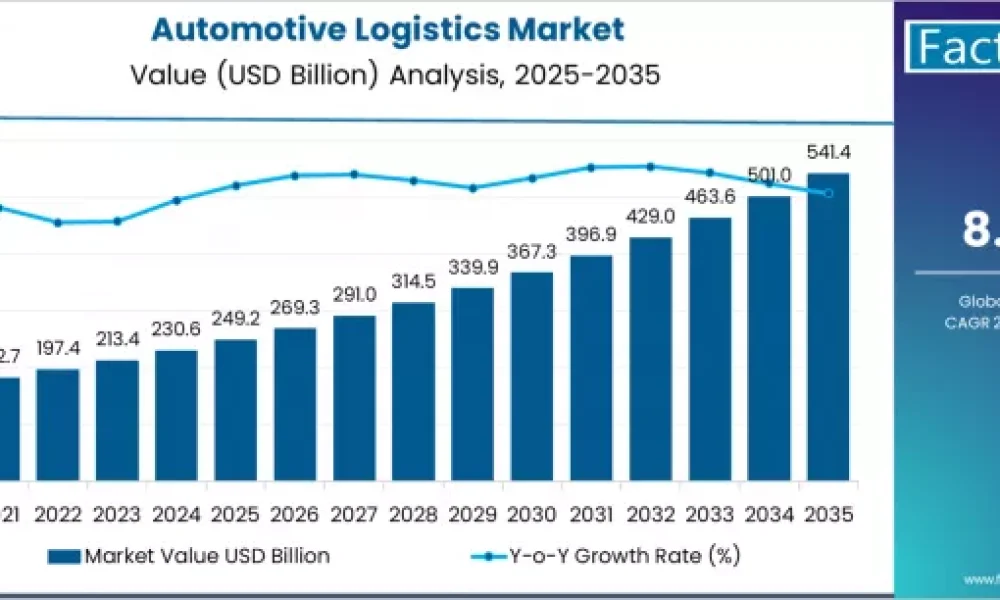
The automotive logistics market is entering a major growth phase as global vehicle production, evolving supply chains, and increasing demand for efficient, tech-enabled distribution converge to create robust opportunities. In 2025, the market is estimated to be worth approximately USD 249.2 billion — and forecasts suggest it will surge to around USD 541.4 billion by 2035, nearly doubling over the decade at a projected compound annual growth rate (CAGR) of 8.1%.
As supply chains become more complex — with rising numbers of auto parts, components, finished vehicles, and rapidly evolving requirements for electric vehicles (EVs) — the need for specialized automotive logistics services is growing sharply. Transportation remains the dominant activity, but warehousing, reverse logistics, and integrated supply-chain solutions are gaining prominence.
Key Market Highlights (2025 Baseline)
| Metric / Segment | Value / Insight |
|---|---|
| Market Value (2025) | ~ USD 249.2 billion |
| Forecast Value (2035) | ~ USD 541.4 billion |
| Forecast CAGR (2025–2035) | ~ 8.1% |
| Dominant Activity Segment | Transportation (≈ 81.1% share in 2025) |
| Leading Type Segment | Automobile parts logistics (≈ 65.0% share in 2025) |
| Fastest Growth in Type Segment | Finished-vehicle logistics (growing share) |
| Logistic-Solution Segment Leader | Inbound logistics (≈ 55.0% share in 2025) |
| Distribution Segment Leader | Domestic distribution (≈ 70.0% share in 2025) |
| Key Growth Regions | Asia-Pacific, North America, Europe |
To access the complete data tables and in-depth insights, request a Discount On The Report here: https://www.factmr.com/connectus/sample?flag=S&rep_id=11908
Growth Drivers & Market Momentum
Surge in Global Vehicle Production & EV Adoption
As automotive manufacturers ramp up output worldwide — including growth in electric vehicle (EV) production — demand for robust logistics systems intensifies. A larger number of parts, complex sub-assemblies, and new supply-chain footprints create substantial demand for logistics services, both for inbound components and outbound finished vehicles or replacements.
Supply Chain Complexity & Just-in-Time Requirements
Modern automotive production increasingly relies on “just-in-time” and “just-in-sequence” delivery models, requiring highly dependable inbound logistics to ensure parts arrive precisely when needed. This has pushed manufacturers to outsource their logistics to specialized providers, fueling adoption of integrated logistics solutions.
Technological Innovation & Digitalization
Logistics service providers are investing in digital platforms — real-time freight tracking, IoT-enabled monitoring, warehouse automation, predictive analytics, and advanced route optimization. These technologies boost transparency, reliability, and efficiency, making third-party logistics increasingly attractive compared to in-house logistics.
Rising Demand for Aftermarket & Spare Parts Logistics
Apart from new vehicle distribution, aftermarket parts logistics (spare parts, replacements, servicing components) is becoming a key growth area. The frequent need for parts replenishment and distribution to service centers, dealers, and consumers has amplified demand for flexible, responsive logistics.
Sustainability & Green Logistics Trends
With environmental regulation tightening, increased focus on reducing carbon footprint, and rising awareness of sustainability across industries, “green logistics” is becoming a differentiator. Logistics providers are exploring eco-friendly transport modes, optimized routing, and more efficient warehousing to meet sustainability goals.
Challenges & Market Constraints
Volatile Fuel and Transportation Costs: Fluctuating fuel prices can significantly impact logistics pricing and profitability, especially for long-haul vehicle part shipments and finished vehicle distribution.
Infrastructure and Regulatory Hurdles: In some regions, limitations in road, rail, or port infrastructure — along with complex customs and cross-border regulations — can hamper logistics efficiency and add delays or costs.
Labor and Resource Constraints: The shortage of skilled labor for trucking, warehousing, and logistics operations — especially in emerging markets — may limit capacity expansion and affect service quality.
Rising Supply-Chain Complexity with EVs: EVs introduce new logistical challenges — specialized handling for batteries, sensitive components, and compliance with safety standards — which demand more sophisticated logistics capabilities. Some smaller or under-equipped providers may struggle to adapt.
Strategic Recommendations
For Logistics Providers & 3PL Firms
Invest in digital infrastructure: IoT tracking, warehouse automation, predictive analytics, and supply-chain-management tools to enhance reliability and transparency.
Expand service offerings: Provide end-to-end solutions — from inbound parts logistics to outbound vehicle distribution and aftermarket parts delivery — to serve the full automotive ecosystem.
Position sustainability: Offer “green logistics” packages (optimized routing, alternative-fuel fleets, eco-friendly warehousing) to attract eco-conscious clients and comply with emerging regulations.
For Automotive OEMs & Parts Manufacturers
Partner with specialized logistics providers to manage complexity and avoid in-house logistics overhead.
Adopt just-in-time and lean-manufacturing supply chains, leveraging logistics partners for consistent parts delivery.
Factor in aftermarket and reverse-logistics from the outset, considering spare-parts availability and returns management as integral to product lifecycle planning.
For Investors & Market Entrants
Consider the automotive logistics space as a high-growth investment opportunity — particularly for service providers that integrate technology, sustainability, and flexibility.
Target emerging markets where vehicle production growth and expanding supply chains offer high upside.
Watch for consolidation: established players with global reach and tech-enabled services are likely to lead; new entrants should differentiate via niche services (e.g. EV logistics, regional specialization, green logistics).
Market Outlook to 2035
By 2035, the global automotive logistics market is poised to more than double in size compared to 2025 — reaching roughly USD 541.4 billion if current growth trends hold.
Growth will be driven by continued expansion of global vehicle production (including EVs), rising demand for parts and aftermarket logistics, increasing adoption of digital logistics technologies, and mounting regulatory and consumer pressure for sustainability. As supply chains become more global and complex, integrated logistics providers offering transportation, warehousing, inventory management, and value-added services will become indispensable for manufacturers, suppliers, and dealers.
Companies that successfully combine technological sophistication, geographical reach, specialty EV-capable logistics, and sustainability credentials are likely to lead the market. For stakeholders — from OEMs to parts suppliers, from logistics firms to investors — the next decade represents a strategic opportunity to build scalable, efficient, and future-proof logistics ecosystems across the automotive industry.
Have specific requirements or need assistance on report pricing or have a limited budget? Please contact [email protected]
About Fact.MR:
Fact.MR is a global market research and consulting firm, trusted by Fortune 500 companies and emerging businesses for reliable insights and strategic intelligence. With a presence across the U.S., UK, India, and Dubai, we deliver data-driven research and tailored consulting solutions across 30+ industries and 1,000+ markets. Backed by deep expertise and advanced analytics, Fact.MR helps organizations uncover opportunities, reduce risks, and make informed decisions for sustainable growth.



