
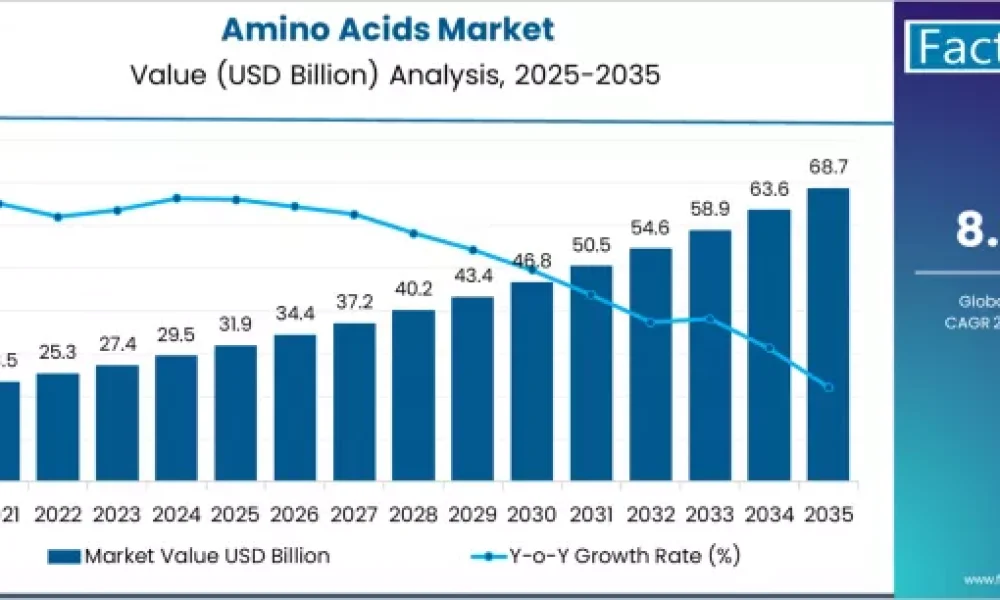
The U.S. amino acids market is poised for sustained expansion through 2035, supported by rising demand across animal nutrition, human health, pharmaceuticals, and emerging bio-based manufacturing. With baseline U.S. market value estimated at approximately USD 4 billion in 2023, the industry is positioned to enter a decade of accelerated innovation, capacity investments, and portfolio diversification.
Market Outlook and Growth Projection
Between 2025 and 2035, the U.S. amino acids market is expected to grow at a consistent mid-to-high single-digit compound annual growth rate. Several structural factors underpin this trajectory, including advances in fermentation technologies, dietary shifts toward higher protein intake, and increased utilization of amino acids in precision nutrition for both animals and humans.
Global benchmarks indicate that the broader amino acids industry may reach USD 70–75 billion by 2035, nearly doubling from mid-2020s valuations. While the U.S. forms a smaller proportion of the global total, it remains one of the most innovation-driven markets with strong demand for specialty and high-purity amino acids.
To access the complete data tables and in-depth insights, request a Discount On The Report here: https://www.factmr.com/connectus/sample?flag=S&rep_id=12088
Key Demand Drivers in the U.S.
1. Animal Feed Industry Expansion
The animal feed sector remains the largest consumer of amino acids in the U.S., particularly lysine, methionine, and threonine. These ingredients are essential for optimizing feed conversion ratios, reducing nitrogen excretion, and lowering overall feed costs while supporting animal health.
Poultry and swine operations, which dominate U.S. livestock production, are adopting more amino-acid-fortified diets to meet sustainability goals and comply with evolving environmental standards. By 2035, the value of amino acids used in feed formulations is projected to grow substantially as producers seek more efficient, protein-balanced feed solutions.
2. Growth in Human Nutrition and Wellness
Amino acids used in dietary supplements, sports nutrition, clinical nutrition, and medical formulations are experiencing heightened consumer demand. Branched-chain amino acids (BCAAs), glutamine, arginine, and glycine remain among the top-selling products across retail and clinical channels.
Drivers include:
The expansion of personalized and precision nutrition programs
Increased attention to metabolic and muscle health in aging populations
Growth of sports and active-lifestyle consumer segments
Clinical use in immune health, post-surgery recovery, and metabolic therapy
Specialty amino acids tend to command premium pricing, creating high-margin opportunities for U.S. manufacturers capable of producing ultrapure and pharmaceutical-grade variants.
3. Rising Applications in Pharmaceuticals and Biotechnology
Amino acids play essential roles in biologics manufacturing, infusion solutions, parenteral nutrition, and cell culture media. U.S. pharmaceutical and biotech sectors continue expanding domestic manufacturing of biologic drugs, driving demand for high-purity amino acid inputs.
Innovations such as continuous fermentation, advanced purification systems, and novel amino-acid-based APIs are expected to elevate product differentiation and strengthen domestic supply chains.
4. Sustainability and Bio-Manufacturing Trends
Sustainability is becoming a core value driver for amino acid producers. Manufacturers are increasingly investing in:
Low-carbon fermentation pathways
Biomass-derived feedstocks
Energy-efficient processing lines
Sustainable packaging solutions
These efforts align with corporate ESG requirements and growing demand for environmentally responsible ingredients across food, feed, and pharmaceutical sectors.
Supply-Side Developments and Competitive Shifts
The U.S. market is undergoing a structural shift driven by:
Capacity expansions among major producers
Entry of new biotechnology companies specializing in precision fermentation
Consolidation in distribution networks
Supply contracts that emphasize price stability and sustainability metrics
Producers are also relocating or optimizing production footprints to improve resilience and reduce dependency on international supply chains. Periodic plant modernization and maintenance cycles—particularly in methionine and lysine production—continue to influence short-term pricing and availability. This creates opportunities for agile suppliers capable of responding to spot-market demands.
Opportunities for Industry Stakeholders
For Manufacturers
Specialty-grade diversification: Companies that expand into high-value applications such as clinical-grade amino acids, cosmetic actives, and pharmaceutical intermediates will capture higher margins.
Advanced fermentation capabilities: Investments in precision fermentation and continuous bioprocessing will reduce production costs while improving product purity.
Vertical integration: Securing feedstock supply and integrating upstream processes can help insulate companies from raw material volatility.
For Feed Producers
Formulating lower-crude-protein diets with higher amino acid supplementation will support sustainability commitments while improving cost efficiency.
Long-term supply contracts with amino acid producers may help mitigate price volatility associated with maintenance cycles or capacity realignments in the global market.
For Investors
Companies focused on specialty and pharmaceutical-grade amino acids represent strong value propositions.
Investments in bio-manufacturing infrastructure—especially facilities with the flexibility to switch between amino acid types—offer long-term growth potential.
ESG-aligned producers will gain competitive ground as sustainability reporting becomes mandatory for larger enterprises.
Strategic Market Outlook (2025–2035)
The decade ahead is expected to mark a shift from commodity-focused growth to a more specialized, innovation-driven market landscape. Several macro trends will shape the U.S. amino acids industry:
Transition toward premium, differentiated products
Greater adoption of low-carbon manufacturing technologies
Expansion of amino acid use cases in biopharma and advanced nutrition
Increased domestic capacity to strengthen supply chain resilience
Integration of data analytics and precision nutrition in feed and human health
By 2035, the U.S. market is likely to be more diversified, more technologically advanced, and more sustainability-oriented than at any point in its history.
About This Release
This press release provides a data-driven analysis of the U.S. amino acids market based on aggregated industry research, market modeling, and analysis of segment-specific growth trends. It is designed to inform manufacturers, buyers, investors, and policy stakeholders about the expected evolution of the amino acids sector between 2025 and 2035.
Have a specific Requirements and Need Assistant on Report Pricing or Limited Budget please contact us – [email protected]
To View Related Report :
Casamino Acids Market https://www.factmr.com/report/casamino-acids-market
Feed Amino Acids Market https://www.factmr.com/report/2938/feed-amino-acids-market



