
The truck cranes market is an integral part of the construction and heavy equipment industry, providing versatile lifting solutions for various applications. These mobile cranes, mounted on trucks for easy transportation, are essential in construction, infrastructure development, and material handling. This article provides a comprehensive overview of the truck cranes market, exploring current industry trends and recent developments.
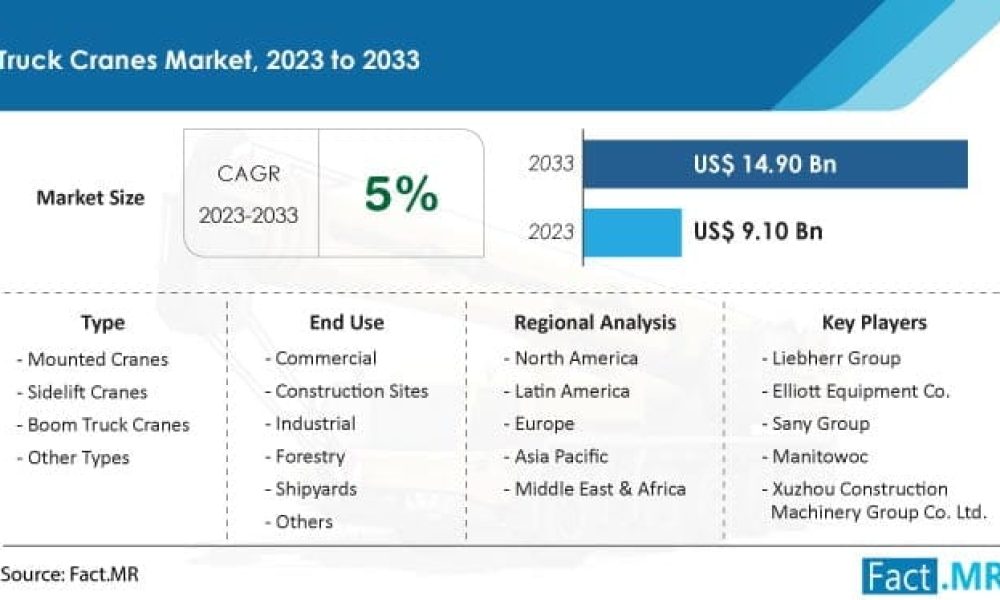
Worldwide sales of truck cranes are estimated at US$ 9.1 billion for 2023 and are forecasted to reach US$ 14.9 billion by the end of 2033. Over the next ten years, the global truck cranes market is predicted to expand steadily at 5% CAGR. A truck crane is a crane mounted on a truck trailer. The truck crane has two components the lower carrier and the upper lifting component. Truck cranes also have a telescopic boom for specific applications wherein materials are lifted at a high position. The carrier truck provides mobility to the crane and hence is used to easily transport the crane to the job site and for loading and unloading different loads.
Download a Sample Copy of This Report:
https://www.factmr.com/connectus/sample?flag=S&rep_id=2169
The truck cranes market has witnessed steady growth, driven by the increasing demand for efficient and mobile lifting equipment in construction and industrial activities. These cranes offer the advantage of mobility, allowing operators to easily transport them to different job sites. The market encompasses various types of truck cranes, including hydraulic truck cranes, all-terrain cranes, and rough-terrain cranes, each designed to cater to specific lifting requirements. The global construction boom, especially in emerging economies, contributes significantly to the demand for truck cranes.
Key Applications
- Construction Industry: Truck cranes play a crucial role in the construction sector, facilitating the lifting and placement of heavy materials, equipment, and structural components. They are commonly used in building construction, infrastructure projects, and the installation of precast elements.
- Infrastructure Development: The development of infrastructure, including roads, bridges, and energy projects, relies heavily on the use of truck cranes. These cranes contribute to the efficient execution of large-scale projects by providing the necessary lifting capabilities in diverse and often challenging environments.
- Oil and Gas Sector: In the oil and gas industry, truck cranes are utilized for various tasks, such as lifting and placing equipment during drilling operations, maintenance activities, and the assembly of structures in refineries and petrochemical plants.
- Utilities and Power Transmission: Truck cranes are employed in the installation and maintenance of utility infrastructure, including power lines and transmission towers. Their mobility allows for quick deployment to remote locations, where traditional stationary cranes may be impractical.
Key Players
- Liebherr Group
- Kato Works Co. Ltd.
- Sany Heavy Industry Co. Ltd.
- Tadano Ltd.
- The Manitowoc Company Inc.
- XCMG Construction Machinery Co., Ltd.
- Elliott Equipment Company
- Böcker Maschinenwerke GmbH
- Terex Corporation
- Manitex International Inc.
Market Dynamics
The truck cranes market is influenced by various factors that contribute to its growth and dynamics:
1. Urbanization and Infrastructure Investments: Rapid urbanization and increasing infrastructure investments, particularly in emerging economies, drive the demand for construction and lifting equipment, including truck cranes. Growing urban populations create the need for new buildings, roads, and utilities.
2. Technological Advancements: Ongoing technological advancements in truck crane design and features enhance their efficiency, safety, and lifting capacities. Innovations such as telematics, advanced control systems, and lightweight materials contribute to the market’s evolution.
3. Sustainability and Environmental Considerations: The push toward sustainability and environmental consciousness is influencing the development of eco-friendly and energy-efficient truck cranes. Manufacturers are exploring ways to reduce fuel consumption and emissions while maintaining performance.
4. Rental Market Growth: The increasing trend toward renting rather than purchasing heavy equipment, including truck cranes, is gaining traction. Rental services provide flexibility to construction companies, allowing them to access the latest equipment without the long-term financial commitment of ownership.
Recent Developments
The truck cranes market has witnessed noteworthy developments reflecting industry trends and technological advancements:
- Integration of Advanced Safety Features: Manufacturers are incorporating advanced safety features into truck cranes, such as collision avoidance systems, load moment indicators, and automatic overload protection. These features enhance operator safety and contribute to accident prevention.
- Telematics and Remote Monitoring: The integration of telematics and remote monitoring systems allows fleet managers to track and manage truck cranes remotely. Real-time data on equipment performance, location, and maintenance needs contribute to improved operational efficiency.
- Electric and Hybrid Truck Cranes: Responding to the growing emphasis on sustainability, some manufacturers are exploring electric and hybrid solutions for truck cranes. These alternatives aim to reduce environmental impact by minimizing fuel consumption and emissions.
- Customization and Modular Design: Manufacturers are offering customization options and modular designs that allow customers to tailor truck cranes to their specific requirements. This flexibility ensures that the equipment meets the diverse lifting needs of different industries.
Key Segments of Truck Cranes Industry Research
- By Lifting Capacity (Tonnes) :
- <150
- 150 to 300
- >300
- By End Use :
- Commercial
- Construction Sites
- Industrial
- Forestry
- Shipyards
- Others
- By Type :
- Mounted Cranes
- Sidelift Cranes
- Boom Truck Cranes
- Others
- By Region :
- North America
- Latin America
- Europe
- APAC
- MEA
Challenges
While the truck cranes market presents significant opportunities, it is not without its challenges:
- Global Economic Uncertainties: Economic uncertainties and fluctuations in global markets can impact construction activities and infrastructure investments, directly influencing the demand for truck cranes. Manufacturers may face challenges in predicting and responding to market fluctuations.
- Regulatory Compliance and Standards: Adhering to diverse international standards and regulatory requirements poses challenges for manufacturers. Ensuring that truck cranes meet safety and environmental standards in different regions requires continuous compliance efforts.
- Supply Chain Disruptions: The truck cranes market is susceptible to supply chain disruptions, which can affect the availability of components and materials. Events such as natural disasters, geopolitical tensions, or global health crises can impact the production and delivery of equipment.
- Skilled Operator Shortage: The shortage of skilled operators for truck cranes is a persistent challenge in the industry. The safe and efficient operation of these machines requires trained professionals, and addressing the shortage is crucial for maximizing the utilization of equipment.
Get Customization on this Report for Specific Research Solutions:
https://www.factmr.com/connectus/sample?flag=RC&rep_id=2169
The truck cranes market plays a vital role in supporting construction, infrastructure, and industrial activities globally. As the industry embraces technological advancements and strives for sustainability, manufacturers that focus on innovation, safety, and customization are poised for success in this dynamic and essential segment of the heavy equipment market.
Contact:
US Sales Office:
11140 Rockville Pike
Suite 400
Rockville, MD 20852
United States
Tel: +1 (628) 251-1583
E Mail : [email protected]




