
The Medical Animation market is experiencing robust growth as a result of the increasing demand for visually engaging and educational content in the healthcare sector. Medical animation involves the use of 3D computer-generated graphics to visualize complex biological processes, medical procedures, and anatomical structures. These animations serve various purposes, including medical education, patient communication, and marketing within the healthcare industry. The market’s dynamics are shaped by technological advancements, the rising need for effective communication in healthcare, and the integration of animation in medical training and diagnostics.
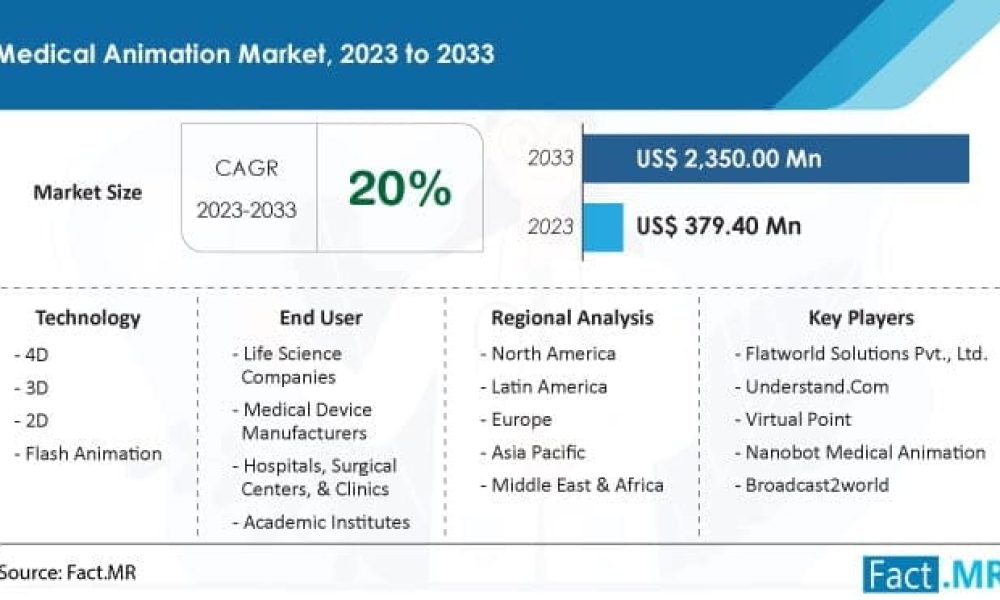
According to Fact.MR, the global medical animation market achieved a valuation of US$ 316.11 million in 2022. Projections for the assessment period spanning from 2023 to 2033 indicate a remarkable Compound Annual Growth Rate (CAGR) of 20%, culminating in an industry size of US$ 2.35 billion by the close of 2033. The escalating demand for medical animation is propelled by healthcare practitioners’ increasing adoption of various animation techniques to convey specific medical procedures or ideas, fostering improved comprehension and contributing to market expansion.
Download a Sample Copy of This Report:
https://www.factmr.com/connectus/sample?flag=S&rep_id=8935
A significant outcome of this technology is the rising enrollment of patients in various programs for wellness and illness management. The substantial expansion of the smartphone market, coupled with a growing number of pharmaceutical firms embracing animation for educational and promotional purposes, stands as a key driver contributing to the robust growth of the medical animation market.
Key Companies Profiled
- Flatworld Solutions Pvt., Ltd.
- Understand.Com
- Random42 Scientific Communication
- Elara Systems, Inc.
- vAnimations Studio
- Austin Visuals 3D Animation Studio
- Nanobot Medical Animation
- 3FX
- Virtual Point
- Delaplaine Creative
- Broadcast2world
“Technological Advancements Revolutionizing Medical Animation in Healthcare Industry”
The healthcare industry is undergoing a transformation owing to the relentless pace of technological advancements in healthcare. Key breakthroughs in virtual reality (VR), 3D modeling, and medical imaging are some myriad innovations that are estimated to revolutionize the approach to the development and utilization of medical animations.
These innovations are predicted to enhance the realism of anatomical animation. In addition, they are also projected to broaden the application of scientific visualization while making them indispensable in multiple aspects of communication and medical education.
Rapid advancements taking place in medical technology are anticipated to take the development and utilization of pharmaceutical animation to new heights. These newly developed technologies are projected to significantly improve the depth, accessibility, and precision of medical animations. Thus, owing to technological advancements, medical animation is estimated to find more impressive applications in the healthcare sector.
Key Market Drivers:
- Advancements in Technology: A primary driver for the Medical Animation market is the continuous advancements in technology, particularly in the field of computer-generated imagery (CGI) and 3D animation. High-quality and realistic medical animations are made possible by cutting-edge software and hardware, enabling the creation of detailed visualizations of complex medical concepts. This technological progress enhances the effectiveness of medical animations in conveying information to healthcare professionals, students, and patients.
- Growing Importance of Patient Education: With an increasing emphasis on patient-centered care, there is a growing importance placed on patient education. Medical animations serve as powerful tools for explaining medical conditions, treatment procedures, and the functioning of pharmaceuticals to patients in a comprehensible and engaging manner. The market benefits from the shift towards informed and empowered patients who seek a better understanding of their health and treatment options.
- Medical Training and Simulation: The use of medical animation in training healthcare professionals is a significant driver for the market. Institutions and healthcare organizations utilize animations to simulate surgical procedures, anatomical structures, and disease mechanisms, providing a valuable educational resource for medical students, residents, and practicing professionals. The interactive and immersive nature of animations aids in skill development, decision-making, and enhancing overall competency in healthcare practices.
Market Competition
Competition in the medical animation market is driving providers to implement diverse strategies aimed at achieving their objectives. These strategies include effective management of supply chain systems, rigorous quality control of products, and continuous innovation. Key players in the industry are actively engaged in initiatives such as product launches and portfolio expansion to generate leads and retain their existing consumer base.
For instance:
- Understand.com’s Advancements (October 2022): In October 2022, Understand.com unveiled an advanced high-definition photo-facial animation as an addition to its skin treatment catalog. This innovation enhances the depiction of skin anatomy and aging effects, featuring popular techniques like Led, BBL, and PL. The introduction of this cutting-edge technology reflects the company’s commitment to staying at the forefront of advancements in medical animation.
- Orthopedic Library Expansion (August 2022): Further solidifying its market presence, Understand.com expanded its orthopedic library in August 2022 with the introduction of Diagnostic Hip Arthroscopy. This addition enables the precise representation of procedures, recovery processes, and associated risks in diagnostic hip arthroscopy. The move exemplifies Understand.com’s dedication to continually enriching its portfolio to meet the evolving needs of the medical community.
Challenges and Restraints:
- Cost of Animation Production: One of the challenges in the Medical Animation market is the cost associated with producing high-quality animations. The creation of detailed and accurate medical animations requires skilled professionals, specialized software, and substantial investment in technology. Small healthcare institutions and educational organizations may find it challenging to allocate resources for in-house animation production or commissioning custom animations from external providers.
- Ensuring Accuracy and Scientific Validity: Maintaining accuracy and scientific validity is a critical restraint in the Medical Animation market. The content of medical animations must align with the latest medical research, standards, and guidelines to ensure that the information presented is reliable and credible. Achieving this accuracy requires collaboration between animators, healthcare professionals, and medical experts, adding a layer of complexity to the production process.
Technological Advancements:
Technological advancements in the Medical Animation market focus on enhancing the realism, interactivity, and customization of animations. Innovations include the use of virtual reality (VR) and augmented reality (AR) technologies to create immersive educational experiences. Additionally, advancements in motion capture technology contribute to more lifelike animations that accurately represent human movements and anatomical dynamics.
Segmentation of Medical Animation Industry Research
- By Technology :
- 4D
- 3D
- 2D
- Flash Animation
- By Therapeutic Area :
- Oncology
- Cosmeceuticals/Plastic Surgery
- Cardiology
- Dental
- By End User :
- Life Science Companies
- Medical Device Manufacturers
- Hospitals, Surgical Centers, & Clinics
- Academic Institutes
- By Region :
- North America
- Europe
- Asia Pacific
- Latin America
- Middle East & Africa
Current Industry News (2023):
Several trends and developments may have shaped the Medical Animation market in 2023.
- Integration of Virtual Reality in Medical Education: The industry may have witnessed increased integration of virtual reality in medical education through immersive medical animations. Virtual reality platforms provide students and healthcare professionals with an interactive and realistic learning experience, allowing them to explore medical scenarios, surgical procedures, and anatomical structures in a three-dimensional space. This trend aligns with the broader adoption of VR technologies in healthcare training.
- Personalized Patient Education Tools: Customization and personalization of medical animations for patient education may have gained prominence. Healthcare providers and pharmaceutical companies could be leveraging animation technologies to create personalized educational materials tailored to individual patient needs and medical conditions. This approach enhances patient engagement and understanding, contributing to improved health outcomes.
- Rise of Animation in Telemedicine: With the expansion of telemedicine, medical animations may have played a crucial role in remote patient communication. Healthcare professionals could be utilizing animations to explain diagnoses, treatment plans, and post-operative care to patients during virtual consultations. This application of medical animation supports effective communication between healthcare providers and patients, even in a digital healthcare landscape.
- Collaborations for Content Development: Collaborations between animation studios, healthcare institutions, and technology companies may have increased for the development of high-quality and scientifically accurate medical content. These collaborations bring together the expertise of animators, medical professionals, and technology specialists to create animations that meet the educational and informational needs of diverse healthcare audiences.
Get Customization on this Report for Specific Research Solutions:
https://www.factmr.com/connectus/sample?flag=RC&rep_id=8935
The Medical Animation market continues to thrive as a key component of medical education, patient communication, and professional training in the healthcare sector. Technological advancements, a growing focus on patient education, and the integration of animation in medical training contribute to the market’s expansion. Addressing challenges related to production costs and ensuring scientific validity will be crucial for sustaining the market’s growth and delivering impactful medical animations that meet the evolving needs of healthcare professionals and patients alike.
Contact:
US Sales Office:
11140 Rockville Pike
Suite 400
Rockville, MD 20852
United States
Tel: +1 (628) 251-1583
E Mail : [email protected]




