
New Exhibition Maps Decades of Collective Resistance from Central America to the US.
In a powerful and formally sophisticated move, the Los Angeles Contemporary Exhibitions (LACE) has mounted an exhibition that reconfigures the contemporary discourse on migration, borders, and systemic violence. Titled Intergalactix: against isolation/contra el aislamiento, the show transcends the descriptive language of simple activism, positioning itself instead as a deep intellectual and artistic interrogation of the ‘necropolitics’ of global borders. This is not merely an exhibition of art about the border; it is a meticulously researched project mapping the genealogies of collective artistic and activist practices stretching from Central America up through the Mexico-United States divide.
The exhibition, which ran from May 15 to August 14, 2020, challenges the core mechanisms of control and segregation that borders represent. The curatorial vision frames physical and conceptual boundaries as historical tools for isolation and discrimination, arguing that in the current era, particularly in the US context, the border has been weaponized into an essential instrument of the politics of death and the annulment of the human body. The art presented, featuring commissions from The Fire Theory, Tanya Aguiñiga, Cog nate Collective, and a special collaboration among Beatriz Cortez, Kaqjay Moloj, and FIEBRE Ediciones, serves as the counter-narrative, presenting a testament to the myriad forms of collective resistance built across these contested regions.
Reframing Isolation as a Political Weapon
A central thesis of the exhibition is the idea of isolation not as a mere psychological state, but as a deliberate political and tactical strategy. The curatorial text posits that isolation is employed to attack and weaken intergalactic connections, meaning the coalitional, collective life and the cosmic condition that links humans to all living forces. Actions such as dispossession, displacement, and uprooting are understood as calculated steps toward human isolation and against collectivity. This framing provides a sharp, analytical lens on structures like migrant detention centers along the US border, which are intentionally designed to isolate, degrade, and criminalize the fundamental human condition of mobility.
The exhibition’s intellectual foundation draws heavily from the history of resistance, specifically the indigenous Zapatista rebellion in southern Mexico. The concept of ‘intergalactix’ is a direct reference to the Zapatistas’ 1996 “Intergalactic Encounter,” a forum convened in defense of humanity against neoliberalism, famously inviting participation from any form of life within and outside our galaxy. This moment is not simply historical trivia; it is posited as a decisive pivot point in global movements that presaged large-scale anti-globalization protests like the 1999 Battle of Seattle. By invoking this history, Intergalactix elevates the artistic response to border issues from a local lament to a globally interconnected, potentially universal struggle.
A Genealogy of Collective Artistic Practice
Intergalactix functions as a long-term research project that meticulously traces and maps the collaborative artistic practices that emerged in the wake of the 1994 North American Free Trade Agreement (NAFTA) and its attendant neoliberal policies. These genealogies, which were collectively tracked through encounters in various cities across Central America, Mexico, and the United States, are presented as a root system for the exhibition itself. This approach honors the long-standing efforts of numerous artists and activists, moving the spotlight away from individual genius and toward a sustained, collective effort.
The exhibition’s documentation of personal and collective maps, created by a diverse group of contributors including Amitis Motevalli, Ricardo Dominguez, Dignicraft, and various Salvadoran artists and communities, embodies this research focus. These maps are interpretive devices, recording not just geography, but the flows of resistance, the shared political consciousness, and the trans-regional dialogues forming the backbone of the counter-movement. For example, collective maps feature collaborations such as Cog nate Collective with sociologist Norma Iglesias Prieto and activist David Avalos, demonstrating the necessary cross-pollination between academic, artistic, and direct action fields.
The exhibition consciously extends LACE’s own four decade legacy of presenting politically engaged, trans-border art. Curator Daniela Lieja Quintanar cites past LACE shows like Border Art Workshop/Taller de Arte Fronterizo’s Destination L.A. from 1991 and Art Against Empire from 2010 as precedents, confirming that Intergalactix is not an isolated event but a continuation and expansion of a foundational spirit at the institution. This contextualization provides the necessary institutional depth, establishing the show as a significant, researched contribution to a decades-long conversation, rather than a fleeting moment of topical commentary.
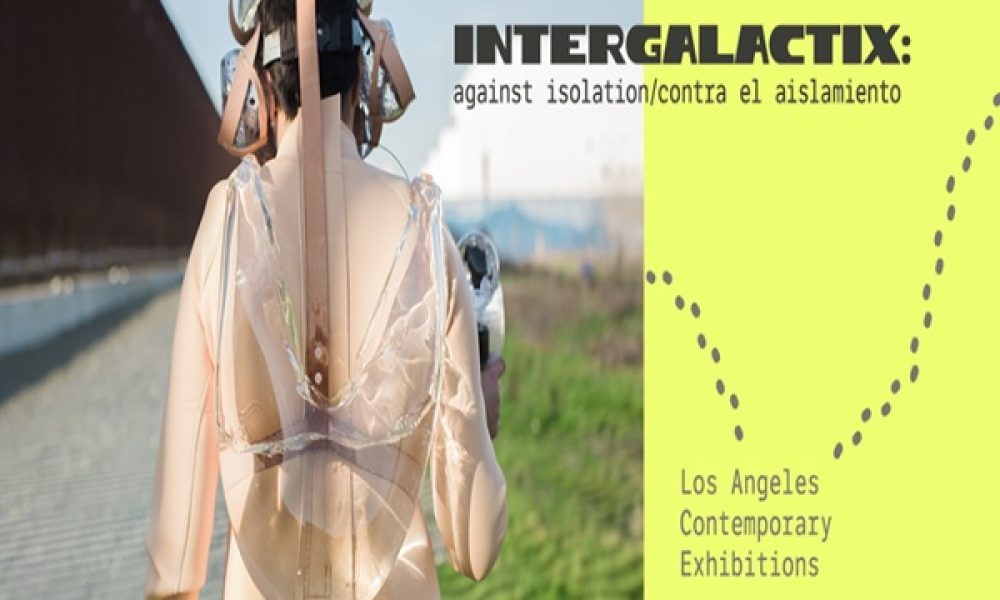
Beyond simply exhibiting static works, the show featured a robust public program, including in-person and virtual talks such as “And will be again… (Y de nuevo será…)” by Cog nate Collective and sessions on the free publication, “Objeto Antiguo.” This programming underlines the exhibition’s central goal: to establish a platform for exchange and dialogue among artists, poets, activists, curators, and writers against the oppressive force of isolation. The continuing legacy, as Lieja Quintanar states, is to “extend the transversal crossings in contemporary art,” ensuring that the intergalactic spirit of coalition and resistance remains a vital, evolving force. The project’s deep research and analytical framing, supported by prestigious grants from the Mike Kelley for the Arts and the Andy Warhol Curatorial Fellowship, among others, confirm its standing as a serious, intellectually rigorous intervention in the discourse of contemporary art and global politics. The image from Tanya Aguiñiga’s Metabolizing the Border, a 2020 piece featured in the show, is a perfect visual distillation of the exhibition’s core theme, presenting the body as the site of political engagement, a terrain that absorbs, processes, and ultimately resists the structural violence of the border.



