
Temperature Sensors for Aerospace Industry Market 2025-2032: Trends, Innovations & Growth
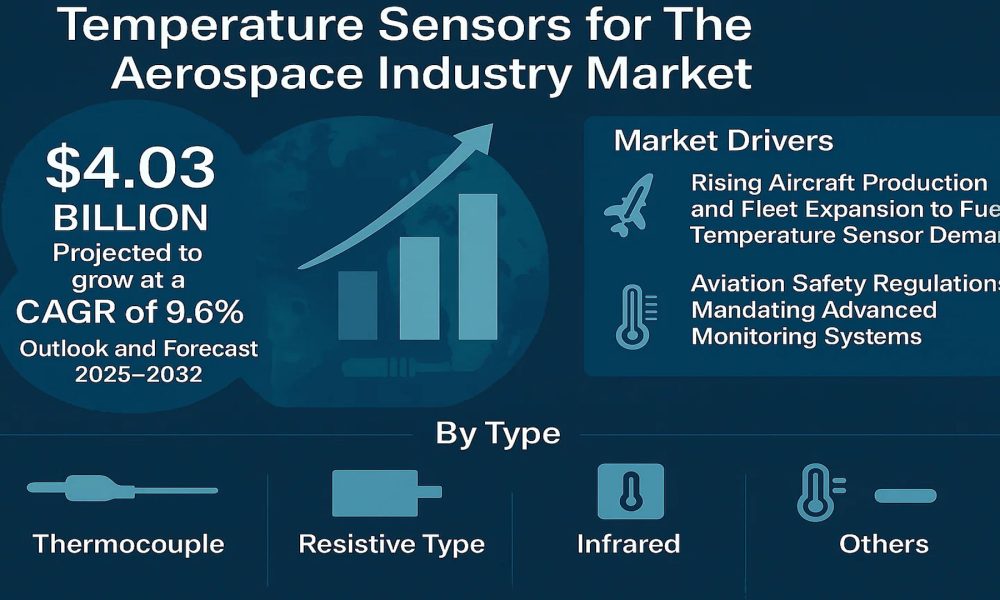
Global Temperature Sensors for The Aerospace Industry Market size was valued at US$ 2.14 billion in 2024 and is projected to reach US$ 4.03 billion by 2032, at a CAGR of 9.6% during the forecast period 2025-2032.
Temperature sensors in aerospace are critical components that monitor environmental and system temperatures to ensure operational safety and performance. These devices include thermocouples, resistive temperature detectors (RTDs), infrared sensors, and other specialized variants. They are deployed across aircraft engines, avionics systems, cabin environments, and structural components to provide real-time thermal data for flight control systems.
Market growth is driven by increasing aircraft production rates and technological advancements in sensor miniaturization. Airbus plans to increase A320 production to 75 units monthly by 2025, up from 60 in 2019, directly boosting sensor demand. The global aerospace industry generated USD 386.4 billion revenue in 2021 (4.1% YoY growth), with military modernization programs and commercial fleet expansions further accelerating adoption. Key players like Honeywell, TE Connectivity, and Collins Aerospace are developing high-precision sensors with enhanced durability for extreme aerospace conditions.
Get Full Report with trend analysis, growth forecasts, and Future strategies : https://semiconductorinsight.com/report/temperature-sensors-for-the-aerospace-industry-market/
Segment Analysis:
By Type
Thermocouple Segment Dominates Due to High Accuracy and Durability in Extreme Aerospace Conditions
The market is segmented based on type into:
- Thermocouple
- Subtypes: Type K, Type J, Type T, and others
- Resistive Type
- Subtypes: RTDs (Resistance Temperature Detectors), Thermistors, and others
- Infrared
- Others
By Application
Military Aircraft Segment Leads Due to Critical Temperature Monitoring Requirements
The market is segmented based on application into:
- Military Aircraft
- Civil Aircraft
- Spacecraft
- Unmanned Aerial Vehicles (UAVs)
- Others
By End User
OEMs Maintain Largest Market Share Due to Direct Integration in Aircraft Manufacturing
The market is segmented based on end user into:
- OEMs (Original Equipment Manufacturers)
- MRO (Maintenance, Repair and Overhaul) Providers
- Airlines
- Space Agencies
By Aircraft Type
Commercial Aviation Leads with Rising Passenger Traffic and Fleet Expansion
The market is segmented based on aircraft type into:
- Narrow-body Aircraft
- Wide-body Aircraft
- Regional Jets
- Business Jets
- Military Aircraft
MARKET DYNAMICS
MARKET DRIVERS
Rising Aircraft Production and Fleet Expansion to Fuel Temperature Sensor Demand
The commercial aerospace sector is witnessing robust growth, with Airbus and Boeing ramping up production rates to meet pent-up demand post-pandemic. Airbus increased production of its A320 family to 65 units per month in 2023, with plans to reach 75 per month by 2025 – up from just 40 during the pandemic lows. This production surge directly correlates with increased demand for temperature sensors used in engine monitoring, environmental control systems, and avionics cooling. Each new generation aircraft requires 15-20% more sensors than previous models due to enhanced monitoring requirements, creating substantial market opportunities.
Aviation Safety Regulations Mandating Advanced Monitoring Systems
Strict aviation safety standards are compelling manufacturers to incorporate more sophisticated temperature monitoring solutions. The Federal Aviation Administration (FAA) and European Union Aviation Safety Agency (EASA) have introduced regulations requiring real-time temperature monitoring in critical aircraft systems. These regulations are driving adoption of smart temperature sensors with predictive analytics capabilities. Recent accidents attributed to thermal runaway in lithium-ion batteries have further accelerated regulatory focus, with the aerospace temperature sensor market expected to benefit from these mandated upgrades across commercial and military fleets.
The growing integration of IoT-enabled sensors in modern aircraft for condition-based maintenance is another key growth driver. Airlines are increasingly adopting these systems to reduce unscheduled maintenance and improve operational efficiency.
➤ Modern twin-aisle aircraft now incorporate over 500 temperature sensors throughout airframe and power systems, compared to about 300 in early 2000s models.
MARKET OPPORTUNITIES
Emerging Electric Aircraft Market Creating Demand for Next-Gen Sensors
The burgeoning electric vertical takeoff and landing (eVTOL) and hybrid-electric aircraft market represents a significant growth opportunity. These aircraft require specialized temperature monitoring systems for high-voltage battery packs, electric motors, and power electronics. Current estimates suggest each eVTOL aircraft will need 40-60% more temperature sensors than conventional helicopters, with the global eVTOL market projected to reach $30 billion by 2030. Sensor manufacturers investing in high-voltage compatible, lightweight solutions stand to gain substantial market share as these aircraft enter commercial service.
Additionally, the increasing adoption of additive manufacturing in aerospace enables new sensor integration approaches. Embedded temperature sensors in 3D-printed components are opening possibilities for distributed temperature monitoring that were previously impractical.
The growing emphasis on predictive maintenance in both commercial and military aviation also presents opportunities. Airlines are investing heavily in sensor networks that can provide early warning of thermal anomalies, reducing maintenance costs and improving aircraft availability.
TEMPERATURE SENSORS FOR THE AEROSPACE INDUSTRY MARKET TRENDS
Increasing Aircraft Production Rates to Drive Demand for Temperature Sensors
The aerospace industry is experiencing a significant rebound in aircraft production following pandemic-related slowdowns. Airbus plans to increase monthly production of its A320 family to 65 units by 2023 and potentially 75 units by 2025, which will directly stimulate demand for temperature sensors across engines, avionics, and environmental control systems. This resurgence occurs as temperature monitoring becomes increasingly critical for modern aircraft, where sensors must operate reliably in extreme conditions ranging from -55°C to over 1,000°C in turbine sections. The growing complexity of aerospace systems is driving adoption of advanced sensor technologies that combine high accuracy with minimal drift over time.
Other Trends
Miniaturization and Smart Sensor Integration
Aerospace manufacturers increasingly demand temperature sensors with reduced size and weight while maintaining or improving performance characteristics. This trend aligns with broader aircraft electrification initiatives where smart sensors with embedded diagnostics can communicate directly with maintenance systems. The integration of MEMS (Micro-Electro-Mechanical Systems) technology allows sensors to occupy less space while providing real-time data to predictive maintenance algorithms. These advancements help aircraft operators reduce weight and improve fuel efficiency while enhancing system monitoring capabilities.
Expanding Space Sector Investments Accelerate Sensor Innovation
Government and private sector investments in space exploration are creating new opportunities for temperature sensor manufacturers. With global aerospace industry revenues reaching $386.4 billion in 2021, representing 4.1% annual growth, demand has increased for specialized sensors capable of operating in the vacuum of space and extreme thermal cycling environments. Space applications require sensors with exceptional radiation hardness and long-term reliability, pushing manufacturers to develop innovative solutions using materials like platinum resistance elements and advanced thermocouple alloys. The growing satellite sector, which represents 73% of aerospace industry value, particularly drives demand for sensors with low power consumption and minimal calibration drift over multi-year missions.
Recent Developments:
- Miniaturization for Space Applications
- As the demand for more compact, lightweight sensors increases, temperature sensors in the aerospace industry are becoming smaller and more efficient, making them ideal for space missions and satellite systems.
- Integration with IoT and Smart Systems
- Temperature sensors are now being integrated into IoT systems used for real-time monitoring and predictive maintenance in aircraft and aviation operations. This shift is enhancing safety by detecting potential issues early.
- Use in Advanced Aircraft Materials
- The latest temperature sensors are being designed to withstand extreme conditions encountered in high-speed aircraft. These sensors are crucial for monitoring new aerospace materials such as composite structures that need to be temperature-sensitive.
- Wireless Sensing Technologies
- The aerospace industry is moving toward wireless temperature sensors to reduce wiring complexity in aircraft systems. These sensors provide real-time data without adding weight, improving overall system performance and efficiency.
- Enhanced Durability for Extreme Conditions
- Temperature sensors are now being engineered for higher durability to operate in the extreme conditions of aerospace environments, from high altitudes to extreme temperatures, ensuring long-term reliability and functionality in various aerospace applications.
Learn more about Competitive Analysis, and Forecast of Temperature Sensors for Aerospace Industry Market: https://semiconductorinsight.com/download-sample-report/?product_id=107446
COMPETITIVE LANDSCAPE
Key Industry Players
Innovation and Reliability Drive Market Leadership in Aerospace Temperature Sensing
The global temperature sensors market for the aerospace industry features a competitive mix of established manufacturers and emerging specialists. With aircraft production rates rebounding post-pandemic—Airbus plans to produce 75 A320-family aircraft monthly by 2025—demand for precision temperature monitoring solutions is accelerating. This dynamic has intensified competition among sensor providers to deliver products that meet stringent aviation safety standards while improving cost efficiency.
Honeywell International Inc. dominates the market, leveraging its vertically integrated aerospace solutions and decades of expertise in extreme-environment sensing. The company’s recent $100M investment in next-gen aerospace IoT sensors underscores its commitment to maintaining technological leadership. Close behind, TE Connectivity has gained significant market share through strategic acquisitions, including its 2023 purchase of Firstrate Sensor to expand its aerospace portfolio.
Meanwhile, Collins Aerospace differentiates itself through proprietary thin-film sensor technology, particularly in military aviation applications. The company reported 18% year-over-year growth in its sensor division during 2023, attributed to rising defense budgets across NATO countries. Smaller players like IST AG compete through niche innovations—their micro-miniature sensors are increasingly adopted in satellite thermal management systems as the space sector grows to $386 billion globally.
The competitive landscape continues evolving as manufacturers pursue three key strategies: 1) Developing wireless and self-powered sensors to reduce aircraft weight, 2) Enhancing predictive maintenance capabilities through AI integration, and 3) Expanding MRO (Maintenance, Repair, and Overhaul) networks to capture aftermarket opportunities. Recent partnerships, like Meggitt Sensing Systems’ collaboration with Lufthansa Technik, demonstrate how sensor providers are aligning with operators to co-develop customized solutions.
List of Key Temperature Sensor Providers for Aerospace
- Honeywell International Inc. (U.S.)
- TE Connectivity Ltd. (Switzerland)
- Collins Aerospace (U.S.)
- Meggitt Sensing Systems (U.K.)
- Conax Technologies (U.S.)
- TT Electronics (U.K.)
- IST AG (Switzerland)
- Thermocoax (France)
- Emerson Electric Co. (U.S.)
- Ametek Fluid Management Systems (U.S.)
- San Giorgio S.E.I.N. s.r.l. (Italy)
- Minco (U.S.)
Browse Related Reports : LED Dimmer Switch Market
CONTACT US:
City vista, 203A, Fountain Road, Ashoka Nagar, Kharadi, Pune, Maharashtra 411014
+91 8087992013
[email protected]




