
Market Overview
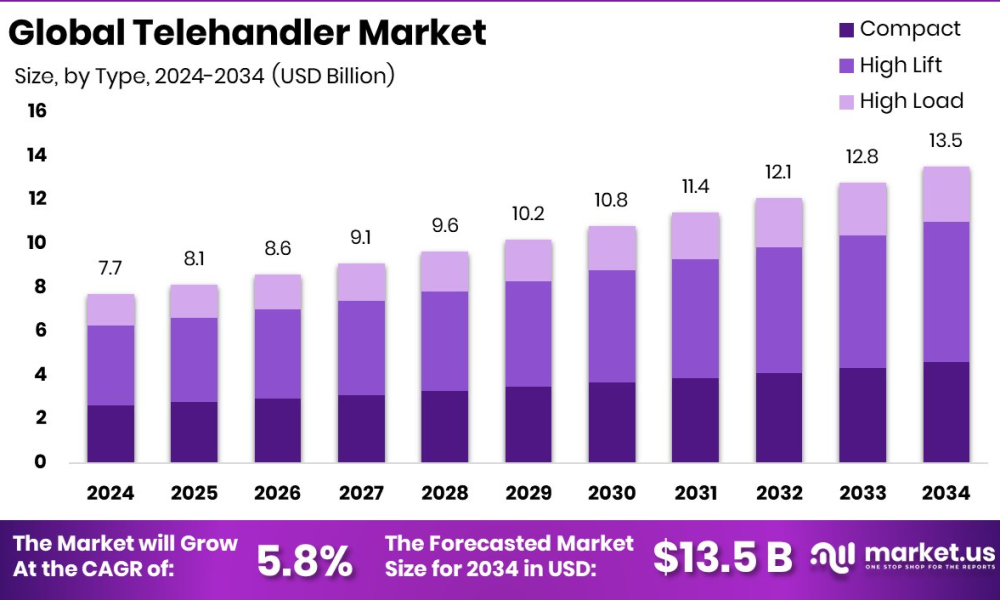
According to market.us, The global Telehandler Market is projected to reach approximately USD 13.5 billion by 2034, rising from USD 7.7 billion in 2024, and expanding at a compound annual growth rate (CAGR) of 5.8% from 2025 to 2034. Asia-Pacific dominates the market with a 46.2% share, valued at USD 3.5 billion, driven by rapid industrial expansion and infrastructure development across key economies.
Telehandlers, also known as telescopic handlers, are highly versatile lifting machines equipped with an extendable boom, allowing them to perform the functions of cranes, forklifts, and loaders. Their adaptability in lifting, transporting, and positioning materials at various heights makes them indispensable in construction, agriculture, and industrial sectors. The equipment’s utility is further enhanced by its compatibility with a range of attachments, including forks, buckets, and lifting jibs.
The innovation front, SENNEBOGEN has launched a new telehandler model tailored for recycling operations, delivering up to 50% faster work speeds compared to earlier versions. In parallel, the U.S. Maritime Administration (MARAD) has allocated $8.75 million through the Small Shipyard Grant Program to support 15 small shipyards nationwide, aiming to strengthen shipbuilding infrastructure. Additionally, JCB has announced a $500 million investment to expand its manufacturing operations in North America, a move expected to enhance production capacity and stimulate market growth in the region.
Important Revelation
- Global Telehandler Market is expected to be worth around USD 13.5 billion by 2034, up from USD 7.7 billion in 2024, and grow at a CAGR of 5.8% from 2025 to 2034.
- In the Telehandler Market, high lift models accounted for 47.3%, reflecting strong demand globally.
- Telehandlers with a lifting range of 5-15 meters dominated, capturing 58.4% of market share.
- Models with a lift capacity of 3-10 tons held a significant 51.8% market presence.
- The construction sector remained the largest end-user, contributing 48.1% to the Telehandler Market.
- Construction projects in Asia-Pacific drove 46.2% Telehandler Market share, USD 3.5 Bn.
Download Exclusive Sample Of This Premium Report (Including Full TOC, Table & Figures): https://market.us/report/global-telehandler-market/free-sample/
Factors Affecting the Growth of the Telehandler Market
- Infrastructure Expansion and Urbanization: The global surge in infrastructure projects—ranging from roads and bridges to residential and commercial construction—is significantly driving telehandler adoption. Their ability to handle heavy loads, reach elevated heights, and operate in confined spaces makes them ideal for complex urban construction environments. Rapid urbanization in emerging economies, especially in the Asia-Pacific region, is a major growth catalyst.
- Versatility and Multifunctionality: Telehandlers combine the capabilities of cranes, forklifts, and loaders, offering unmatched versatility on job sites. The ability to switch between various attachments—such as forks, buckets, winches, and lifting jibs—enables operators to perform multiple tasks with a single machine. This flexibility reduces equipment costs and improves operational efficiency, making telehandlers highly attractive across construction, agriculture, logistics, and industrial sectors.
- Industrial and Agricultural Automation: The trend toward automation and mechanization in industries such as agriculture and manufacturing is boosting the demand for telehandlers. These machines support precision material handling, stacking, and transport tasks, contributing to productivity gains in warehouses, farms, and factories.
- Technological Advancements: Modern telehandlers are increasingly being equipped with advanced features such as GPS, telematics, load management systems, and hybrid powertrains. These innovations enhance safety, efficiency, and machine monitoring, driving adoption across tech-savvy construction and industrial firms.
- Government Investments and Funding Support: Public sector initiatives and infrastructure funding are playing a crucial role in stimulating telehandler demand. For example, the U.S. Maritime Administration (MARAD) allocated $8.75 million under the Small Shipyard Grant Program in 2024 to improve equipment and capacity in 15 shipyards, some of which utilize telehandlers. Similarly, major manufacturers like JCB are investing $500 million to expand North American production, which is expected to enhance regional supply and market growth.
Report Segmentation
By Type Analysis: In 2024, the High Lift segment led the “By Type” category in the Telehandler Market, securing a 47.3% market share. This dominance reflects the growing demand for telehandlers with extended reach and higher load-handling capacity, particularly in construction applications that require the movement of materials to elevated positions. High Lift telehandlers are widely utilized in infrastructure projects where vertical lifting efficiency is critical. Their ability to manage heavy materials with improved stability and operational control aligns with the industry’s focus on safety and productivity. With continued investment in large-scale urban and industrial developments, this segment is expected to retain its market leadership.
By Technology Analysis: Telehandlers with a reach range of 5 to 15 meters accounted for the largest share in the “By Technology” segment, capturing 58.4% of the market in 2024. These models are favored for their versatility across various sectors including construction, logistics, and agriculture. Their ability to efficiently access mid-range heights, combined with cost-effectiveness, makes them ideal for small to medium-scale projects. Additionally, their adaptability to different worksite conditions and compatibility with multiple attachments contribute to their widespread use. As the demand for practical and flexible lifting solutions continues to grow, the 5-15 meter segment is expected to maintain its dominant position.
By Lift Capacity Analysis: In the “By Lift Capacity” segment, telehandlers with a capacity of 3 to 10 tons held the largest market share in 2024, accounting for 51.8%. This capacity range is well-suited for medium-duty operations that require efficient material handling without sacrificing mobility. These telehandlers are commonly used across construction sites, warehouses, and industrial facilities due to their ability to lift substantial loads while remaining cost-effective. Their flexibility across different terrains and environments enhances their value for diverse applications. As infrastructure projects expand globally, the demand for telehandlers in this capacity range is expected to grow steadily, reinforcing their market leadership.
By End-Use Analysis: The construction sector dominated the “By End-Use” segment of the Telehandler Market in 2024, with a 48.1% share. Telehandlers are widely adopted on construction sites for their ability to lift, move, and position materials with precision and speed. Their versatility across varying terrain and ability to support multiple tasks with interchangeable attachments make them essential for modern construction workflows. The segment’s growth is further supported by rising global investment in residential, commercial, and industrial infrastructure. Additionally, enhanced safety standards and the need for efficient labor-saving equipment continue to drive telehandler adoption in the construction industry, securing its lead in market share.
To Purchase this Premium Report@ https://market.us/purchase-report/?report_id=148503
Market Key Segmentation List
By Type
- Compact
- High Lift
- High Load
By Technology
- Less than 5 meters
- 5-15 meters
- More than 15 meters
By Lift Capacity
- Less than 3 tons
- 3-10 tons
- More than 10 tons
By End-Use
- Construction
- Forestry
- Agriculture
- Oil and Gas
- Manufacturing, Transport and Logistics
- Power utilities
- Others
Regional Analysis
In 2024, the Asia-Pacific region led the global Telehandler Market, holding a dominant 46.2% share valued at USD 3.5 billion. This leadership position is largely driven by accelerated construction activity and infrastructure development in emerging economies such as China and India. Ongoing government investments in large-scale public and industrial projects have significantly boosted the demand for telehandlers as essential equipment for efficient material handling.
North America also experienced substantial growth, fueled by the increasing adoption of advanced telehandler technologies in both construction and agriculture. Europe continues to be a key regional market, supported by strict safety standards and a growing preference for technologically advanced and multifunctional telehandlers. Additionally, the Middle East & Africa and Latin America are witnessing gradual market expansion, spurred by urbanization and infrastructure improvements that are creating new opportunities for equipment deployment in these regions.
Competitive Landscape
- JCB
- Caterpillar
- Manitou Group
- Haulotte Group
- Dieci Srl
- Merlo S.p.A.
- Bobcat Company
- JLG Industries, Inc.
- Terex Corporation
- Wacker Neuson SE
- CLAAS KGaA mbH
- CNH Industrial
- Liebherr-International AG
- Weidemann GmbH
- Zoomlion Heavy Industry Science & Technology Co., Ltd.
Recent Developments
In November 2024, JCB unveiled two new rotating telehandler models featuring upgraded lifting capacities of 5,800 kg—an increase of 300 kg compared to previous versions. These machines are equipped with an Autec radio remote control system and are powered by a Stage V JCB Diesel engine, coupled with a Bosch Rexroth two-speed hydrostatic transmission, enhancing both performance and operator control.
In November 2023, Merlo introduced the Turbofarmer 30.7 and 27.6 models at LAMMA 2024. These compact telehandlers are specifically engineered for use in tight and restricted environments, with the TF30.7 measuring just 2 meters in width and 2.10 meters in height, making it ideal for traditional farmyard operations.
Get in Touch with Us
Market.us (Powered By Prudour Pvt. Ltd.)
Address: 420 Lexington Avenue, Suite 300 New York City, NY 10170, United States
Send Email: [email protected]



