Supercapacitor Electrolyte Market Overview
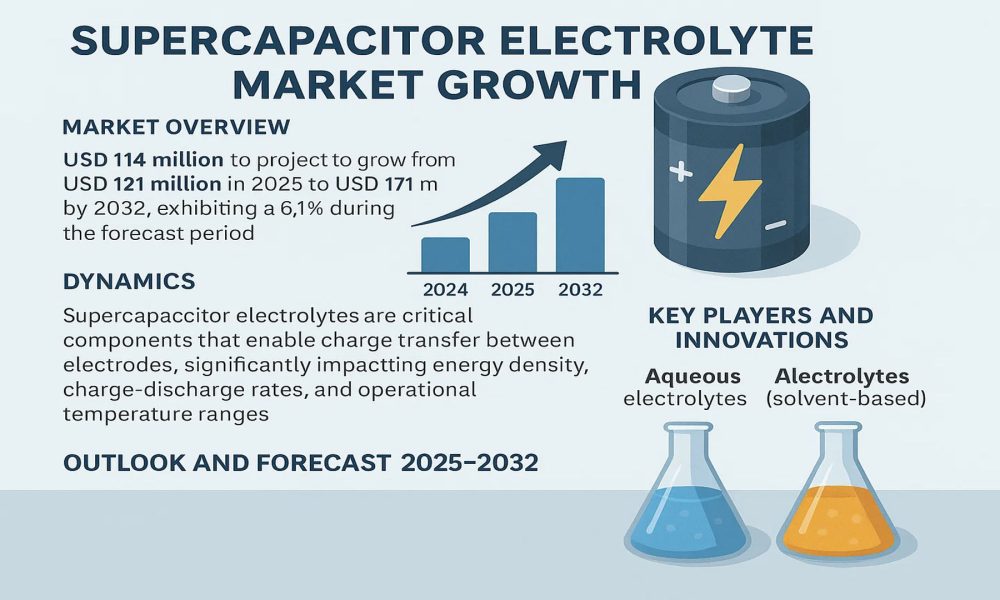
The global supercapacitor electrolyte market was valued at USD 114 million in 2024 and is expected to grow to USD 171 million by 2032, reflecting a CAGR of 6.1% during the forecast period. Supercapacitor electrolytes play a vital role in energy storage systems, enabling efficient charge transfer between electrodes and directly influencing energy density, charge-discharge efficiency, and operational stability.
Get FREE Sample of this Report at https://www.intelmarketresearch.com/download-free-sample/8679/supercapacitor-electrolyte-market
Electrolytes are typically formulated as aqueous (water-based) or organic (solvent-based) solutions, each offering unique benefits. Aqueous solutions are more cost-effective and highly conductive, while organic variants provide superior energy density and wider voltage windows, making them ideal for advanced applications in electric vehicles (EVs), renewable energy systems, aerospace, and consumer electronics.
Key Market Growth Drivers
The rising adoption of renewable energy and electric mobility is fueling demand for high-performance energy storage systems. Governments across more than 15 countries have announced bans on fossil fuel vehicles by 2035, pushing the need for supercapacitor electrolytes in next-generation EVs. In renewable energy, wind and solar farms are increasingly deploying supercapacitors to stabilize intermittent power generation, driving electrolyte demand at double-digit growth rates.
Technological advancements are also shaping the market. The introduction of ionic liquid electrolytes offers higher energy density, enhanced safety, and broader operational temperature ranges. Hybrid electrolyte formulations that combine the conductivity of aqueous solutions with the stability of organic solvents are being developed for critical applications such as military and aerospace systems.
Market Opportunities
Emerging applications in consumer electronics, medical devices, and IoT represent lucrative opportunities for manufacturers. Smartphones, wearables, and connected devices now integrate compact supercapacitors powered by polymer-based electrolytes to support rapid charging and high energy efficiency. The medical sector is exploring biocompatible electrolytes for implantable devices and portable diagnostics, offering premium margins and long-term revenue potential.
Solid-state electrolytes are another breakthrough, eliminating leakage risks while enabling thinner, flexible supercapacitor designs. With pilot production already underway, this segment is projected to capture up to 20% of the market share by 2030, revolutionizing aerospace and high-performance energy storage applications.
Market Challenges
Despite strong growth potential, high production costs and raw material shortages pose barriers to mass adoption. Specialized salts and solvents used in electrolyte formulations are significantly more expensive than those used in battery technologies. Supply chain volatility, particularly for acetonitrile and ionic liquids, adds further uncertainty.
Technical limitations also restrict widespread adoption. Organic electrolytes lose conductivity at extremely low temperatures, while aqueous solutions face stability issues above 70°C. These challenges make performance optimization a priority for manufacturers investing in R&D and testing new formulations.
Competitive Landscape
The supercapacitor electrolyte market is moderately consolidated, with the top five players controlling 35–40% of global revenue. Leading companies include Shenzhen Capchem Technology, Nippon Chemi-Con Corporation, BASF SE, Solvay SA, and Mitsubishi Chemical Corporation.
Asian manufacturers such as Shenzhen Capchem and Jiangsu Guotai Super Power New Materials dominate with cost-competitive products and government-backed initiatives. Japanese and European players are focusing on premium electrolyte formulations for EVs and industrial applications, while U.S. companies continue to invest in renewable energy storage and grid modernization.
Strategic partnerships are shaping the competitive environment. Automakers and energy storage providers are forming alliances with electrolyte suppliers to ensure stable supply chains and co-develop specialized solutions. Several joint ventures and patent filings in 2023–2024 highlight the market’s strong innovation pipeline.
Market Segmentation
By Type
Aqueous Solutions
Organic Solvents
Organic solvent-based electrolytes hold the largest share of the market as they offer higher voltage tolerance and superior energy density, making them the preferred choice for advanced and high-performance supercapacitors.
By Application
New Energy Vehicles (NEVs)
Distributed Energy Storage Systems
Consumer Electronics
Others
Among these, new energy vehicles are the fastest-growing application segment. The rapid adoption of electric and hybrid vehicles has accelerated the need for electrolytes that enable high power density and rapid charging cycles, strengthening this segment’s dominance.
By End User
Automotive Manufacturers
Energy Storage Providers
Electronics Manufacturers
Automotive manufacturers account for the largest end-user segment, driven by the growing integration of supercapacitors in regenerative braking systems, onboard power stabilization, and hybrid drivetrains. The push for vehicle electrification continues to make this category the most influential in overall market demand.
Recent Developments in the Supercapacitor Electrolyte Market
Advancement in Ionic Liquid Electrolytes: In 2023–2024, several manufacturers introduced ionic liquid-based electrolytes with higher energy density and thermal stability, allowing supercapacitors to operate safely at voltages up to 3.5V.
Solid-State Electrolytes in Pilot Stage: Companies such as BASF SE and UBE Corporation are piloting solid-state electrolytes that improve safety by eliminating leakage risks, while enabling lightweight and flexible device designs.
Capacity Expansion in Asia-Pacific: Shenzhen Capchem Technology expanded its electrolyte production by 30% in 2023 to meet rising demand from the EV and renewable energy sectors, reinforcing its dominance in the region.
Patent Filings & R&D Investments: Nippon Chemi-Con and Jiangsu Guotai Super Power New Materials filed multiple patents for next-generation electrolytes designed for automotive and aerospace applications, with a focus on wider voltage windows and improved low-temperature performance.
Collaborations with Automakers: Leading automakers are entering strategic partnerships with electrolyte suppliers to secure customized formulations for next-generation EV platforms, reducing development cycles and strengthening supply chains.
Medical-Grade Electrolytes: Research institutions reported progress in biodegradable and biocompatible electrolytes for implantable devices, opening new opportunities in the medical device sector.
Regulatory Shifts in Europe: Updates to the EU REACH legislation in 2023 have reclassified certain solvents as high-risk, pushing European players to accelerate the development of sustainable and compliant formulations.
Regional Insights
- Asia-Pacific leads the market, driven by China’s large-scale manufacturing and rapid adoption of renewable energy and EVs.
- North America benefits from government-backed energy storage initiatives and EV infrastructure investments.
- Europe emphasizes sustainable and eco-friendly electrolytes under strict regulatory frameworks, with Germany and France as key hubs.
- South America and Middle East & Africa remain emerging markets, showing potential in renewable energy projects, smart cities, and localized industrial applications.
Outlook
The supercapacitor electrolyte market is on a steady growth trajectory, powered by global electrification, renewable integration, and rapid advances in energy storage technologies. With innovation in ionic liquids, solid-state formulations, and hybrid electrolytes, the market will continue to expand across automotive, aerospace, consumer electronics, and healthcare applications.
By 2032, supercapacitor electrolytes are set to become a cornerstone of next-generation energy systems, offering high efficiency, safety, and adaptability across diverse industries.
Recent Developments in the Supercapacitor Electrolyte Market
- Ionic Liquid Electrolytes Gain Traction: In 2023–2024, several manufacturers introduced advanced ionic liquid-based electrolytes with wider voltage windows (up to 3.5V) and enhanced thermal stability, improving performance for electric vehicles and aerospace applications.
- Solid-State Electrolyte Prototypes: Companies like BASF and UBE Corporation are piloting solid-state supercapacitor electrolytes, eliminating leakage risks and enabling lightweight, flexible devices—expected to capture significant market share by 2030.
- Strategic Collaborations: Automakers have partnered with electrolyte producers (e.g., joint ventures in China and Japan) to secure supply for next-gen EV platforms. These collaborations have reduced development timelines by up to 40%.
- Patent Activity: Key players including Shenzhen Capchem Technology and Nippon Chemi-Con filed multiple patents in 2023–2024 for electrolyte formulations with higher energy density and better low-temperature performance.
- Capacity Expansion: Shenzhen Capchem expanded electrolyte production capacity by 30% in 2023 to meet growing EV and renewable energy demand, strengthening its leadership in Asia-Pacific.
- Medical Device Applications: Research institutions have developed biodegradable and biocompatible electrolytes for implantable medical devices, with promising clinical trial results showing long-term stability in physiological conditions.
Get the Complete Report & TOC at https://www.intelmarketresearch.com/chemicals-and-materials/8679/supercapacitor-electrolyte-market
CONTACT US:
276 5th Avenue, New York , NY 10001,United States
International: (+1) 646 781 7170
Email: [email protected]
Follow Us On linkedin :- https://www.linkedin.com/company/24-market-reports




