
The global rugged embedded system market is experiencing strong growth as industries increasingly rely on reliable computing systems capable of operating in extreme and unpredictable environments. Rugged embedded systems are specially designed electronic platforms that can withstand harsh conditions such as extreme temperatures, shock, vibration, dust, and moisture. These capabilities make them essential for mission-critical applications in sectors such as defense, aerospace, industrial automation, transportation, telecommunications, and energy.
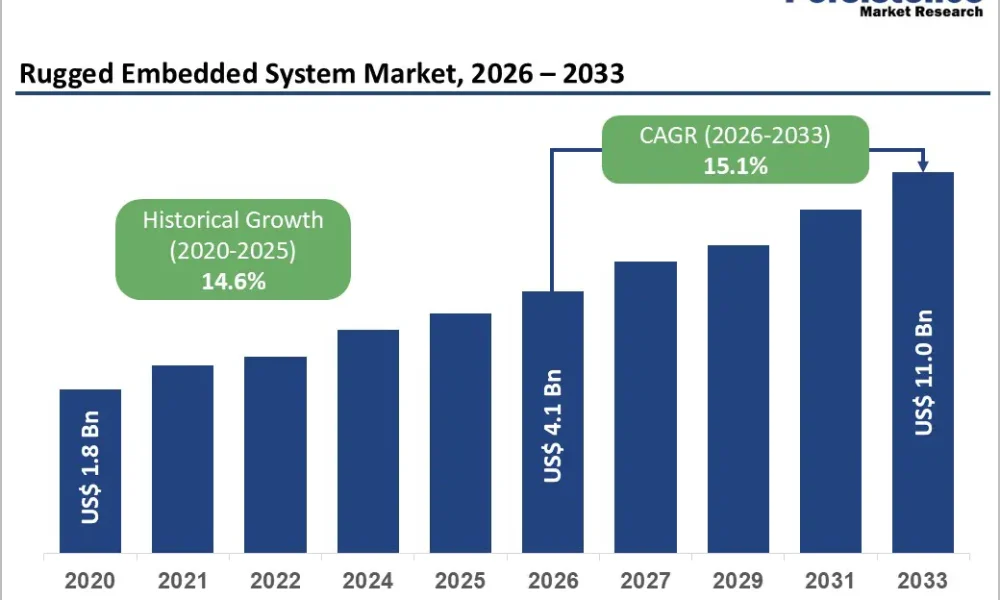
According to recent market analysis, the rugged embedded system market size is projected to reach US$4.1 billion in 2026 and is expected to grow to US$11.0 billion by 2033, expanding at a compound annual growth rate (CAGR) of 15.1% during the forecast period from 2026 to 2033.
This rapid growth is primarily driven by rising defense modernization programs, Industry 4.0 initiatives, and the increasing need for high-reliability computing in demanding environments. Defense organizations worldwide are upgrading mission-critical systems such as unmanned aerial vehicles (UAVs), naval platforms, and ground combat vehicles. At the same time, industrial sectors are deploying rugged computing solutions to enable automation, real-time monitoring, and predictive maintenance.
Key Market Highlights
Leading Regional Market
North America currently dominates the global rugged embedded system market, accounting for 35.7% of total revenues. The region benefits from high defense spending, strong aerospace manufacturing capabilities, and advanced industrial automation infrastructure.
Fastest-Growing Region
Asia Pacific is emerging as the fastest-growing regional market, contributing approximately 28.3% of global revenues. Rapid industrialization, infrastructure expansion, and large-scale manufacturing growth in countries such as China, Japan, South Korea, and India are driving demand for rugged computing solutions.
Dominant Product Category
Single-board computers (SBCs) and embedded modules hold approximately 38% of the global market share. These platforms are favored for their modularity, compatibility with ARM and x86 architectures, and strong software ecosystem support.
Key End-Use Sector
The defense and aerospace sector accounts for around 30–35% of total demand, requiring highly reliable embedded systems for avionics, unmanned systems, and mission-critical applications.
Emerging Opportunity
Integration of edge computing and artificial intelligence (AI) into rugged platforms is enabling real-time analytics, predictive maintenance, and intelligent automation across industries.
Market Dynamics
Driver: Rising Defense and Aerospace Modernization
Global defense and aerospace modernization programs are a major driver of the rugged embedded system market. Modern military platforms rely heavily on advanced electronics for mission execution and situational awareness.
Embedded computing systems are deployed in several defense applications, including:
- Radar and surveillance systems
- Avionics and flight control systems
- Unmanned aerial vehicles (UAVs)
- Naval command systems
- Ground combat vehicles
These systems must comply with strict military standards while operating in environments exposed to extreme temperatures, high vibration, and electromagnetic interference.
As governments invest in next-generation defense technologies such as autonomous systems, sensor fusion, and electronic warfare, the demand for rugged embedded computing solutions continues to rise.
Driver: Industrial Automation and Smart Manufacturing
The expansion of industrial automation and smart manufacturing is another major factor driving the adoption of rugged embedded systems.
Manufacturing facilities increasingly integrate technologies such as:
- Industrial Internet of Things (IIoT)
- Edge computing platforms
- Robotics and automation systems
- Advanced monitoring and control solutions
Rugged embedded computers are often installed close to production equipment or in outdoor environments where traditional IT hardware cannot survive. These systems are capable of operating in environments with:
- High dust levels
- Electrical noise
- Moisture exposure
- Continuous vibration
By enabling real-time machine monitoring, predictive maintenance, and industrial process optimization, rugged embedded systems play a critical role in Industry 4.0 transformation.
Market Restraints
Thermal Management Challenges
Thermal management is one of the most significant challenges in rugged embedded system design.
Modern embedded platforms integrate high-performance processors such as CPUs, GPUs, and FPGAs, which generate substantial heat during operation. However, rugged systems are often deployed in sealed enclosures to protect against environmental hazards.
In environments such as engine compartments, deserts, or industrial plants where temperatures may exceed 70°C, effective heat dissipation becomes difficult.
Manufacturers must adopt advanced thermal strategies, including:
- Conduction cooling systems
- Optimized heat spreaders
- Rugged airflow designs
- Extensive environmental testing
These requirements significantly increase design complexity and development costs.
High Development and Certification Costs
Another major challenge in the rugged embedded system market is the high cost of development and certification.
Mission-critical applications require compliance with strict industry standards such as:
- Aerospace certification standards
- Defense-grade reliability requirements
- Rail and transportation safety regulations
Meeting these requirements involves extensive testing, validation, and documentation processes, resulting in long development cycles and high engineering costs.
Additionally, rugged embedded systems often require long product lifecycles of 10 to 15 years, which increases component sourcing and support costs.
Market Opportunities
Edge Computing and Artificial Intelligence Integration
The integration of edge computing and artificial intelligence (AI) into rugged embedded platforms represents one of the most significant growth opportunities in the market.
Edge computing allows data processing to occur directly at the source rather than relying solely on centralized cloud infrastructure. This approach is particularly beneficial in environments where network connectivity may be limited.
AI-powered rugged embedded systems enable applications such as:
- Predictive maintenance in industrial machinery
- Automated quality inspection
- Real-time anomaly detection
- Intelligent energy management
Studies suggest that AI-based predictive maintenance systems can reduce unplanned downtime by 20–30%, significantly improving operational efficiency.
5G Infrastructure and Critical Systems Deployment
The rollout of 5G networks and smart infrastructure projects is creating additional demand for rugged embedded computing solutions.
Telecommunication companies deploy embedded controllers in base stations, small cells, and edge data centers located in outdoor environments. These systems must operate reliably despite exposure to weather conditions and environmental hazards.
Similarly, infrastructure modernization projects in sectors such as:
- Power utilities
- Water management
- Transportation networks
- Renewable energy plants
require rugged embedded platforms capable of secure and continuous operation.
As governments worldwide invest in smart cities and digital infrastructure, demand for rugged embedded computing systems is expected to grow significantly.
Elevate your business strategy with comprehensive market data. Request a sample report now: https://www.persistencemarketresearch.com/samples/14329
Category-wise Market Analysis
Product Type Insights
Single-board computers (SBCs) and embedded modules dominate the rugged embedded system market with approximately 38% of total revenue share.
ARM-based SBCs hold the largest share due to their power efficiency, scalability, and strong ecosystem support. Open-source operating systems such as Linux are widely used on these platforms, enabling extensive customization and long-term support.
These modules serve as core computing components in various systems, including:
- Box PCs
- Panel PCs
- Portable industrial devices
Their modular architecture allows original equipment manufacturers (OEMs) to standardize computing platforms while customizing connectivity and enclosure designs.
Fastest-Growing Product Segment
Rugged box PCs and panel PCs are the fastest-growing product categories in the market.
These systems are widely used in:
- Industrial automation
- Smart manufacturing plants
- Transportation hubs
- Energy production facilities
Their robust design allows them to function reliably in environments exposed to dust, vibration, moisture, and extreme temperatures.
Industry Analysis
Defense and Aerospace Sector
The defense and aerospace sector remains the largest end-use industry, accounting for approximately 30–35% of global demand.
Embedded systems support several mission-critical functions in military and aviation platforms, including:
- Flight control systems
- Navigation and mission management
- Electronic warfare systems
- Secure communications networks
These applications require highly reliable electronics that comply with stringent industry standards.
Industrial Automation and Transportation
Industrial automation and transportation sectors are the fastest-growing end-use markets.
Rugged embedded systems are increasingly deployed on factory floors and transportation infrastructure to enable:
- Real-time system monitoring
- Predictive maintenance
- Industrial IoT connectivity
- Automated process control
These capabilities are essential for companies adopting Industry 4.0 technologies and smart manufacturing strategies.
Regional Market Insights
North America
North America leads the global rugged embedded system market with 35.7% market share.
The region benefits from strong investments in:
- Defense modernization
- Aerospace manufacturing
- Industrial automation
The United States defense budget allocates billions of dollars annually toward advanced electronics used in autonomous systems, command-and-control platforms, and electronic warfare technologies.
Industrial sectors such as automotive, oil and gas, and utilities also rely heavily on rugged computing platforms for digital operations.
Europe
Europe is experiencing steady market growth due to its strong manufacturing sector and focus on digital transformation.
The region’s push toward renewable energy expansion and smart infrastructure is creating demand for rugged embedded systems used in wind turbines, solar farms, and grid monitoring systems.
Industrial automation initiatives and strict safety regulations also encourage the adoption of high-reliability computing platforms.
Asia Pacific
Asia Pacific is emerging as the fastest-growing market for rugged embedded systems.
Rapid industrialization and infrastructure development across China, Japan, South Korea, and India are driving demand for embedded computing solutions in manufacturing and logistics.
Government initiatives promoting smart factories, robotics, and digital infrastructure are also accelerating adoption across the region.
The availability of cost-effective manufacturing and a growing supplier ecosystem further support the region’s strong growth potential.
Competitive Landscape
The rugged embedded system market is moderately concentrated and includes both multinational corporations and specialized technology providers.
Companies compete based on factors such as:
- Product reliability and durability
- Software ecosystem compatibility
- Long-term component availability
- Industry-specific application expertise
Leading vendors are investing in edge AI technologies, advanced thermal management systems, and strategic partnerships with semiconductor and software companies.
Key Market Developments
Recent developments highlight ongoing innovation in the rugged embedded system industry.
In February 2025, Curtiss-Wright Corporation reported strong bookings and sales growth in its aerospace and defense segments, driven by increasing demand for mission-critical embedded computing solutions.
In November 2025, AAEON Technology introduced the PICO-ARU4 Pico-ITX board based on Intel Core Ultra processors, offering high-performance edge computing capabilities for rugged environments.
In October 2025, the company also showcased multiple AI-enabled edge computing platforms designed for transportation infrastructure and smart city applications.
Major Companies in the Rugged Embedded System Market
Key companies operating in the market include:
- Advantech Co., Ltd.
- Kontron AG
- Curtiss-Wright Corporation
- Siemens AG
- Rockwell Automation, Inc.
- Emerson Electric Co.
- ABB Ltd.
- Intel Corporation
- AAEON Technology Inc.
- Crystal Group, Inc.
- Portwell, Inc.
- Vecow Co., Ltd.
- OnLogic, Inc.
- Elma Electronic AG
- ADLINK Technology Inc.
These companies are actively expanding their product portfolios to support emerging applications in edge computing, AI integration, smart manufacturing, and digital infrastructure.
Future Outlook
The rugged embedded system market is expected to witness robust growth through 2033 as industries increasingly depend on reliable computing solutions in harsh environments.
Key factors shaping the market’s future include:
- Rising defense modernization programs
- Rapid adoption of Industry 4.0 technologies
- Growth of edge computing and AI-enabled devices
- Expansion of 5G networks and digital infrastructure
Companies that invest in advanced technologies, reliable system design, and long-term product support will be well positioned to capture emerging opportunities in this rapidly evolving market.
Related Reports:




