
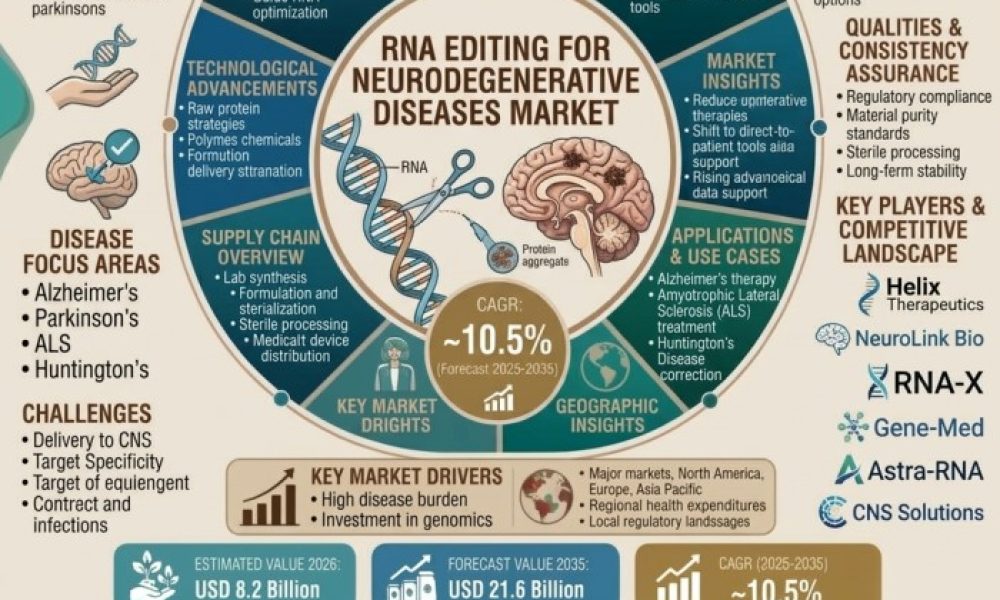
Advances in central nervous system delivery, expanding genetic target discovery and investment in RNA-based therapeutic platforms are shaping the market’s growth outlook, according to Fact.MR.
NEWARK, Del., October 13, 2026. The global RNA editing for neurodegenerative diseases market is projected to reach USD 1,026.82 million by 2036, up from USD 151.375 million in 2026, expanding at a compound annual growth rate (CAGR) of 21.1%, according to Fact.MR. The market is expected to generate an incremental opportunity of USD 875.45 million over the forecast period. RNA editing therapeutics are projected to account for 47% of product revenue in 2026, while demand is supported by research targeting Huntington’s disease, amyotrophic lateral sclerosis (ALS), Parkinson’s disease and other neurodegenerative conditions.
The market’s growth reflects continued investment in therapeutic approaches that modify RNA without changing the underlying genomic DNA. Progress in intrathecal oligonucleotide delivery and the development of engineered adeno-associated virus (AAV) delivery systems are expanding research options for central nervous system (CNS) applications. However, broader adoption will depend on delivery performance, clinical outcomes and regulatory clarity.
Get detailed market forecasts, competitive benchmarking, and pricing trends:
Where growth is fastest
The United States leads the country-level growth outlook, supported by established CNS-focused biotechnology clusters, venture capital investment and engagement with the U.S. Food and Drug Administration (FDA). Fact.MR projects the following country CAGRs for 2026–2036:
- United States: 23.5%. Concentrated biotechnology investment, active regulatory engagement and established patient advocacy networks support research and clinical development.
- Germany: 22.8%. Research centres in Munich, Heidelberg and Berlin, alongside established academic networks, contribute to the country’s outlook.
- United Kingdom: 22.1%. Research clusters around Cambridge and Oxford support neurodegeneration biology and therapeutic development.
- Japan: 21.4%. National dementia research initiatives and expanding CNS therapeutic pipelines underpin growth.
- France: 20.7%. Neurology research activity and established research institutions support market development.
- South Korea: 20.0%. An expanding biotechnology sector supports the development of domestic CNS therapeutic pipelines.
These forecasts point to opportunities across established biotechnology markets and countries strengthening their research capabilities. For companies assessing expansion, the location of specialist research teams, access to clinical development infrastructure and the availability of strategic partners are relevant considerations alongside projected market growth.
What leads the market
RNA editing therapeutics account for the largest projected product share, while oligonucleotide-based approaches and delivery technologies provide additional opportunities across the value chain.
- RNA editing therapeutics: 47% of product revenue in 2026. This segment includes ADAR-recruiting oligonucleotides, synthetic guide RNA systems and engineered RNA deaminase approaches designed for CNS applications.
- Oligonucleotide therapies: approximately 27% in 2026. This category covers chemically modified oligonucleotide approaches adapted for site-directed RNA editing and CNS delivery.
- Gene therapy delivery platforms: approximately 15% in 2026. These platforms include engineered AAV systems and lipid nanoparticle technologies being explored for CNS delivery.
The report also identifies Huntington’s disease and ALS as the leading combined indication pool in 2026. These conditions have relatively well-characterized genetic targets and established clinical endpoints, making them important areas for early-stage therapeutic development. Alzheimer’s disease, Parkinson’s disease, frontotemporal dementia and hereditary ataxias represent additional areas of research and potential expansion.
The hurdle: delivering therapies across the central nervous system
Delivery remains a major technical constraint for RNA editing programmes targeting neurological conditions. Intrathecal administration can provide access to the central nervous system, but achieving broad distribution throughout the brain remains difficult for conditions such as Alzheimer’s and Parkinson’s disease.
Fact.MR also identifies off-target editing risks in brain tissue, lengthy regulatory pathways and extended clinical trial timelines as barriers to commercial development. Manufacturing chemically complex oligonucleotide editors and specialised delivery systems at scale may add costs before production processes and platforms mature.
These challenges make delivery performance, specificity and evidence from clinical development central considerations for companies allocating capital to the field. Research progress alone does not guarantee commercial adoption; the ability to demonstrate reproducible results and navigate regulatory review will influence how quickly programmes advance.
Industry investment and competitive outlook
Specialist biotechnology companies and established pharmaceutical businesses are contributing to the development of RNA editing approaches for neurological indications. The report identifies Shape Therapeutics, Korro Bio and ProQR Therapeutics among the specialist companies, while larger pharmaceutical participants include Roche, Biogen and Novartis.
Other companies profiled in the report include Wave Life Sciences, Ionis Pharmaceuticals, Beam Therapeutics, Intellia Therapeutics, Editas Medicine, Tessera Therapeutics and Locana.
Fact.MR describes specialist platform intellectual property and CNS delivery capabilities as important sources of competitive differentiation. Companies with complementary editing technologies and delivery expertise may be better positioned to address the technical requirements of neurological applications. The report does not specify dated company announcements or individual transaction dates in its published summary; accordingly, no specific partnership or development date is attributed here.
Analyst perspective
“RNA editing in neurodegenerative disease is one of the most technically ambitious and commercially consequential frontiers in biopharma. The category sits at the intersection of severe unmet medical need, mature underlying biology around genetic and RNA-level disease drivers, and rapid progress in CNS delivery technology.”
— S.N. Jha, Principal Consultant, Future Market Insights
The analyst’s assessment highlights a central commercial question: how quickly can delivery platforms progress from approaches suitable for selected neurological targets to systems capable of reaching a wider range of CNS tissues? The report identifies monogenic conditions, including Huntington’s disease and hereditary ALS, as near-term areas of opportunity because of the strength of genetic target validation. Broader applications will depend on advances in delivery and continued validation of RNA-level targets.
What this means for biotechnology companies and pharmaceutical investors
- Prioritise programmes with clearly defined targets. Assess whether the indication has a well-characterised genetic target and measurable clinical endpoints. Huntington’s disease and hereditary ALS are identified in the report as important areas for early development.
- Evaluate delivery alongside editing technology. Compare candidate platforms on their ability to reach the intended CNS tissues, their specificity and the evidence supporting their delivery approach. The report identifies CNS delivery complexity and off-target editing as material constraints.
- Plan investment around development risk. Account for lengthy clinical timelines, evolving regulatory pathways and the cost of manufacturing specialised oligonucleotide editors. Strategic partnerships may provide access to complementary expertise, but commercial decisions should be based on programme-specific evidence rather than market growth forecasts alone.
The projected expansion creates a substantial potential market, but its commercial trajectory will depend on successful clinical development, delivery improvements and the ability of companies to establish viable manufacturing and regulatory pathways.
Report details
Fact.MR’s RNA Editing for Neurodegenerative Diseases Market report examines market size and forecasts, product segments, neurological indications, enabling technologies, delivery routes, regional growth and competitive positioning through 2036.
Explore More Related Studies Published by Fact.MR Research
Critical Care Diagnostics Market
Fact.MR is a market research and consulting firm providing syndicated research, customized research, investment research, and market intelligence across a broad range of industries. Its research coverage includes food and beverage, healthcare, pharmaceuticals, biotechnology, consumer products, chemicals and materials, technology, industrial goods, and packaging.
Fact.MR provides market intelligence designed to help organizations understand market dynamics, emerging opportunities, competitive developments, and changing industry requirements.
Media Contact
Fact.MR
Email: [email protected]
Phone: +1 (628) 251-1583
Website: www.factmr.com



