
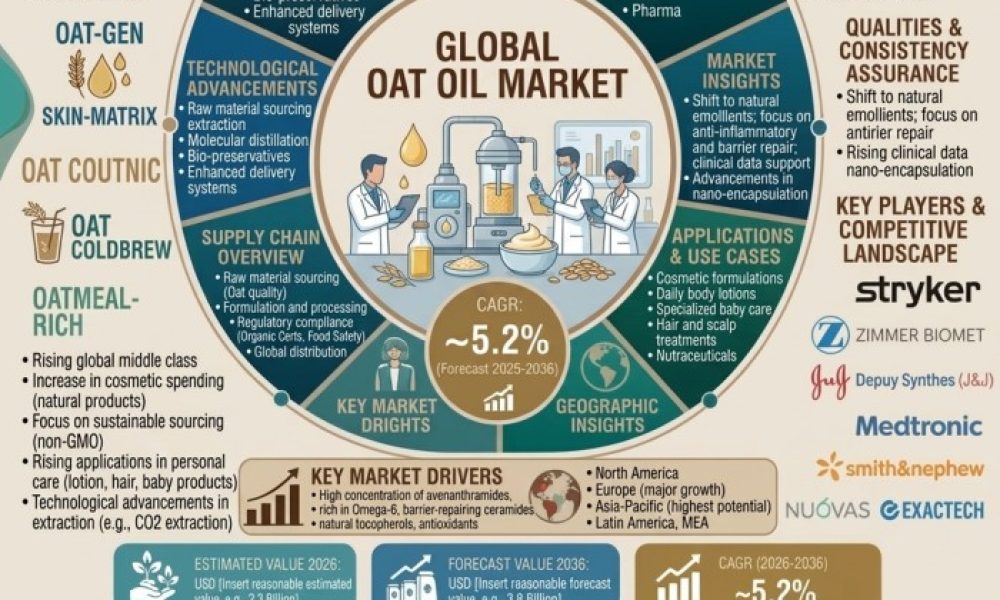
Growing demand for plant-derived ingredients in personal care and functional food formulations is opening new opportunities for oat oil suppliers, according to Fact.MR.
NEWARK, Del., October 13, 2026. The global oat oil market is projected to reach USD 130.38 million by 2036, up from USD 73.49 million in 2026, expanding at a compound annual growth rate (CAGR) of 5.9%, according to Fact.MR. The market is expected to generate an incremental opportunity of USD 56.89 million over the 2026–2036 forecast period.
Demand is being supported by the use of plant-derived oils in personal care and cosmetics, alongside growing interest in functional food ingredients and clean-label formulations. Oat oil suppliers have opportunities to serve cosmetic manufacturers, food producers and nutraceutical businesses, although extraction capacity and comparatively high production costs remain constraints.
Get detailed market forecasts, competitive benchmarking, and pricing trends:
Demand shifts create opportunities across personal care and food
Personal care and cosmetics represent the largest application segment, accounting for 42% of market demand in 2026. Manufacturers use oat oil in skin care, hair care and body care formulations, while food and beverage companies represent an additional market for oat-derived lipid ingredients.
Fact.MR identifies three principal growth drivers: demand for plant-derived emollients in personal care, adoption of oat lipid ingredients in functional foods and nutraceuticals, and increasing formulator preference for clean-label ingredients. These trends are creating opportunities for suppliers that can deliver consistent ingredient quality and meet application-specific formulation requirements.
The report does not identify a specific new regulation or compliance deadline as the principal market trigger. Its outlook instead emphasizes changing ingredient preferences and expanding applications across several end-use industries.
Where growth is fastest
Fact.MR projects growth across five profiled country markets between 2026 and 2036.
- India — 7.6% CAGR: Expanding personal care manufacturing and domestic demand for natural cosmetic ingredients support the country’s leading growth rate. Increasing functional food adoption adds another demand channel.
- China — 7.5% CAGR: Premium personal care demand and the expansion of functional food and nutraceutical manufacturing support adoption.
- Germany — 5.9% CAGR: Established personal care and pharmaceutical demand, alongside growing interest in natural ingredients, supports market expansion.
- United States — 5.8% CAGR: Clean-label cosmetic formulations and functional food applications contribute to demand.
- United Kingdom — 5.2% CAGR: Established personal care demand and preference for natural cosmetic ingredients support continued growth.
India and China lead the country outlook, while Germany provides a European market benchmark for suppliers targeting established personal care and pharmaceutical formulation industries.
What leads the market
Refined oil, cosmetic applications and cosmetic manufacturers account for the leading positions across the market’s product, application and end-use segments.
- Refined oat oil — 36% of product-segment revenue in 2026: Refined grades serve cosmetic and food applications, including skin care, hair care and functional food formulations.
- Personal care and cosmetics — 42% of application demand in 2026: Skin care products, hair care products and body lotions represent the principal uses within this segment.
- Cosmetic manufacturers — 38% of end-use demand in 2026: Procurement by premium skin care brands and mass-market personal care companies supports this segment’s leading position.
- Cold-press extraction — 34% of extraction technology in 2026: The technology represents a significant share of the market’s extraction methods.
The report also identifies conventional oats as a major source category. Its summary lists a share of approximately 52%, although the accompanying text labels this figure as an application share. The segment classification should be confirmed before that figure is used in external promotional material.
The hurdle: supply costs and extraction capacity
The main constraint is the difficulty of scaling supply while keeping ingredient costs competitive. Fact.MR identifies limited oat oil extraction infrastructure as a barrier to expansion. The cost per litre is also higher than that of conventional plant oils, including sunflower, olive and jojoba oils, restricting adoption in price-sensitive formulations.
Suppliers must also explain the ingredient’s functionality and differences between available grades to formulators. For manufacturers evaluating oat oil, sourcing consistency, suitability for the intended application and total formulation cost are therefore relevant considerations alongside the ingredient’s plant-derived positioning.
Industry investment and competitive outlook
The market remains fragmented, with specialist suppliers competing alongside larger ingredient businesses. Fact.MR identifies Oat Cosmetics, Charkit Chemical, COSCIENS Biopharma, Fazer Mills and Givaudan among the key companies profiled.
The report’s development notes identify the following company activities:
- 2025 — Oat Cosmetics: Expanded its oat lipid extract portfolio with new ceramide-enriched oat oil variants for premium skin care formulations.
- 2025 and 2026 — Givaudan: Expanded its natural cosmetic ingredient portfolio, including plant-derived lipid ingredients for personal care applications.
- 2025 — Fazer Mills: Expanded oat oil extraction capacity to serve demand from European personal care and functional food manufacturers.
These developments are described in the Fact.MR report, which does not provide exact months or specific announcement dates for the activities listed.
Oat Cosmetics is positioned as a specialist supplier of cosmetic-grade oat oil and oat lipid extracts. Charkit Chemical and COSCIENS Biopharma participate in ingredient supply and distribution, while Fazer Mills brings oat-processing capabilities. Givaudan participates through its broader natural ingredient portfolio.
Fact.MR also identifies Swedish Oat Fiber AB, Lantmannen, Grain Millers, Richardson International, Avena Foods, Naturex (Givaudan), Symrise AG, BASF Care Chemicals, Croda International and Ashland Global among additional companies in the market.
Analyst perspective
The report’s analyst opinion describes oat oil as a specialist plant-lipid ingredient serving personal care, functional food and pharmaceutical applications. It identifies natural ceramides, beta-glucan content and consumer interest in clean-label ingredients as factors shaping its commercial positioning.
The report also notes that the market remains fragmented and that a key strategic question is whether oat oil will remain a specialist ingredient or expand into mainstream personal care and functional food supply.
Attribution note: The source page identifies S.N. Jha as Principal Consultant and report author, but does not present this analyst opinion as a direct quotation. It is therefore paraphrased here rather than attributed to the analyst as a verbatim quote.
What this means for cosmetic manufacturers, food producers and ingredient buyers
- Evaluate supply capacity before expanding formulations. Limited extraction infrastructure can constrain availability. Buyers should assess supplier capacity, sourcing continuity and grade consistency before committing to larger production volumes.
- Match the oil grade to the intended application. Refined oat oil leads the product segment, while personal care and cosmetics lead application demand. Procurement teams should compare technical specifications and formulation requirements rather than treating all oat oil products as interchangeable.
- Assess premium positioning against cost constraints.MR identifies premium skin care, nutraceutical capsule development and private-label personal care as opportunities. Manufacturers should evaluate the potential commercial value of these formats against ingredient costs and the price sensitivity of their target customers.
Report coverage
Fact.MR’s Oat Oil Market report examines market size and forecasts through 2036, country-level growth, product and application segmentation, extraction technologies, end-use demand, competitive positioning, market constraints and opportunities.
Explore More Related Studies Published by Fact.MR Research
Sugar-Reduction Taste Optimization Systems Market
Plant Protein Off-Note Masking Systems Market
About Fact.MR
Fact.MR is a market research and consulting firm providing syndicated research, customized research, investment research, and market intelligence across a broad range of industries. Its research coverage includes food and beverage, healthcare, pharmaceuticals, biotechnology, consumer products, chemicals and materials, technology, industrial goods, and packaging.
Fact.MR provides market intelligence designed to help organizations understand market dynamics, emerging opportunities, competitive developments, and changing industry requirements.
Media Contact
Fact.MR
Email: [email protected]
Phone: +1 (628) 251-1583
Website: www.factmr.com



