
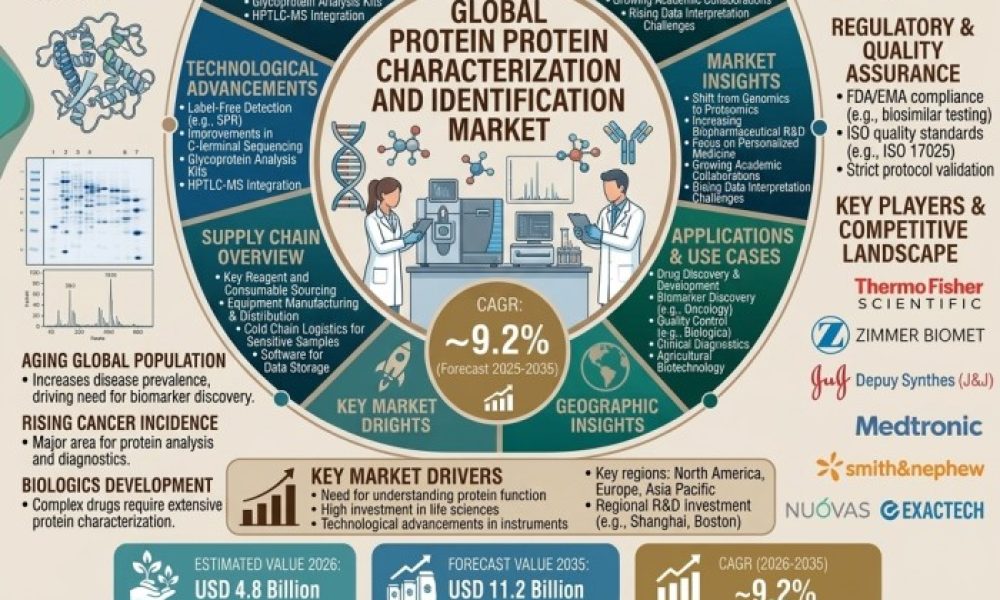
Rising biologics development, expanding biosimilar pipelines and more demanding analytical requirements are increasing the need for protein characterization capabilities, according to Fact.MR.
NEWARK, Del., October 13, 2026. The global protein characterization and identification market is projected to reach USD 46.3 billion by 2036, up from USD 20.1 billion in 2026, expanding at a compound annual growth rate (CAGR) of 8.7%, according to Fact.MR. The market is expected to generate an incremental opportunity of USD 26.2 billion over the 2026–2036 forecast period.
Demand is being supported by pharmaceutical companies’ expanding biologics and biosimilar pipelines, the growth of contract development and manufacturing organizations (CDMOs), and instrument upgrades across pharmaceutical research and development. Fact.MR identifies consumables as the leading product segment, while mass spectrometry accounts for the largest share of technology revenue.
Get detailed market forecasts, competitive benchmarking, and pricing trends:
What is driving demand now?
Protein analysis is becoming more central to biologics development and manufacturing as companies assess protein structure, post-translational modifications and host cell proteins. These analytical requirements support product characterization, comparability assessments, process control and manufacturing quality activities.
Fact.MR identifies regulatory expectations associated with the U.S. Food and Drug Administration (FDA) and European Medicines Agency (EMA) as important demand drivers. The report discusses guidance related to biosimilar comparability and higher-order structure characterization, but does not specify a particular regulation number or publication date. No individual regulatory deadline is identified on the report page.
The expansion of cell and gene therapies, antibody-drug conjugates, bispecific antibodies and other advanced modalities is also creating demand for specialized analytical methods. Pharmaceutical companies and CDMOs are upgrading mass spectrometry, chromatography and automation capabilities to increase sample throughput and manage characterization costs.
Where growth is fastest
Fact.MR projects growth across North America, Europe and Asia, with the United States leading the listed countries by forecast CAGR.
- United States — 10.2% CAGR: A substantial biologics pipeline, NIH-backed academic research and established CDMO capacity support demand for analytical instruments, consumables and services.
- Germany — 9.6% CAGR: Biologics and biosimilar manufacturing, research networks and CDMO activity underpin demand for protein characterization systems.
- United Kingdom — 9.2% CAGR: Biotechnology clusters around Cambridge and Oxford, pharmaceutical R&D and CRO/CDMO capacity support market expansion.
- Japan — 8.8% CAGR: Domestic biopharmaceutical activity and CDMO operations, particularly around Osaka and Kobe, support recurring demand for analytical workflows.
- South Korea — 8.4% CAGR: Biologics and biosimilar manufacturing capacity, alongside domestic biotechnology research, supports investment in mass spectrometry and chromatography.
- France — 8.0% CAGR: An established pharmaceutical sector, biotechnology activity around Paris and Lyon, and academic research support demand.
These are forecast CAGRs for 2026–2036, not historical growth rates. The report identifies North America as the largest regional market by revenue.
What leads the market?
Consumables account for the largest product share, reflecting recurring expenditure on materials used in analytical workflows.
- Consumables — 49% of product-segment revenue in 2026: Chromatography columns and resins, mass spectrometry consumables, calibration standards, electrophoresis gels and reagents support repeated testing and characterization.
- Mass spectrometry — 41% of technology-segment revenue in 2026: LC-MS/MS, MALDI-TOF and high-resolution mass spectrometry workflows support protein analysis, proteomics and biologics characterization.
- Drug discovery and development — approximately 44% of application demand in 2026: Protein identification, target research, biologics characterization and vaccine development contribute to demand.
- Pharmaceutical and biotechnology companies — 48% of end-user revenue in 2026: These organizations represent the leading end-user segment, reflecting their research and manufacturing requirements.
The segment shares refer to different classification categories and should not be added together.
The hurdle: capital costs and specialized skills
The cost of advanced analytical equipment remains a constraint for smaller biotechnology companies, CROs and laboratories in emerging markets. High-resolution mass spectrometers, sophisticated chromatography platforms and validated software systems can require substantial investment.
Technical complexity adds another barrier. Organizations need skilled analysts to operate advanced systems, interpret results and maintain validated methods. Regulatory and data-integrity requirements can increase the cost and effort of establishing in-house analytical capabilities.
Fact.MR identifies outsourced protein characterization services as an opportunity for CDMOs and CROs serving companies that prefer not to build every specialized capability internally.
Industry investment and competitive outlook
Competition is increasingly shaped by the ability to supply complete analytical workflows rather than instruments alone. Fact.MR points to opportunities in integrated systems that combine instruments, consumables, software, validated application libraries and technical support.
The report profiles the following companies:
- Thermo Fisher Scientific
- Agilent Technologies
- Waters Corporation
- Bruker Corporation
- Bio-Rad Laboratories
- PerkinElmer Inc.
- Danaher Corporation
- Shimadzu Corporation
- SCIEX
- LECO Corporation
Fact.MR describes the market as moderately concentrated, with five leading vendors accounting for an estimated 58% to 63% of global market share in 2026. The report page does not provide dated, company-specific announcements or transactions that can be independently attributed to particular months and years. Accordingly, no individual company development is presented here as a confirmed recent event.
Analyst perspective
S.N. Jha, Principal Consultant at Future Market Insights, states:
“Protein characterization is structurally tied to the biologics boom. The customer is no longer just academic research. It is biopharma manufacturing, CDMOs, and regulators. Mass spectrometry instrument vendors that used to compete on peak resolution are now competing on workflow integration, software, and regulatory validation support. The real commercial leverage is in the recurring consumables and service stream that sits under the instrument, not in the capital sale. Companies that can pair high-end instruments with validated application libraries, regulatory-grade data handling, and global service networks will capture disproportionate share as biologics, biosimilars, and next-generation modalities scale.”
What this means for pharmaceutical and biotechnology buyers
- Evaluate total workflow costs, not just instrument prices. Compare consumable requirements, software, service coverage, validation support and expected sample volumes when assessing analytical platforms. Consumables account for 49% of product-segment revenue in 2026, making recurring expenditure an important procurement consideration.
- Compare in-house investment with outsourced analysis. Smaller sponsors should assess whether the cost of equipment, specialist staff, method validation and ongoing maintenance justifies building internal capabilities. CDMOs and CROs offer an alternative identified by the report’s market analysis.
- Assess capability for emerging modalities before committing capital. Buyers working with cell and gene therapies, oligonucleotides or advanced protein conjugates should evaluate whether a platform supports their characterization requirements and offers suitable validated workflows. This can help align investment decisions with pipeline needs without assuming that every laboratory requires the same configuration.
Report coverage
Fact.MR’s Protein Characterization and Identification Market report examines market size and forecasts, product and technology segments, applications, end users, country-level growth, competitive positioning, demand drivers, constraints and emerging analytical opportunities.
Explore More Related Studies Published by Fact.MR Research
Rhizoma Gastrodiae Tablets Market
Radiation Proctitis Treatment Market
About Fact.MR
Fact.MR is a market research and consulting firm providing syndicated research, customized research, investment research, and market intelligence across a broad range of industries. Its research coverage includes food and beverage, healthcare, pharmaceuticals, biotechnology, consumer products, chemicals and materials, technology, industrial goods, and packaging.
Fact.MR provides market intelligence designed to help organizations understand market dynamics, emerging opportunities, competitive developments, and changing industry requirements.
Media Contact
Fact.MR
Email: [email protected]
Phone: +1 (628) 251-1583
Website: www.factmr.com



