
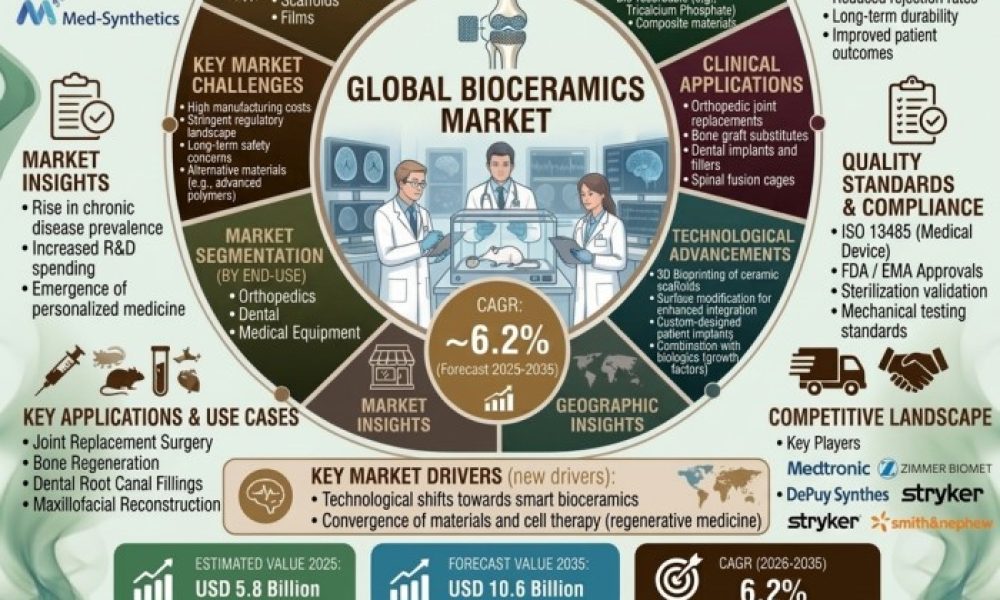
Rising implant volumes, additive manufacturing and demand for patient-matched ceramic materials are reshaping procurement priorities, according to Fact.MR.
NEWARK, Del., October 8, 2026. — The global bioceramics market is estimated at USD 21.0 billion in 2026 and is projected to reach USD 41.3 billion by 2036, expanding at a 7.0% CAGR, according to Fact.MR. The market is expected to create an incremental opportunity of USD 20.3 billion over the 2026–2036 forecast period. Bioinert bioceramics account for 58.7% of product demand in 2026, while orthopedic applications hold 41.6% of the application segment.
Get detailed market forecasts, competitive benchmarking, and pricing trends:
What is changing demand?
Aging populations are increasing orthopedic and dental implant volumes, supporting demand for zirconia and calcium phosphate ceramics. At the same time, additive manufacturing is broadening the use of ceramic materials in patient-matched implants, including applications involving hip, knee and craniofacial reconstruction.
The report also identifies growing use of porous bioceramic scaffolds in regenerative medicine and bone-regeneration applications. Surface modification and nanostructured ceramic development are creating additional opportunities by targeting improved bone integration and broader applications.
Regulatory documentation is becoming a larger procurement consideration. In Germany, EU MDR compliance and DIN/EU performance standards govern material qualification, increasing documentation and validation requirements. The report also notes FDA pathways for personalized medical devices in the United States and JIS compliance in Japan. The page does not provide specific regulation numbers or dates for these frameworks.
Where growth is fastest
- China: The market is projected to expand at a 9.4% CAGR through 2036, supported by domestic ceramic-production capacity, downstream orthopedic and dental manufacturing, and expanding hospital capacity. Centralized procurement is also increasing pressure for cost-competitive materials.
- India: Growth is forecast at an 8.8% CAGR. Rising procedure volumes and private hospital investment are supporting adoption of zirconia and calcium phosphate grades, while import dependence for specialty feedstock affects pricing and lead times.
- Germany: The market is projected to grow at an 8.1% CAGR. Precision engineering, domestic producers and medical-device manufacturing capabilities support demand, while EU MDR validation requirements raise documentation standards.
- Brazil: Fact.MR forecasts a 7.4% CAGR through 2036.
- United States: The market is expected to expand at a 6.7% CAGR, supported by hospital and orthopedic-center networks, early adoption of 3D-printed implants and domestic sourcing trends.
- United Kingdom: The market is projected to grow at a 6.0% CAGR.
- Japan: The country CAGR table lists 5.3% growth through 2036. The country narrative on the same page states 5.2%, creating a data inconsistency that should be checked before publication.
What leads the market?
- Bioinert Bioceramics: This product category holds a 58.7% share in 2026. Alumina and zirconia support established orthopedic and dental applications, particularly where chemical stability and wear resistance are required.
- Orthopedic Applications: The segment accounts for 41.6% of the application market in 2026. Hip and knee implants, fracture repair and bone-regeneration applications anchor demand.
The hurdle
Cost remains a central constraint. Advanced ceramic grades require intensive feedstock processing and manufacturing, limiting price competitiveness against metallic alternatives. Stringent medical-device approval and validation requirements can also extend development timelines and increase compliance costs for smaller developers.
The report further identifies brittle failure and limited tensile performance relative to metals as constraints in high-load-bearing applications. For suppliers, this makes processing efficiency, validated material performance and regulatory documentation important considerations when competing for device-maker accounts.
Recent developments
In October 2024, Zimmer Biomet introduced an advanced bioceramic knee replacement solution designed to improve clinical outcomes through enhanced material performance and implant durability.
In May 2024, Himed and Lithoz launched the Bioceramics Center of Excellence™ (BCoE) at Himed’s New York headquarters. The facility combines Himed’s bioceramic materials expertise with Lithoz’s ceramic 3D-printing technology for rapid prototyping, material characterization, design optimization and biomaterial customization.
Key companies profiled in the report include CeramTec GmbH, KYOCERA Corporation, CoorsTek, Inc., Zimmer Biomet Holdings, Inc., Stryker Corporation, Straumann Holding AG, Morgan Advanced Materials, BONESUPPORT AB, CAM Bioceramics B.V., and Dentsply Sirona Inc.
Analyst view
“Bioceramics is increasingly a materials story driven by aging-population implant demand and the move to additive manufacturing. Bioinert grades still dominate, but patient-matched 3D-printed implants are where differentiation is emerging, and device makers reward suppliers who pair validated materials with regulatory documentation. Cost remains the brake against metals, so the winners manage feedstock and processing efficiency carefully.
China and India are scaling fastest as implant volumes rise and capacity expands. The firms best positioned combine material breadth, additive-manufacturing capability, and the digital dental ecosystems that lock in recurring zirconia consumable demand rather than competing on commodity feedstock.”
— Shambhu Nath Jha, Principal Consultant at Fact.MR
What this means for medical-device manufacturers and procurement teams
- Prioritize validated supply chains. Procurement teams should assess material documentation, validation capabilities and regulatory readiness alongside price, particularly when sourcing for markets with demanding qualification requirements.
- Evaluate additive manufacturing beyond prototyping. The report points to patient-matched ceramic implants as an emerging area of differentiation. Manufacturers should assess where 3D printing and robocasting can support customization while controlling material waste and distribution costs.
- Watch feedstock economics closely. High processing costs and specialty-feedstock dependence can affect competitiveness. Buyers should evaluate sourcing stability, processing efficiency and regional supply options when comparing ceramic suppliers.
Explore More Related Studies Published by Fact.MR Research
Elastomeric Pump Cartridges Market
CPAP Humidifier Chambers Market
About Fact.MR
Fact.MR is a market research and consulting firm providing syndicated research, customized research, investment research, and market intelligence across a broad range of industries. Its research coverage includes food and beverage, healthcare, pharmaceuticals, biotechnology, consumer products, chemicals and materials, technology, industrial goods, and packaging.
Fact.MR provides market intelligence designed to help organizations understand market dynamics, emerging opportunities, competitive developments, and changing industry requirements.
Media Contact
Fact.MR
Email: [email protected]
Phone: +1 (628) 251-1583
Website: www.factmr.com



