
Rising demand for GLP-1 peptide therapeutics and capacity constraints in specialized manufacturing are reshaping outsourcing decisions, according to Fact.MR.
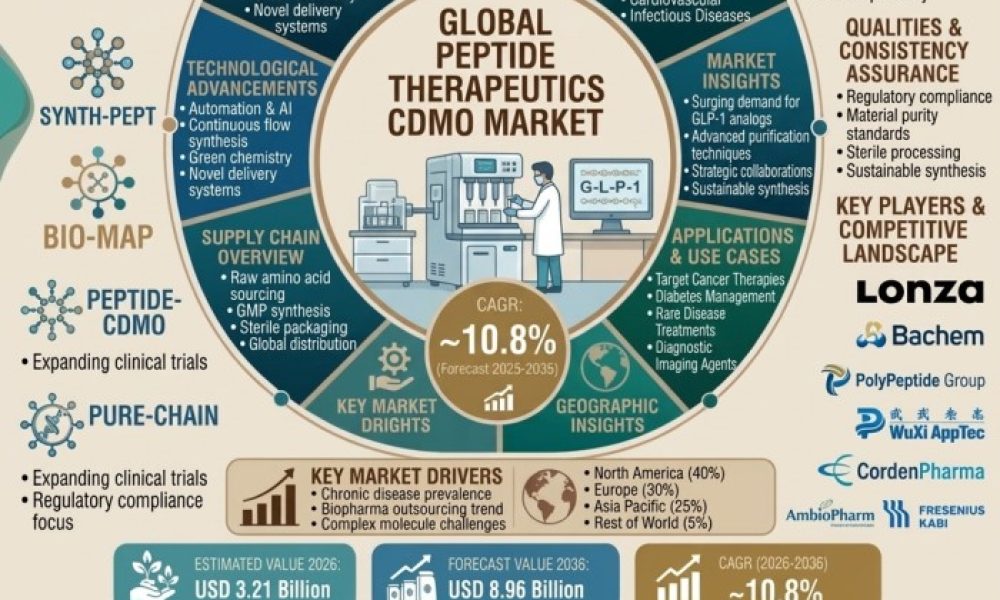
NEWARK, Del., October 13, 2026. The global peptide therapeutics contract development and manufacturing organization (CDMO) market is projected to grow from USD 3.2132 billion in 2026 to USD 8.961 billion by 2036, expanding at a compound annual growth rate (CAGR) of 10.8%, according to Fact.MR. The market is expected to create an incremental opportunity of USD 5.75 billion over the 2026–2036 forecast period.
The expansion reflects demand for commercial-scale peptide active pharmaceutical ingredient (API) manufacturing, particularly for GLP-1 therapies and metabolic disease programs. Fact.MR identifies peptide API manufacturing services as the leading service segment, accounting for 42% of the segment in 2026. Oncology is expected to represent approximately 34% of the application segment.
Get detailed market forecasts, competitive benchmarking, and pricing trends:
Manufacturing capacity becomes a strategic concern
Limited production capacity is emerging as a central challenge for pharmaceutical companies seeking reliable peptide manufacturing partners. Fact.MR attributes the demand increase to commercial requirements for semaglutide and tirzepatide, along with additional candidates such as retatrutide. These programs require specialized solid-phase peptide synthesis (SPPS), purification infrastructure and manufacturing expertise.
Building internal peptide manufacturing capabilities can require substantial capital investment, specialized equipment and dedicated quality systems. Outsourcing allows pharmaceutical sponsors to access established production infrastructure without independently developing every manufacturing capability.
However, expanding capacity takes time. Fact.MR estimates that construction and qualification of new peptide manufacturing facilities can require 24 to 36 months. Specialty amino acid and resin supply constraints, together with shortages of experienced peptide chemists, may further limit the industry’s ability to meet demand.
Where growth is fastest
Fact.MR’s country forecasts for 2026–2036 identify the following growth markets:
- India — 15.8% CAGR: Expanding domestic CDMO capacity, competitive operating costs and export-oriented manufacturing support growth. Piramal Pharma Solutions and Auro Peptides are among the companies identified in the report.
- China — 14.2% CAGR: Domestic peptide manufacturing expansion and demand from biopharmaceutical companies support the outlook. WuXi AppTec is a prominent participant.
- South Korea — 12.9% CAGR: Investment in peptide manufacturing capabilities and the country’s established biopharmaceutical ecosystem contribute to growth.
- Germany — 10.8% CAGR: CordenPharma, Wacker Chemie and Fresenius Kabi contribute to the country’s peptide manufacturing capabilities.
- Switzerland — 10.1% CAGR: Established manufacturing infrastructure, including Bachem’s Bubendorf facility and Lonza’s Visp operations, supports the country’s position in peptide manufacturing.
- Japan — 11.7% CAGR: Domestic pharmaceutical pipelines and established peptide manufacturing capabilities underpin the forecast.
- United States — 9.6% CAGR: An established sponsor base and selective capacity expansion support continued growth.
The country figures are forecasts published by Fact.MR, not guarantees of future performance.
What leads the market
Peptide API manufacturing services account for 42% of the service segment in 2026. Demand is supported by commercial-scale production requirements, process development for clinical-stage programs and the manufacturing complexity of lipidated and conjugated peptides.
Oncology is expected to account for approximately 34% of the application segment in 2026. The report also identifies GLP-1 agonists and metabolic disease peptides as the leading therapeutic class by demand, reflecting commercial requirements for existing therapies and programs in development.
Solid-phase peptide synthesis is the leading manufacturing technology in 2026. Liquid-phase and hybrid synthesis approaches remain relevant for selected peptide types and production requirements.
Pharmaceutical companies represent the majority of end-user demand, reflecting procurement by large pharmaceutical sponsors and biotechnology companies with clinical-stage peptide programs.
The hurdle: scaling production without overcommitting
Capacity expansion presents both an opportunity and a financial risk. New facilities require significant investment and extended qualification periods, while specialized raw materials and skilled personnel can constrain production.
CDMOs must weigh long-term supply commitments against the possibility that individual drug-development programs may not reach expected commercial volumes. Pharmaceutical buyers, meanwhile, must assess supplier capacity, manufacturing complexity, supply-chain resilience and the risks of relying on a limited number of qualified partners.
Fact.MR identifies India and China as important expansion markets, where additional capacity may help serve demand that established Western manufacturing infrastructure cannot immediately accommodate.
Industry investment and competitive developments
The report identifies three capacity developments:
- 2025 — Bachem: Announced a multi-hundred-million-dollar expansion at its Bubendorf and Sisseln facilities, including additional SPPS capacity and sterile fill-finish infrastructure.
- 2025 — Lonza: Expanded peptide manufacturing capacity at its Visp, Switzerland site, adding commercial-scale SPPS infrastructure and integrated services.
- 2025–2026 — Polypeptide Group: Announced capacity expansion across multiple global sites in response to commercial peptide demand.
These developments are reported by Fact.MR. The report does not specify the exact month for these announcements.
Companies profiled include Bachem, Lonza Group, Polypeptide Group, AmbioPharm, CordenPharma, WuXi AppTec, Piramal Pharma Solutions, CPC Scientific, Fresenius Kabi, Almac, Wacker Chemie, Auro Peptides, Samsung Biologics, Catalent, Thermo Fisher Scientific and Siegfried.
Analyst perspective
Fact.MR attributes the following assessment to its analyst-opinion section:
“Peptide therapeutics CDMO has moved from a steady specialty manufacturing niche to one of the most commercially attractive and capacity-constrained segments in biopharma contract manufacturing. The demand surge is driven almost entirely by GLP-1 peptides, where semaglutide, tirzepatide, and the next-wave candidates have created order volumes that substantially exceed historical peptide manufacturing capacity.”
The report identifies S.N. Jha as its Principal Consultant and lead analyst. The quoted passage appears in the report’s analyst-opinion section; confirmation that it is approved as a verbatim public quotation should be obtained before publication.
What this means for pharmaceutical buyers and CDMO decision-makers
- Evaluate capacity commitments early. Buyers with clinical-stage or commercial peptide programs should assess available manufacturing capacity, qualification timelines and the consequences of delayed supply before finalizing sourcing arrangements.
- Assess the complete manufacturing requirement. Compare providers on peptide synthesis capabilities, complex chemistry expertise, analytical testing and sterile fill-finish services. An integrated service model may reduce the number of separate suppliers a sponsor must coordinate.
- Balance geographic diversification with technical qualification. India’s and China’s faster forecast growth makes their expanding manufacturing ecosystems worth evaluating. Supplier selection should still account for program-specific requirements, quality systems, raw-material sourcing and the time needed to qualify a manufacturing partner.
Report coverage
Fact.MR’s Peptide Therapeutics CDMO Market report examines market size, forecasts, service categories, therapeutic applications, manufacturing technologies, country growth and competitive positioning through 2036.
Explore More Related Studies Published by Fact.MR Research
Critical Care Diagnostics Market
Radiation Proctitis Treatment Market
About Fact.MR
Fact.MR is a market research and consulting firm providing syndicated research, customized research, investment research, and market intelligence across a broad range of industries. Its research coverage includes food and beverage, healthcare, pharmaceuticals, biotechnology, consumer products, chemicals and materials, technology, industrial goods, and packaging.
Fact.MR provides market intelligence designed to help organizations understand market dynamics, emerging opportunities, competitive developments, and changing industry requirements.
Media Contact
Fact.MR
Email: [email protected]
Phone: +1 (628) 251-1583
Website: www.factmr.com



