
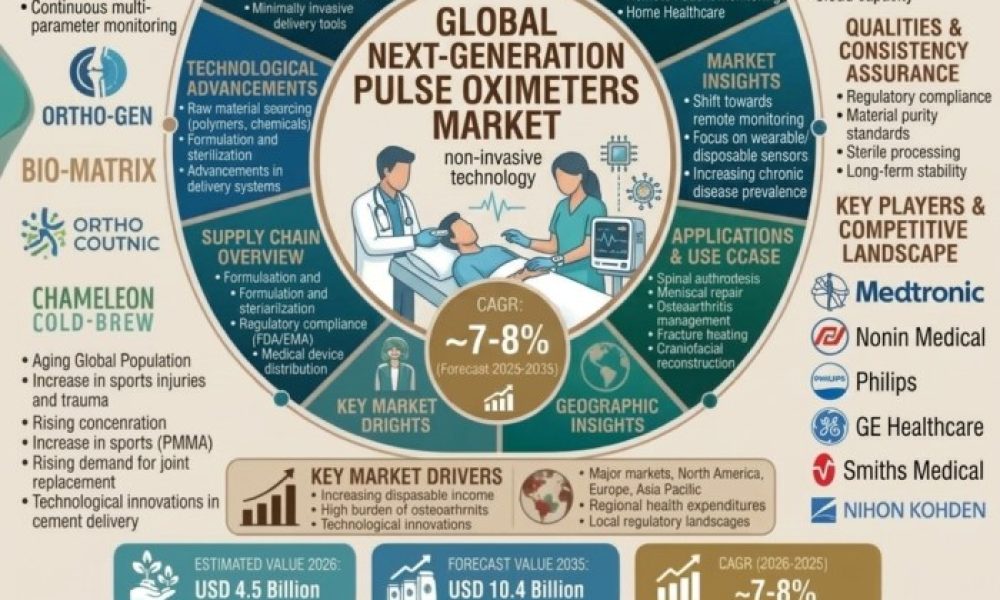
Remote patient monitoring, wearable device adoption and regulatory scrutiny of pulse oximeter accuracy are reshaping product development and purchasing priorities, according to Fact.MR.
NEWARK, Del., October 13, 2026. The global next generation pulse oximeters market is projected to grow from USD 533.0 million in 2026 to USD 1.37 billion by 2036, expanding at a compound annual growth rate (CAGR) of 9.9%, according to Fact.MR. The market is expected to generate an incremental opportunity of USD 836.97 million over the forecast period. Wearable pulse oximeters are projected to account for 46% of product revenue in 2026, while home healthcare and remote monitoring are expected to represent approximately 42% of application demand.
The expansion reflects a shift from occasional oxygen-saturation measurements toward continuous monitoring across home healthcare, clinical settings and consumer wearables. Device manufacturers are competing to combine reliable measurement performance with wireless connectivity, app integration and compatibility with remote patient monitoring platforms.
Get detailed market forecasts, competitive benchmarking, and pricing trends:
Regulatory scrutiny puts measurement accuracy in focus
Pulse oximeter accuracy across different skin tones has become a significant consideration for manufacturers, healthcare providers and procurement teams. The U.S. Food and Drug Administration (FDA) continues to review accuracy concerns and validation requirements, creating pressure to demonstrate device performance across diverse patient populations.
The report identifies the FDA’s ongoing review as a factor influencing product specifications and replacement decisions. It also highlights reimbursement for remote patient monitoring through the Centers for Medicare & Medicaid Services (CMS), including CPT codes 99453, 99454, 99457 and 99458, as a commercial driver for connected monitoring deployments.
These developments are relevant to suppliers serving hospitals, ambulatory care providers and home healthcare programs. However, consumer wearables and medical devices do not necessarily share the same regulatory status. Fact.MR notes that most consumer devices are not FDA-cleared for diagnostic use, limiting their positioning for certain clinical applications.
Where growth is fastest
Fact.MR’s country forecasts show that the United States and Germany lead the six profiled markets, with Japan and France also recording CAGRs above 10%.
- United States — 11.2% CAGR: Remote patient monitoring reimbursement, device replacement activity linked to accuracy reviews and consumer wearable adoption support demand.
- Germany — 10.8% CAGR: Statutory health insurance coverage, an aging population and the Digital Health Applications (DiGA) framework support connected healthcare adoption.
- Japan — 10.4% CAGR: Aging-related healthcare needs, home monitoring demand and established domestic device manufacturing support market expansion.
- France — 10.0% CAGR: Chronic disease management coverage and telemedicine development support remote monitoring adoption.
- United Kingdom — 9.6% CAGR: NHS digital transformation initiatives and demand for remote monitoring in chronic disease management contribute to growth.
- South Korea — 9.2% CAGR: Smart hospital initiatives, digital health infrastructure and consumer electronics adoption support market development.
The country estimates indicate opportunities for suppliers to assess local reimbursement arrangements, clinical procurement requirements and consumer demand before committing resources to expansion.
What leads the market
Wearable devices are at the center of the product transition, while home-based monitoring provides a major application opportunity.
- Wearable pulse oximeters — 46% of product revenue in 2026: Ring oximeters, smartwatch-based devices and continuous monitoring wearables support demand for more convenient measurement formats.
- Home healthcare and remote monitoring — approximately 42% of application demand: Connected monitoring supports home-based care and remote observation of patients with chronic conditions.
- Fingertip wireless oximeters — approximately 28% of market revenue in 2026: Bluetooth-enabled and app-integrated products serve home monitoring and telehealth requirements.
- Bedside and clinical monitors — approximately 22% of market revenue in 2026: Multi-parameter monitors and intensive care systems serve hospital and clinical monitoring needs.
These figures describe different market dimensions: product shares measure device categories, while the home healthcare figure represents an application segment. They should not be added together.
The hurdle: accuracy, regulation and pricing
The market’s main constraint is the challenge of establishing measurement accuracy across diverse patient populations while meeting the requirements of intended clinical use. Manufacturers must also account for changing validation expectations and potential regulatory exposure.
Consumer device classification presents another challenge. A wearable that measures oxygen saturation for wellness purposes may not have the clearance required for diagnostic use. Procurement teams therefore need to distinguish between consumer monitoring features and clinically validated device capabilities.
Pricing pressure also affects suppliers. Fact.MR identifies competition from manufacturers including Contec and Mindray, alongside privacy and security requirements for connected health data under frameworks such as the U.S. Health Insurance Portability and Accountability Act (HIPAA) and the European Union’s General Data Protection Regulation (GDPR).
Recent developments and companies profiled
The report describes product and platform developments during 2025 and 2026 that illustrate how established medical device manufacturers and consumer electronics companies are approaching connected monitoring.
- Masimo Corporation, 2025–2026: The report describes expansion of its W1 consumer watch portfolio, including continuous SpO2 monitoring and remote patient monitoring platform integration.
- Apple, 2025–2026: The report discusses Apple Watch Series 10 SpO2 capabilities and clinical validation efforts, alongside patent litigation involving Masimo.
- Medtronic, 2025–2026: The report describes developments in the Nellcor portfolio involving next-generation sensors and remote monitoring integration.
The published report identifies the following companies among the major and emerging participants:
Masimo Corporation; Medtronic plc (Covidien/Nellcor); Koninklijke Philips N.V.; GE HealthCare Technologies Inc.; Nihon Kohden Corporation; Nonin Medical Inc.; Smiths Medical (ICU Medical Inc.); Apple Inc.; Samsung Electronics Co. Ltd.; Garmin Ltd.; Withings SA; Oura Health Oy; Contec Medical Systems Co. Ltd.; Mindray Medical International Ltd.; Beurer GmbH; Spacelabs Healthcare Inc.; and BPL Medical Technologies.
The report’s competitive analysis distinguishes companies with established clinical monitoring portfolios from consumer wearable brands competing through device design, connectivity and app ecosystems.
Analyst perspective
Fact.MR’s published analyst opinion identifies three structural shifts shaping the market: increased scrutiny of pulse oximeter accuracy across skin tones, the move from spot checks to continuous wearable monitoring, and the integration of continuous SpO2 measurement into remote patient monitoring and post-acute care.
The report concludes: “The commercial winners over the next decade will combine clinically validated accuracy with consumer-friendly form factors and seamless integration into remote patient monitoring platforms.”
— S.N. Jha, Healthcare Desk Lead Analyst, Fact.MR
What this means for healthcare procurement teams and device manufacturers
- Evaluate clinical validation before comparing device prices. Procurement teams should assess the evidence supporting accuracy across diverse patient populations, the intended use of each device and its applicable regulatory status. Consumer wellness features should not be treated as equivalent to clinical clearance.
- Assess connectivity alongside hardware performance. Hospitals and home healthcare providers evaluating connected oximeters should consider compatibility with remote monitoring platforms, data workflows and existing healthcare information systems. Integration requirements can influence implementation costs and ongoing operational needs.
- Match expansion plans to local market conditions. Manufacturers considering geographic expansion should examine reimbursement arrangements, hospital replacement cycles and the adoption of home monitoring. The United States and Germany have the highest projected growth rates among the six profiled countries, but commercial strategies should account for each market’s regulatory and procurement requirements.
Report coverage
Fact.MR’s Next Generation Pulse Oximeters Market report examines market size, forecasts, product categories, applications, end users, distribution channels, regional demand, competitive positioning, growth drivers, constraints and opportunities from 2026 to 2036.
Explore More Related Studies Published by Fact.MR Research
Radiation Proctitis Treatment Market
About Fact.MR
Fact.MR is a market research and consulting firm providing syndicated research, customized research, investment research, and market intelligence across a broad range of industries. Its research coverage includes food and beverage, healthcare, pharmaceuticals, biotechnology, consumer products, chemicals and materials, technology, industrial goods, and packaging.
Fact.MR provides market intelligence designed to help organizations understand market dynamics, emerging opportunities, competitive developments, and changing industry requirements.
Media Contact
Fact.MR
Email: [email protected]
Phone: +1 (628) 251-1583
Website: www.factmr.com



