

Increased global trade, particularly in developing economies, is expected to drive the growth of the global retail logistics market in the forecast period from 2023 to 2032. However, inadequate transportation infrastructure, like congested highways, limited ports, and poorly maintained roads, can cause delays in the delivery of products, which may hamper the retail logistics market growth in the coming future.
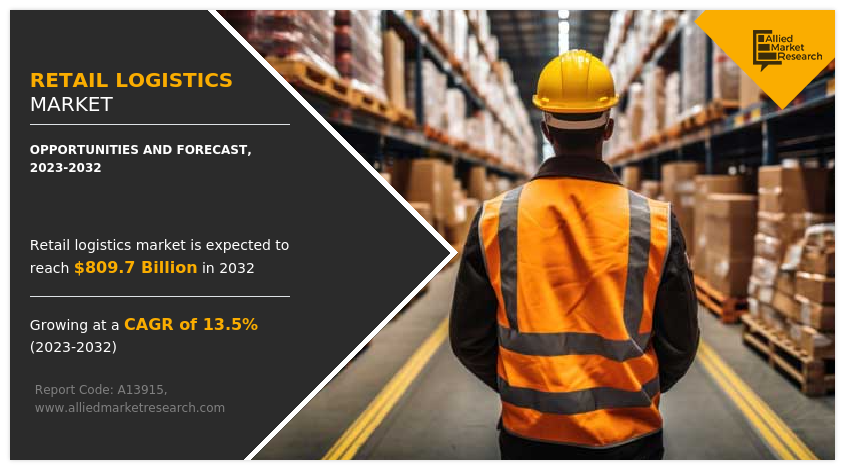
The global retail logistics market size was valued at $238.5 billion in 2022, and is projected to reach $809.7 billion by 2032, growing at a CAGR of 13.5% from 2023 to 2032.
Key players in the retail logistics market:
The key players profiled in the retail logistics market report include XPO Logistics, Inc., DSV, Kuehne + Nagel International, C.H. Robinson Worldwide, Inc., Nippon Express, FedEx, Schneider, United Parcel Service, APL Logistics Ltd, and DHL International GmbH.
Request Sample Pages: https://www.alliedmarketresearch.com/request-sample/A13915
Segmental Review of the retail logistics market:
The supply chain solutions sub-segment of the global retail logistics market accounted for the largest share of 28.4% in 2022 and is expected to grow significantly during the forecast period. The prominent growth of the sub-segment is mainly due to the increased adoption of cloud-based supply chain technologies, which help with tracking and optimizing transportation and handling returns.
The conventional retail logistics sub-segment of the global retail logistics market accounted for the highest share of 54.3% in 2022 and is projected to witness substantial growth during the forecast period. The prominent growth of the sub-segment is mainly due to the growing use of conventional retail logistics services by consumers who have limited dependence on the Internet and thus choose to shop in conventional retail locations.
The roadways sub-segment of the retail logistics market accounted for the highest share of 31.5% in 2022 and is projected to experience widespread growth during the forecast period. The prominent growth of the sub-segment is mainly due to the increased need for roadway vehicles for transporting retail products over large distances, particularly in domestic regions.
Enquiry Before Buying: https://www.alliedmarketresearch.com/purchase-enquiry/A13915
Retail logistics refers to the processes, strategies, and activities involved in managing the movement and distribution of products from manufacturers or suppliers to the final consumers within the retail industry. It encompasses various aspects of supply chain management that are specifically tailored to meet the demands of the retail sector.
The globalization of supply chains in the retail industry has been driven by various factors. Efficient international logistics solutions are indeed crucial for retailers to effectively manage their global operations. Furthermore, globalization opens up new markets for retailers. By sourcing products from different parts of the world they can cater to diverse customer bases and expand their reach. Efficient logistics enable them to serve these markets effectively.
Moreover, retailers that can streamline their global supply chains through efficient logistics gain a competitive edge. Quick and reliable delivery of products can lead to an increase in customer satisfaction and loyalty. Furthermore, retailers are increasingly conscious of their environmental footprint. Efficient logistics can help reduce carbon emissions by optimizing transportation routes and modes and contributing to sustainability goals. By diversifying suppliers and sourcing from different regions, retailers can reduce the risk of disruptions in their supply chains. Efficient logistics ensure that they can quickly adapt to changing circumstances.
The report offers a comprehensive analysis of the global retail logistics market trends by thoroughly studying different aspects of the market including major segments, market statistics, market dynamics, regional market outlook, investment opportunities, and top players working towards the growth of the market. The report also highlights the present scenario and upcoming trends & developments that are contributing toward the growth of the market. Moreover, restraints and challenges that hold power to obstruct the market growth are also profiled in the report along with the Porter’s five forces analysis of the market to elucidate factors such as competitive landscape, bargaining power of buyers and suppliers, threats of new players, and emergence of substitutes in the market.
Buy this Complete Report (310 Pages PDF with Insights, Charts, Tables, and Figures) at: https://www.alliedmarketresearch.com/retail-logistics-market/purchase-options
The use of data analytics and artificial intelligence can provide valuable insights into consumer behavior, inventory management, demand forecasting, and route optimization. Retailers can make more informed decisions and optimize their logistics operations for efficiency. With real-time data analysis, retailers can gain better visibility into their inventory levels across various locations. AI can predict which products are likely to sell quickly and adjust inventory accordingly. This minimizes the costs associated with excess inventory while ensuring that popular products are readily available.
However, retail logistics relies on having an adequate number of skilled workers to handle various tasks simultaneously. Labor shortages can lead to delays in order processing and delivery which can negatively impact the customer experience. In the competitive retail landscape, customer satisfaction is crucial, and any disruptions caused by labor shortages could result in customer dissatisfaction and potential loss of business.
Regional Insights:
The retail logistics market in the Asia-Pacific region accounted for the largest share of 43.6% in 2022 and is predicted to grow at the highest CAGR of 14.1% by 2032. This growth is mainly due to the increased focus on transportation systems and ongoing logistics infrastructure enhancements in emerging countries.
The retail logistics market share is segmented on the basis of type, solution, mode of transport, and region. By type, it is classified into conventional retail logistics and e-commerce retail logistics. By solution, it is classified into commerce enablement, supply chain solutions, reverse logistics & liquidation, transportation management, and others. By mode of transport, it is classified into railways, airways, roadways, and waterways. By region, the market is analyzed across North America, Europe, Asia-Pacific, and LAMEA.
About us:
Allied Market Research (AMR) is a full-service market research and business-consulting wing of Allied Analytics LLP based in Wilmington, Delaware. Allied Market Research provides global enterprises as well as medium and small businesses with unmatched quality of “Market Research Reports” and “Business Intelligence Solutions.” AMR has a targeted view to provide business insights and consulting to assist its clients to make strategic business decisions and achieve sustainable growth in their respective market domain.
Contact:
David Correa
1209 Orange Street,
Corporation Trust Center,
Wilmington, New Castle,
Delaware 19801 USA.
Int’l: +1-503-894-6022
Toll Free: +1-800-792-5285
UK: +44-845-528-1300
India (Pune): +91-20-66346060
Fax: +1-800-792-5285
[email protected]




